
SPOILER FREE REVIEW
I am not one of those people who hate comic book movies, nor have I ever bought into the argument that they’re destroying cinema as we know it, let alone dumbing down culture to the point of no return. As for established filmmakers who make these claims, well, I believe they may simply be afraid of change, or at least what they perceive as a loss of quality (both in terms of craftsmanship and in the current streaming vs. traditional theatrical experience battle). I think what’s happening in the film industry is explained by several factors, but at the end of the day, it’s a business, and that business will always lean into what’s popular and thus, profitable. Times change, and opinions shift, and no one knows what will be popular next.
All of that is to say that while I generally love comic book movies, Doctor Strange in the Multiverse of Madness is a bloated, disjointed mess.
And I definitely had high hopes for this one, too, especially being a fan of the first, so this is all the more disappointing.
There were a ton of speculations regarding what finally might be shown in the Multiverse, especially since WandaVision and Loki seemingly teased us with many possibilities (including sort of, kind of, maybe introducing an X-Men character from 20th Century Fox’s movies that wasn’t possible before Disney bought that studio). And let’s not forget Spider-Man: No Way Home, which directly played with our nostalgia and love for characters and actors that we never thought we’d see together on screen. With different rights to Marvel characters now seemingly all together (even those still owned by Sony), the possibilities were endless! Maybe your favorite comic book character would make a cameo here, or your favorite actor would finally do justice to a superhero that was portrayed terribly or inaccurately in a previous movie. Surely, this Doctor Strange sequel would blow us away, right? Right??
Well, no, it doesn’t.
And maybe it’s not fair to put that much pressure on one film, but Endgame delivered with perhaps even more weight on its massive shoulders. And Marvel hasn’t taken many missteps in my opinion.
So what went wrong?
To answer that, let’s talk about the elephant in the room (and no, not that one from Darkman): Director Sam Raimi.
He directed the first three Spider-Man movies that starred Tobey Maguire. Those that listen to our podcasts know that I wasn’t the biggest fan of those, but even I know they were well received. Raimi can be a great director. The problem here is that he was brought in to replace original director Scott Derrickson over creative differences between Derrickson and Marvel. Raimi has a very unique, sometimes polarizing style that is nothing like Derrickson’s, and he claimed this movie would be MCU’s first horror film. While that certainly sounded promising, there were rumors that poor test screenings forced him to do extensive reshoots. All of this seemed to indicate that there were problems going on behind the scenes, and a movie was being made with a severe identity crisis.
So, is it a horror film? In many ways it is, albeit watered down, and it’s arguably the MCU’s most violent film. It even has an Evil Dead type vibe at times, but it never fully commits. There’s one gruesome scene in particular that I just know Raimi must have been itching to show more than the PG-13 rating would allow, but he was forced to imply the violence rather than show it. Restraint in gore has never been Raimi’s style, and the scene suffers from a lack of clarity as a result.
Is this movie a direct follow-up to Derrickson’s first movie, as well as to the animated series What If…? on Disney+? Again, in many ways, yes, but definitely not in terms of style or tone and that makes it feel disconnected from both. It certainly never takes the baton and runs with it as you might think based on its trailers.
Does it introduce new characters, and revamp some old ones? Does it have some cameos? Yes, but probably not in the way you’d like or expect. Defying expectations and shocking you can be a good thing, but here it just feels underwhelming and lazy. Not to mention that superpowers ebb and flow depending on the scene without any explanation. Sometimes characters are god-like and sometimes the simplest thing can take them out. The rules are never clear.
Does it expand the Multiverse concept? Yes, but only in short bursts. The majority of the movie takes place in only two universes, and they are nearly indistinguishable from each other. The stakes never really feel that high, and actions never feel permanent.
Combine all of that, and the takeaway here is that this movie was pulled in a lot of different creative directions that were all patch-worked together. It never knows what it wants to be, and thus, fails at being anything other than a jumbled pile of ideas that never make a cohesive whole. In that sense, it reminded me of Rise of Skywalker, and that’s never a good thing.
Oh, and for those wondering, the extra half star is for Bruce Campbell because, well, he’s always groovy.
The post Doctor Strange in the Multiverse of Madness first appeared on It's Just Awesome DOT com.]]>
Wow.
That was my initial reaction.
As I sat in the flickering light of the credits, I felt dumbfounded by what I had just seen and yet, profoundly moved and compelled by it as well. You see, I haven’t written a full length review like this one since War For The Planet of the Apes, and that was FIVE years ago. And yet, the words here were immediately forming in my head, and I knew I had to get them out as soon as I could.
Everything Everywhere All At Once had inspired me to forget about everything else and do what I love. It had inspired me to just… write.
I’m sure a big part of that inspiration comes from the amazing cast, which includes James Hong, Jamie Lee Curtis, Stephanie Hsu, and Kay Hu Quan (!!), but at the center of it all, it’s the incredible performance by Michelle Yeoh that connected with me the most. She is versatile, beautiful, flawless, and fierce (and sometimes all at once).
But what exactly is it about?
Well, without spoilers, you could say it’s about a mid-life crisis and wasted potential told in a very original, ambitious, entertaining way. Or that it’s about nihilism and losing the fight on just giving up, here represented by a bagel with everything on it. Truly.
You could also say it’s a goofy and chaotic comedy packed with absurd imagery like hot dog fingers, or maybe that it’s a deep meditation on life and love, regrets and acceptance, and ultimately finding contentment within your particular place in the multi-verse, which is to say inner peace.
Perhaps you could even claim that it’s an action movie filled with deep appreciation for Asian Cinema as a whole, especially films created by Wong Kar-Wai, Ang Lee, and the Shaw Brothers Studios. Or maybe it’s even about music and life imitating art, such as when the lyrics to Absolutely (Story of a Girl) are spoken out loud in a scene and it somehow seems so completely appropriate that you might even question whether it was intentional or not.
Maybe it’s really about the mundane things in life that can eventually consume you if you’re not careful, like getting up early every day to go to work at a job you hate because of whatever circumstance or choice has put you in the position where you can’t quit. Heck, maybe it’s actually about filing your taxes on time.
Well, it’s actually all of these things and more, of course, but don’t worry. As weird as it gets, and as rambling as I might sound doing my best to describe it, none of it feels particularly pretentious or complicated. Kudos to the filmmakers for somehow achieving that precarious balance because what the Daniels have achieved is nothing short of mind-blowing. The production design and editing are absolutely some of the best I’ve ever seen.
But you know, at the end of this, I’m finding that my initial expression still sums this movie up the best.
Wow.
The post Everything Everywhere All At Once first appeared on It's Just Awesome DOT com.]]>- La Llorona (1933)
- The Uninvited (1944)
- House on Haunted Hill (1959)
- 13 Ghosts (1960)
- The Innocents (1961)
- The Haunting (1963)
- Burnt Offerings (1976)
- The Amityville Horror (1979)
- The Fog (1980)
- The Changeling (1980)
- The Shining (1980)
- The Evil Dead (1981)
- Ghost Story (1981)
- The Entity (1982)
- Poltergeist (1982)
- Ghostbusters (1984)
- The Sixth Sense (1999)
- House on Haunted Hill (1999)
- What Lies Beneath (2000)
- The Others (2001)
- Thir13en Ghosts (2001)
- The Ring (2002)
- Ju-on: The Grudge (2002)
- 1408 (2007)
- Paranormal Activity (2007)
- Lake Mungo (2008)
- Insidious (2010)
- The Woman in Black (2012)
- The Conjuring (2013)
- Doctor Sleep (2019)
- Host (2020)

I’ll admit: I was skeptical when I heard they were rebooting the Planet of the Apes series again after the mess that was Tim Burton’s attempted reboot, but most of that skepticism had to do with the decision to use entirely computer generated apes instead of modern makeup. I’ve typically been of the opinion that effects done practically are the best and that CG is often used excessively and done lazily. I also LOVE the original Planet of the Apes. It’s one of my favorite movies.
But then I actually saw Rise of the Planet of the Apes and that trepidation vanished. Not only was the movie fantastic, but the decision to use CG apes was completely justified. What Andy Serkis and WETA had done was, in many ways, the evolution of their work on The Lord of the Rings, but they also imbued a sense of humanity and realism into the main character Caesar that hadn’t quite been seen before. It was brilliant.
But when Matt Reeves was brought on to direct the sequel, again I was skeptical. Apparently, there had been drama, and for various reasons, Rise’s director Rupert Wyatt was not coming back. That’s almost never a good sign. But, just like before, once I actually saw Dawn of the Planet of the Apes, that skepticism was gone. This wasn’t some studio hatchet job that had been created as the result of interference and inflated egos. No. No, in fact, it was actually better than Rise, and the visual effects were even more special while still retaining that sense of unprecedented realism and humanity. There were even touches of Shakespearian-like tragedy thrown in for good measure.
Now, with the new movie, my only reservation was that it couldn’t possibly live up to the other two, and yet again, that turned out to be completely unfounded. If anything, War for the Planet of the Apes might be the best of the new trilogy, and while I’m not quite ready to say it’s as good as the 1968 original, it definitely stands up there.
The movie begins not too long after the last, in a world where most humans have died due to the “Simian Flu.” The remaining armies of the world are trying to kill all of the apes once and for all. They know of Caesar and believe that taking him out will throw the ape hierarchy into chaos, making them easier to dismantle and destroy. Some apes have even sided with the humans and now work alongside them, where they are demeaningly referred to as “donkeys.” These “donkeys” believe the apes will ultimately lose, and some even blame Caesar in how he handled Koba’s mutiny attempt (which was the crux of Dawn).
Through a series of events, including a life-changing encounter with The Colonel, Caesar decides his people must move somewhere else where they can be safe, while he goes to deal with the humans himself. Reluctantly taking a small team with him, Caesar discovers that things are a bit different than he realized. He sees firsthand just how cruel the humans can be in their fight to not be eradicated from this world. Along the way, he and his team encounter a small, strangely mute child and a former zoo ape that has managed to survive through scavenging. Together, they will indeed partake in a massive war for the planet.
Andy Serkis and Woody Harrelson are terrific as Caesar and The Colonel, respectively. What could have been a two dimensional villain in any other film winds up being a richly detailed and thoroughly fleshed out character that you’re never quite sure if you side with or not, and that’s mostly because Mr. Harrelson is able to beautifully run the gamut from one emotional extreme to the next. Likewise, Mr. Serkis allows us to see that even Caesar has flaws and doesn’t always make the best choices. He is constantly tormented by his past, and continues to have surreal visions of a bleeding Koba talking with him. Caesar’s anger may sometimes get the best of him, but his moral compass seems to always be in the right place. I’ve said it many, many times, but Andy Serkis deserves an Oscar for his acting ability here. Yes, the effects are amazing (actually, the best I’ve ever seen), but it’s all rooted in his pitch-perfect performance.
I should also mention that Steve Zahn is fantastic as that former zoo ape, who calls himself “Bad Ape.” These movies always tend to be bleak, and his comic relief is much needed and appreciated without being too over-the-top. Actually, he nearly steals all of the scenes he’s in and that’s really saying something.
Director Matt Reeves once again returns for this movie, and in a Q&A in New York before the movie premiered, he said that he was going for a biblical epic that starred apes. Indeed, Caesar’s experience does seem to mirror that of Moses, mixed in with a prisoner of war type movie. Some may find that blasphemous, but I thought it added to the already rich, woven tapestry of these films, and was certainly not out of place what with the original one’s dealing of evolution and religion and science. And given the way this movie ends, it’s an nice coda to this series, especially if this is to be the last… though something tells me it won’t be (especially if the rumors I’ve heard are true).
And I’m okay with that.
Excited, actually.
How many times can you say for the potential 3rd sequel of a film franchise that has been rebooted twice now?
The post War for the Planet of the Apes first appeared on It's Just Awesome DOT com.]]>
Welcome back to Day 3 of our Clint Eastwood spotlight where we’re talking about Dirty Harry from 1971.
It’s hard to imagine a more iconic role for an actor, but it’s just one of many for Mr. Eastwood in his long and illustrious career. And even though it would eventually become cliched through many knockoffs and bad movies, his anti-hero renegade cop character really broke the mold here.
The movie follows that title character as he tries to stop a serial killer named “Scorpio” in San Francisco. It’s loosely inspired by the real life serial killer “Zodiac” (which was more meticulously followed in David Fincher’s great film), but unlike in real life, we know who this killer is almost from the get-go. It takes away much of the potential suspense and inherent drama, and I think it’s to the determent of this film. It also doesn’t help that Scorpio is rather mundane and not especially powerful or menacing. He seems to stumble and get away on technicalities or by just dumb luck, and it makes much of the movie seem especially dated and laughable.
But that’s why the movie isn’t called “Scorpio,” I suppose.
To that end, Harry Callahan is great and very entertaining to watch. He has so many quotes, but perhaps the most famous one is the “Do you feel lucky, punk?” line. It’s fairly early on in the movie and unfortunately, it’s probably also the film’s best moment. The rest of the movie is mostly him being hampered by routine police work and being blamed for everything that goes wrong. It’s pretty tedious after awhile.
Still, for his character alone, I’m giving this movie three stars.
Come back here tomorrow when Kelley reviews the modern western Unforgiven.
The post Day 3: Dirty Harry (1971) first appeared on It's Just Awesome DOT com.]]>
It’s Day 5 on our Marlon Brando spotlight and we’re talking about one of the best, if not the best, film of all time, The Godfather!!
It’s the story of an Italian-American crime family (led by Brando’s Don Vito Corleone) and a war that breaks out between them and the other “families” of New York. It’s about the American Dream, family, Hollywood, corruption, capitalism and so much more.
Scene after scene is fantastic, with each one somehow topping the last.
Here’s the opening one that sets up the story so perfectly:
Currently, it sits at #2 on IMDB’s Top 250 list (with The Shawshank Redemption at #1) while its sequel is right behind it at #3. It was nominated for 11 Academy Awards and won 3 of them, including Best Picture. It also connected well with audiences and was the highest grossing film of 1972.
To say it was an unmitigated success would be an understatement.
But, of course, as many of you already know, the production was oftentimes a nightmare and very chaotic. The studio didn’t want Al Pacino or Marlon Brando and they fought with director Francis Ford Coppola constantly over them as well as nearly every other issue they could find.
It seemed no one thought the movie would be a success.
At the time, Brando was definitely in a career slump. Despite all his accolades, he had become better known for his antics and behind-the-scene quarrels than for his performances and as a result, there were very few people that wanted anything to do with him. The studio only reluctantly agreed to hire him if he met three conditions, as explained by Coppola:
https://youtu.be/r49QSsGxNtk?t=44s
These were insulting to him, no doubt, but he ended up playing what would become one of cinema’s all time great characters and giving one of the best acting performances in the history of film. The rest of the cast is great (perfect, actually) but Brando steals the show and gives the movie its much needed emotional core. That you can root for the Coreleone family is a testament to his acting. Many of you may think of him as being older when this film was made, but it’s only because of the incredible makeup he wore for the part; in fact, he was only 47 years old during production. That makes the performance even better, even more nuanced.
This is Brando at his finest, and his career was resurrected.
We’re winding down our Spotlight, but Kelley will return tomorrow with one of her favorite Brando films, Last Tango in Paris. Or is that one of her least favorite Brando films? I can never remember.
The post Day 5: The Godfather (1972) first appeared on It's Just Awesome DOT com.]]>
For Day 3 of our Spotlight on Marlon Brando, we’ll be discussing The Wild One from 1953.
Brando plays Johnny, the rough-and-tough leader of a motorcycle gang. They ride from town to town and cause all kinds of ruckus and mayhem, though generally, they leave before it gets too crazy. In one particularly small town, however, a rival gang shows up and tensions begin to mount. That gang’s leader, Chino (played by Lee Marvin), has a history with Johnny and after a brawl in the street between them, Chino ends up being arrested. At this point, all Hell breaks loose. Both gangs are destroying the city in retaliation for the arrest, while Johnny is torn because he’s fallen for the sheriff’s daughter, Kathie (Mary Murphy), and he can’t quite decide whether to do the right thing and help or just leave the city behind like he always does. It’s the classic question of can the “good girl” tame the “bad boy.”
This is one of those movies that I feel straddles the line between popular and being lost to the ages. It certainly feels like it should be well known, but it hasn’t aged well at all. There’s a certain amount of sensationalism that may have been shocking in the 50s, but comes across as mild and… dare I say… cheesy. The opening even has a title card that reads:
“This is a shocking story. It could never take place in most American towns – but it did in this one. It is a public challenge not to let it happen again.”
Knowing this is a 50s movie, my natural proclivity is to roll my eyes and expect a ridiculously campy story with strong morals and bad effects. “A public challenge??” Yes, I have a certain amount of disdain for this kind of high judgement thing, and the opening narration that immediately begins after certainly doesn’t help (especially since there’s no other narration throughout the rest of the film):
So, why am I still giving this movie 3 stars?
Well, Brando, of course (though, to be fair, I do also love that the motorcycle almost hits the camera in that opening shot. Not sure if that was on purpose or not, but it did temporarily make me think the movie might actually be, you know, shocking).
Brando alone makes this movie worth watching. He plays Johnny as a kind soul, someone who knows right from wrong, someone who is introspective and thoughtful, but doesn’t always allow himself to do the right thing. He’s had bad experiences with cops and that has tainted so much of his life that even when the best solution is staring him in the face, he can’t force himself to compromise on silly stubborn ideal he’s created for himself. But Kathie is more than just the average girl to him, and he can see that she really wants to get out of the town, too. For her, it’s too small and too suffocating. She’s certainly a big fish in a small pond and that presents an interesting dynamic because she is shown to be strong and knows exactly what she wants out of life. Johnny, on the other hand, is apparently rebelling just to rebel, unsure of what he’s doing with his life.
That, of course, is one of the movie’s most famous lines (and maybe the only famous line from it) making it perhaps Brando’s version of Rebel Without a Cause (which is ironic because he auditioned for that movie and didn’t get the part).
Still, watch this one only for Brando… and maybe the restrained and nuanced ending (which actually surprised me a bit).
For Day 4 tomorrow, Kelley will be back with her review of On the Waterfront as we continue our spotlight on Marlon Brando!!
The post Day 3: The Wild One (1953) first appeared on It's Just Awesome DOT com.]]>
It’s Day 2 of our Spotlight on Marlon Brando and I have the pleasure of writing about Julius Caesar. If you can’t tell from my score up there, I love this movie.
And why not?
It’s one of Shakespeare’s greatest and most famous plays (who here didn’t have to recite Mark Antony’s speech in high school??), directed by the Oscar winning Joseph L. Mankiewicz (of All About Eve fame), and starring some of the finest actors ever, including James Mason, Deborah Kerr, and, of course, Mr. Brando.
With a pedigree like that, one would have to work especially hard to muck it up, but I suppose stranger things have happened.
Still, that is certainly not the case here.
Oddly enough, I had never before questioned the historical accuracy of the plot… and I was perfectly okay with that. Caesar’s last words just had to be “Et tu, Brute?” didn’t they?? Well, as it turns out, maybe they did. Shakespeare’s account of the betrayal and murder of Caesar by his peers and protégés is (mostly) based on Plutarch’s Lives of Noble Greeks and Romans, and while we will never know for sure, it does make it all the more impressive and all the more tragic that these events likely went down in a similar way in real life.
Brando plays Mark Antony, and though he receives top billing, his character is largely absent for the first half of the movie. But when he finally does appear, man, is it one of the most dynamic and exiting moments in all of cinema. It’s the turning point; you see, Antony was not part of the group that betrayed Caesar, and yet, for whatever reason, he is not murdered despite knowing the truth. In fact, Brutus even allows him to speak at Caesar’s funeral, a mistake that changed the course of history, because Antony is able to get all of Rome on his side in a show of solidarity for Caesar. They are united against the “noble” Brutus and war is started.
Brando is simply electric here, delievering his speech with such gusto that you’re likely to be standing up and yelling at your television by the end, cheering with the good people of Rome.
But this is actually why I’m giving the film 3.5 stars instead of 4.
Antony’s speech is easily the best part, and it never again reaches such heights. That’s not to say the rest isn’t extremely well done, but it just pales in comparison. Still, I definitely recommend this movie, especially if you’re only vaguely familiar with the play. The words really come off the screen and it remains one of Hollywood’s best Shakespeare adaptations.
Tomorrow, I’ll be returning for Day 3 with my review of The Wild One, so come back and check it out!!
The post Day 2: Julius Caesar (1953) first appeared on It's Just Awesome DOT com.]]>I’m not sure where we’re at as far as how many movies on our list could be considered NOT Christmas enough, but not only do I not care, it doesn’t apply to Elf at all anyway. This is a Christmas movie through-and-through. No ifs, ands, or butts. And not only are there are many references to classic Christmas films (including a Burl Ives inspired snowman), it’s a great original story about Santa Claus and Christmas magic as well.
But Elf is really about, well, an Elf. His name is Buddy (played with childlike wonder by Will Ferrell). As an infant, he snuck into Santa’s bag on Christmas and was a stowaway to The North Pole. Once he’s discovered there, Santa decides to keep him and raise him as an elf, and places him under the care of Papa Elf (Bob Newhart). 30 years go by and Buddy still hasn’t realized he’s not an elf, despite being terrible at all the elf jobs (and not to mention that he’s now several feet taller than all of them). As he grows more and more frustrated, Papa Elf finally tells him the truth and sends him on a journey to New York City to find his true father (James Caan). Along the way, He’ll also fall in love with Jovie (Zooey Deschanel) and help to bring the Christmas Spirit in all those around him.
I love this movie.
I consider it to be the best of the “modern” Christmas movies (and that’s a wide range of movies that includes A Christmas Story and Christmas Vacation). Having the incredible Ed Asher play Santa Claus is an inspired choice. He’s just as good as Edmund Gwenn was in Miracle on 34th Street and that’s saying a lot!! He has a mischieveious, magical twinkle and I just love his portrayal.
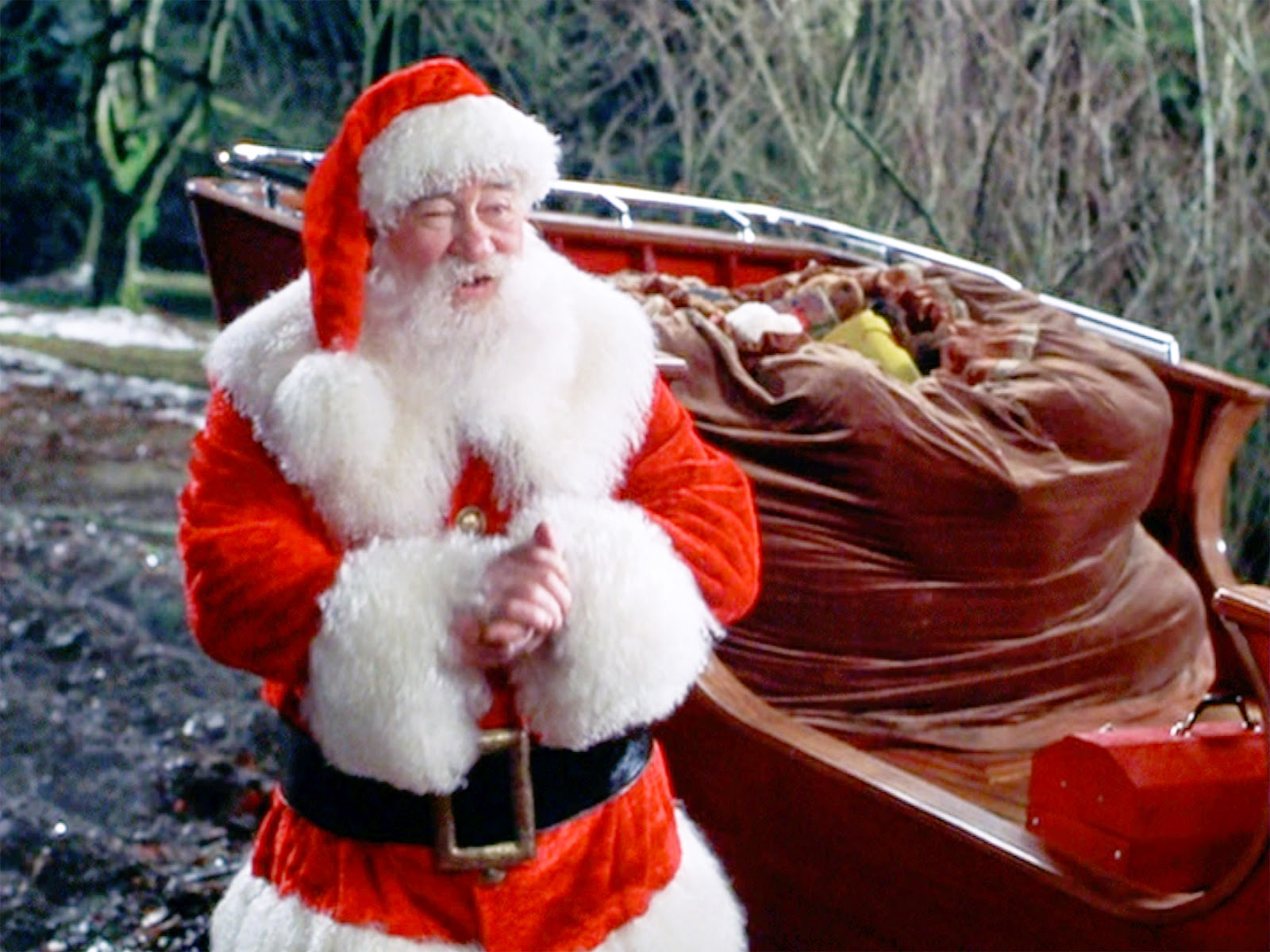
But casting the legendary Bob Newhart as Papa Elf just might be the icing on the cake and he is able to bring out just the right amount of emotional weight to a role that could have been overacted and forgettable. The same goes for Will Ferrell. His character, as written, could have been annoying but he’s somehow just the right blend of innocence and purity.
But what I love most about this movie is that it doesn’t try to go too raunchy like many recent Christmas films have (Bad Santa for example). There are a handful of innuendos here and there, but never pervasive. Make no mistake: This is a great family film. Buddy’s Christmas spirit is contagious and you will feel it, too. Oh, and the music is INCREDIBLE!! I love it when the reindeer fly over New York City. My heart swells every time.
Elf has become a Christmas staple at our house. It’s one of my wife’s all time favorite movies, and though my daughter is too young to fully appreciate it (it’s her first Christmas!!), we are already starting this tradition with her.
So that concludes our 12 Days of Christmas Movie Reviews. We know that we miscounted and on Christmas Eve instead of Christmas Day, but oh well. Maybe next year I’LL learn how to count (Yes, it was my fault).
But whatever you’re doing and however you celebrate this year, we hope you’ve had fun with us and we wish you a Merry Christmas and Happy Holidays!!
On a side note, don’t try to eat spaghetti like Buddy does. I made that mistake once and let’s just say it wasn’t pleasant for anyone involved.
The post Day 12 (Merry Christmas!!): Elf (2003) first appeared on It's Just Awesome DOT com.]]>Depending on whether you agree with Topher’s review on White Christmas and it NOT being a “Christmas movie” or Kelley’s review of It’s a Wonderful Life and it NOT being about Christmas, Gremlins might be the third non-Christmas movie on our list. Personally, I think they’re all Christmas films, but the argument could be made that if you can replace Christmas in a film with any other holiday and have little or no change on the plot, then it’s not really about Christmas and thus not a true Christmas movie.
To me, this is akin to colorizing a black-and-white film. Sure, it can be done, and the plot doesn’t change, but that movie was specifically created to look like that, with costumes and set design that photographed best in black-and-white. In that vein, White Christmas, It’s a Wonderful Life, Gremlins and Die Hard were all written to take place during the Christmas season, and if you were to alter that, you are inherently changing the movie and what the creators envisioned (even if it might not be apparent).
So, I’ll emphatically defend Gremlins as a Christmas movie… and I guess not colorizing black-and-white movies as well.
Gremlins is the blended, twisted creation of director Joe Dante, producer Steven Spielberg, and writer Chris Columbus and their unique influence is clear throughout the entire thing. It also happens to be a fantastic film that blurs the line between being a heartwarming family movie and a gory, frightening film more suited for adults. This is, after all, one of a handful of films in the early 80s that helped lead to the creation of the “PG-13” rating in the U.S. (the other prominent one being Indiana Jones and the Temple of Doom. What’s up, Spielberg??).
Inventor Randall Peltzer is looking for the perfect Christmas gift for his son Billy. In an eerie and strange shop, he discovers a creature known as a “Mogwai,” but the owner of the shop doesn’t want to sell it. After some back alley dealings with the shop owner’s grandson, Randall is able to purchase the Mogwai, but is given three rules he must follow:
Naturally, not along after Billy receives the Mogwai (which he names Gizmo), he breaks all of these rules. It wouldn’t be a very good movie if all of these rules were followed and the mysterious shop owner’s foreshadowing didn’t come true, right??
The lights in the bathroom prove too bright for Gizmo, but it’s when he gets him wet that the real trouble begins. You see, when water is accidentally spilled on Gizmo, more Mogwai pop out of his back. When these other Mogwai are accidentally fed after midnight, they form a cocoon and go through a metamorphosis to become a larger creature… the Gremlin! Soon, there are hundreds, if not thousands, of them wreaking mischievous havoc all throughout the town of Kingston Falls. And only Billy, his girlfriend Kate, and Gizmo can stop them!!
I love this movie.
I love the strange homages it makes to other films and cartoons (not unlike what Dante did in The Howling). I love that Dick Miller is used to great effect, even giving the reason the creatures are named Gremlins. I love Kate’s bizarre story of how her father died (similar to her Abraham Lincoln memory in Gremlins 2) and I love how much fun it is!! A room full of Gremlins singing “Heigh Ho” while watching Snow White and the Seven Dwarfs?? I mean, what’s not to love????
Seriously, watch this movie this holiday season, especially if you’ve never seen it before!!
Tomorrow is Day 9 and Kelley will be reviewing a movie we disagree on: National Lampoon’s Christmas Vacation!!
The post Day 8: Gremlins (1984) first appeared on It's Just Awesome DOT com.]]>You’ll shoot your eye out!
Remember kids – drink more Ovalteen
Look it’s Italian! Frageelé
Oh fuuuuuudge!
The interesting thing about each of the moments though are that taken out of the Christmas context could be funny any time of the year. So just as Kelley begged the question with It’s a Wonderful Life and Christopher with White Christmas, is it a Christmas movie? As far as the story is concerned I would equate it to something like The Sand Lot. A collection of memories from boyhood…that just so happen to be at Christmas.
Ralphie is a boy just trying to make it in his world full of annoying brothers, bullies, the threat of soap poison whose only aspiration in life is a a Red Ryder Carbine Action 200-shot Range Model air rifle with a compass in the stock and “this thing which tells time”. The film follows that plot line as it weaves through humorous scenes akin to stories your family tells over the years. You know, the kind of stories a family member says “We need to write theses down and put it in a book.”
There’s not really much to say about A Christmas Story. There is no brilliant storytelling, directing or acting to stop and discuss. That critique aside, it is a fun movie with great one liners and memorable moments. It’s no wonder TBS airs it for a full day (are they still doing that? seriously somebody look that up). You can jump in at anytime and laugh at the kid who gets his tongue stuck to the flag pole, or giggle at Ralphie in his bunny costume. Then you can just as easily turn it off when it’s time to go to grandma’s house or when Christmas dinner is ready. I honestly enjoy this movie and will sit and watch it anytime it’s on but I can understand why some people say they don’t care for it (which is a surprising amount).
A few years ago I was able to see A Christmas Story in a stage play – narration, kid actors and all. I have to say I appreciated the story more in that version. Then again if you have watched this thing a hundred times, you could probably act it out in your living room all the same.
Tomorrow Charles will be reviewing Gremlins from 1984. Oh Gremlins…I look forward to leaving my comments… Thanks everyone!
The post Day 7: A Christmas Story (1983) first appeared on It's Just Awesome DOT com.]]>The ever-down-trotten Charlie Brown is searching for the meaning of Christmas through all the commercialism and production that surrounds him. His best “frenemy” Lucy suggests he direct the Christmas play. Through all his efforts and his affection for a whimpy Christmas tree he still never finds the meaning of “Christmas” until Linus steers them on the correct road to understanding.
On the original air date, this adaptation of Charles Schultz popular comic strip found many road blocks in its production. The story behind that almost over shadows the film itself! One of the largest hurdles though was Charles Schultz’s stubbornness to make a standard cartoon but instead focus his effort on what he saw as a force that was demeaning the spirit of the holiday: commercialization. I despise the commercialization of Christmas. Jingle bells popping up as Jack-o-lanterns are coming down sickens me! Black Friday dictates when we should bring peace on Earth and good will toward men. This little film is in my corner in that fight.
A good 3/4 of the film follows the pattern most Peanuts animated stories do; 60 second jokes that you can imagine are lifted straight from the daily four panel comic strip with an over-arching plot line following our glum hero Charlie. All these scenes focus on how disgusted and confused he is on the purpose of Christmas. Is it just a “racket cooked up by an Eastern syndicate”? The story takes a turn though when Charlie Brown and Linus are set out to find a tree, which of course Charlie Brown gets the “Charlie Brown-iest” of all trees. In his dismay he cries out “Doesn’t anybody know the true meaning of Christmas?!” Linus answers with a Bible verse and that scene hugs my heart every time. At this point many people think Charlie Brown has been given the resolution to the problem in the plot. Although this would be the climax of the story, the true resolution comes in the last few seconds of the movie.
Now bear with me as I psycho-analyze a 50 year old children’s program! Linus sets the resolution on the right path but neither Charlie Brown or the gang still understand Christmas. In his speech Linus talks about the Christian understanding of Christmas. Essentially he is saying Christmas is about something bigger than an individual’s needs or wants. This applies to all holidays in this season: Chanukah, Christmas, Solstice, or any non-descript Holiday tradition/celebration. The holidays are about stopping selfish thought and joining in a community whether that is family, friends, faith group or just another human being.
So the true resolution is here: Charlie Brown has abandoned his tree. The gang gathers around it and together decorate it (by waving hands – if only it were that easy I wouldn’t climb a ladder in the freezing cold). Together they agree it’s not a bad tree after all. Then they begin humming together. Notice the optimal word there: TOGETHER. Up to this point every character has had their own agenda, played their part in the play their own way, misunderstood each other and even danced different dances. Side note: my favorite is the kid who just shrugs his shoulders. This is the first time they have done something in harmony. I love that there are no musical singing numbers before this scene which in modern day you would probably see in most children’s Christmas movies. This emphasizes the fact this is the first time they have been together.
What can we learn from the Peanuts gang now 50 years later. The true meaning of Christmas is about stopping to think that there is something bigger than you and we are all part of it TOGETHER. This is an important message as we wave an exhausted good bye to to 2016. Christmas is about stopping all rushing about if just for one day to decorate a tree, sing a chorus of “ooo oooo ooo “, and wish somebody who 364 days of the year you think is “just the worst”! Merry Christmas Donald Trump. Merry Christmas Hillary Clinton. Merry Christmas corporate executive. Merry Christmas welfare squatter. Merry Christmas alt-right nationalist. Merry Christmas liberal media. Merry Christmas Charlie Brown.
The post Day 6: A Charlie Brown Christmas (1965) first appeared on It's Just Awesome DOT com.]]>Just so there’s no confusion, I am talking about the original 1947 classic, not the 1994 remake. And while I actually like that movie considerably, nothing holds a candle to the original.
It’s not just the best Christmas movie on our list, it’s probably the best Christmas movie ever, and one of the best movies of all time. I’m sure there’s a certain sense of nostalgia at play here, because I certainly remember watching this with my mom every Christmas when I was a boy. This film that she watched as a girl was now captivating me, and though I didn’t know it at the time, it helped foster my love for movies, and for the wonder of them and the joy they could bring.
Before I get too mushy and sentimental, here’s a summary: Macy’s Department Store quickly needs a Santa Claus replacement for their Thanksgiving Parade after their planned one shows up drunk, and who else should be there but a man named Kris Kringle (Edmund Gwenn in an Oscar-winning role). Kris is quite simply incredible and so, the Director of Special Events, Doris Walker (Maureen O’Hara), hires him to continue “playing” Santa at the store. Naturally, he’s widely successful there as well, but he’s being completely open and honest with Macy’s customers, even if that means sending them to other stores where certain Christmas gifts can be had for cheaper. Once the management find out, they’re not too happy. Tack on the fact that Kris actually believes he’s the real Santa, and they decide he needs to be institutionalized. A court case ensues, and Fred Gailey (John Payne), is the only young lawyer who will help defend him. Fred also happens to be in love with Doris, but she’s pretty emotionally distant. She’s taught her daughter, Susan (Natalie Wood), to be detached as well and to not believe in fantasy and make-believe, including Santa Claus. So, not only must Kris win his case and prove he’s the real deal, but he also must somehow convince Doris and Susan that there is magic in the world, and that miracles do exist. A tall order perhaps, but not for Kris Kringle!!
There’s a particular scene with a young Dutch girl whose adoptive mother doesn’t think will be able to speak with Santa, but lo and behold, Santa speaks her language!! But OF COURSE he does!! Even though this beautiful moment is brief, it still manages to catapult the film into another level.
Then there’s the courtroom scene with all the mail bags being brought it. I can’t help but smile each and every time I see it.
Gwenn gives the definitive portrayal of Santa Claus, in my opinion. It goes beyond an actor playing a role. It’s transcendent. He makes the audience believe in him, as well, and the Christmas joy he spreads feels genuine, and never too saccharine. There’s a magical twinkle in his eye that will live forever in celluloid, and that Christmas joy will only continue to spread as future generations embrace this movie, just like it did for me and my mom… and soon my daughter.
Tomorrow, it’s Day 3 with Topher reviewing White Christmas!!
The post Day 2: Miracle on 34th Street (1947) first appeared on It's Just Awesome DOT com.]]>Day 1: It’s A Wonderful Life (1946);
Day 2: Miracle on 34th Street (1947);
Day 3: White Christmas (1954);
Day 4: Santa Claus (1959);
Day 5: Rudolph the Red-Nosed Reindeer (1964);
Day 6: A Charlie Brown Christmas (1965);
Day 7: A Christmas Story (1983);
Day 8: Gremlins (1984);
Day 9: National Lampoon’s Christmas Vacation (1989);
Day 10: Home Alone (1990);
Day 11: How the Grinch Stole Christmas (2000);
Day 12: Elf (2003).
Mr. Smith Goes to Washington (1939);
The Great Dictator (1940);
All the King’s Men (1949);
The Manchurian Candidate (1962);
Dr. Strangelove (1964);
All the President’s Men (1976);
Dave (1993);
The American President (1995);
Wag the Dog (1997);
Lincoln (2012).
Many of you may not know this, but The Visit is an M. Night Shyamalan film. I imagine when I say his name, there’s a good chance you’re rolling your eyes and thinking back on some of his… shall we say… lesser films, but the truth of the matter is that he is a great filmmaker. When you’ve got The Sixth Sense, Unbreakable, and Signs as back-to-back-to-back films you’ve created on your résumé, you’re clearly doing something right. It’s a shame that he’s taken such a beating recently (so much so that Sony buried his name in all the marketing for After Earth), but I believe The Visit (which was created under Blumhouse) is a return to form for him and should hopefully win him back the respect he deserves.
If you read my review for [Rec], you know my contempt for “found footage” movies. I realized after I wrote it that I actually have enjoyed a few, if I’m being completely honest. I think the Paranormal Activity movies have been pretty great, and I even liked V/H/S and Creep, so the genre CAN work on me. And it did for The Visit, as I didn’t find myself annoyed with the gimmicky approach at all and was genuinely creeped out in quite a few scenes.
It’s basically about a brother and sister who go to spend a week with their grandparents. That may sound perfectly normal, but they’ve never actually met their grandparents, so they have no idea what they look like. Years ago, their mother had a falling out with them and she left home, ever looking back. Despite that, everything is good… at first. As the days pass, however, they notice their grandparents doing strange things, especially after 9:30pm each night. Despite multiple warnings about being in bed before that time, the two never are as their curiosity gets the better of them. Eventually, they think their grandparents might even be trying to kill him!! Oh no!!!!!!
What I like most about this movie is how, despite a very straightforward premise where something is obviously wrong, it doesn’t quite play out like you think it should. It also pushes the boundaries of the PG-13 ratings system, and not even with gore, but with disturbing subject matter. I think that has a lot to do with M. Night Shyamalan’s “classic” directing sensibilities (and maybe also because his goriest film to date, The Happening, happened to be one of his worst ones. It is his only R-rated film, too, so I’m sure that factors in). It seems like he has always tried to be this generation’s Hitchcock, especially by doing cameos in his films, but he certainly does know how to ratchet up the suspense in each scene and then let it play out at its own pace. And that definitely works for this movie. It’s a mystery throughout, but some of the creepiest scenes actually happen early on (like the grandmother eerily chasing after them in the crawlspace). By the time all is revealed, it certainly feels earned and isn’t cheap at all (even if my wife and I saw it coming… something our friend Toby did not), and that’s saying a lot for a film these days. I’m actually really excited to see how he will approach Split now.
All of that’s not to say this is a perfect film, however, as there were a few goofy moments here and there (namely the main kid rapping in the film, and then doing an extended rap during the credits), but it can be easily forgiven because the film is so good in other areas. Overall, it just works.
Well, that just about does it for this year’s 31 Days of Horror. We sincerely hope that you’ve enjoyed our picks and have expanded your horror cinema knowledge by watching our overview videos. I know we’ve had a blast!!
So, on behalf of all of us here at It’s Just Awesome DOT com, we’d like to say thanks and… HAPPY HALLOWEEN!!!!!!!!!!
The post Day 31 (Happy Halloween!!): The Visit (2015) first appeared on It's Just Awesome DOT com.]]>I need to point out that I consider Insidious to be one of the scariest movies of this decade so far. I bring that up because it’s also from director James Wan and shares many of the same styles (and even actors) as The Conjuring. Insidious scared the heck out of me when I watched it in theaters and I had a hard time sleeping for days. I really wanted to see The Conjuring in theaters, but I just never got around to it. This was much to the chagrin of my friend Robert because he loves horror films, too, and we share many of the same tastes in movies.
This year, after he remembered that I hadn’t seen it, he decided he’d buy me the blu-ray version of it for my birthday (as well as a few other scary films, including the 3D version of Dial M for Murder) and wanted to watch it with me at my house. This meant that my wife would also be watching it and as you may recall, she HATES scary movies. But she agreed because it was for my birthday.
Now, after having watched it… wow.
Wow!!!!!
But first, a synopsis.
It follows a couple of real life case files from the Warrens, who were actual paranormal investigators in the 1960s and 70s. The first case (and the opening of this film) is the story of a possessed doll named Annabelle. The second case (and main storyline) is about the event that eventually inspired The Amityville Horror. It’s about a family that begins experiencing supernatural occurrences, including strange noises and freaky apparitions, not long after they move into an older house. They hire the Warrens to investigate it and well, to say much more would spoil a lot of the fun. James Wan really understands horror films, and knows that long takes and fluid camera movements can really amp up the suspension, which is then released with a sudden loud noise or movement on screen. These often catch you off guard and make you laugh at yourself for screaming out loud.
This movie is AT LEAST as scary as Insidious, and when you take into account the “inspired by true events” aspect of it, it may, in fact, be the better movie. It’s also a bit leaner and doesn’t have an ending that feels out slightly of left field (as some people felt was the case with Insidious. I disagree with those people, however). Needless to say, I thoroughly enjoyed The Conjuring (and my wife thoroughly hated it, natch). It reminded me a lot of Poltergeist and other haunted house films, too (maybe even The Haunting). It seems very much rooted in a more classic style of filmmaking and that makes it stand out to me. It’s impressive on every level and I loved it. There’s little gore on display here, and that really works for this material. Thanks to my friend Robert for turning me on to this movie. I’ve got to catch up and watch The Conjuring 2 and the spin-off film Annabelle.
Tomorrow, we will close out this whole thing with M. Night Shyamalan’s The Visit!!
The post Day 30: The Conjuring (2013) first appeared on It's Just Awesome DOT com.]]>Today, though, we’re talking about James Watkins’ The Woman in Black (2012).
This movie, starring Daniel Radcliffe, is an adaptation of Susan Hill’s 1983 horror novella of the same name. Interestingly enough, The Woman in Black is also an immensely successful stage play in London–the second longest-running play in the history of the West End, after The Mouse Trap. Several years ago, my husband and I happened upon a production of the play in Fort Worth, TX, and it is EXCELLENT. At first, I was skeptical because there are only two actors and very few props. I thought it was going to be the kind of pretentious, overly-artsy production beloved by people who say “theatah” and no one else. Suffice it to say, I was completely delighted to be wrong. If you have the chance, I highly recommend buying some tickets and checking it out. It is scary as hell, and particularly impressive given the minimalistic approach.
But, alas, we are not here to talk about the play!
I did not enjoy the 2012 movie as much as the stage performance, but Watkins’ adaptation IS eerie and decently well done. The story is set in the late 19th century, and centers around young junior solicitor, Arthur Kipps (Radcliffe), who is still grieving over the beautiful wife he lost during childbirth. Serving as a painful reminder of that loss is Arthur’s young son, Joseph. It quickly becomes apparent that, despite his best efforts, Arthur’s grief has impeded his ability to perform at work, and his employer gives him one last case to prove his commitment to the law firm. For Joseph’s sake, Arthur agrees, and he proceeds by train to the gloomy Eel Marsh House. We learn that the former mistress of the house, Mrs. Alice Drablow, has passed away and Arthur’s assignment is to sort through the mountain of paperwork and tidy up the widow’s legal affairs.
After arriving in the remote English village where Eel Marsh House is located, Arthur is received with attitudes of wary suspicion (and outright hostility, in some cases) by the townspeople regarding his business with the late Mrs. Drablow. He cannot account for this, until superstitious ghost stories about the old manor reach his ears–namely, stories involving a malevolent woman in black. According to local folklore, each time the woman in black in seen by someone, a child from the village dies in a horrible, tragic fashion. Arthur is dismissive of this at first, but is later horrified to find that he DOES see a woman in black at Eel Marsh House, and children from the village DO begin dying violently, one by one.
This movie does a great job of weaving an eerie, uncomfortable feeling throughout. The horror is understated; it isn’t like The Grudge, where all the spine-tingling moments come from the visuals themselves. The Woman in Black takes a subtler approach to scaring the viewer, which I believe ultimately makes it more successful as a film. Yes, the ghostly appearances of the woman in black are extremely creepy, but it’s a combination of her unexpected presence, the camerawork, and the general sense of quiet unease that ultimately evokes fear in the viewer.
I do wonder if the movie would have been a bit stronger with slightly different casting. I like Daniel Radcliffe, don’t get me wrong, but he seems a bit out of place here. He has zero fatherly chemistry with his 4 year old son, and I just don’t ever fully believe him in this particular role. Maybe it’s a case of being pigeonholed as Harry Potter forevermore, but Radcliffe as Arthur Kipps did not work for me. The character is supposed to be young, but Radcliffe seems TOO young to be a great fit. I’m not sure who could have done it better…I’ll have to think about that.
Regardless, The Woman in Black is a decently executed horror flick, full of suspense and ridiculously unsettling dolls from the 1800s. A brief aside: why are old-timey children’s toys so frightening?!
Tomorrow, Charles will be reviewing The Conjuring (2013), so be sure to stick with us as we close out the final days of 31 Days of Horror!!
The post Day 29: The Woman in Black (2012) first appeared on It's Just Awesome DOT com.]]>[Rec] is a Spanish film that was later remade into Quarantine, but they’re both found footage movies and… I don’t like either one of them.
I have to be upfront: I just don’t like found footage movies. The gimmick quickly wears thin and I grow impatient as the filmmakers constantly come up with new excuses for a person to be recording what’s happening instead of just abandoning the camera and running away (like any normal person would do). I also get annoyed at the characters on-screen yelling at the cameraman. That seems to be a huge staple in these kinds of movies, and only exaggerates the generally poor acting that is typical in this genre. It also distracts and reminds you that you’re watching a movie and totally takes you out of the moment. [Rec] is certainly no different, and when I heard, “GET THAT CAMERA OUT OF HERE,” about the 100th time, I wanted to throw my remote at the screen. And that’s not even counting all of the ways they have to cheat the footage to provide cuts, because, after all, they’re not actually going to do any of this in real time despite what the commercials say. Oh? What’s that? A character in [Rec] wants to check out the footage we just watched so we’re literally going to see it being rewound and then played again? Awesome. You know, for a movie that’s not even an hour and half, that feels like a great way to pad the time (while wasting more of mine).
Even La casa muda, while not a found footage movie, used digital techniques to hide their cuts so that the movie appeared as one long shot. It’s similar to what Hitchcock did practically in Rope, so it can be done, and I think these movies would work so much better if they did. I mean, I guess they could always do it for real but then it might turn out as boring as Russian Ark, so maybe that’s not such a great idea, either.
Then there’s the cinephile in me who wants the cinematography to serve the story in a meaningful way, with a variety of beautiful shots instead of this nausea inducing, shaky-cam garbage. I get it. It makes it seem real and raw and in your face. But it’s a freakin’ movie!! We know it’s fake and you don’t have to give us all motion sickness just because you’re trying to (over)act like it’s not. I didn’t like it in Cloverfield or The Blair Witch Project and I don’t like it in this movie. If you read my review for 28 Days Later, then you know my disdain for crappy, digital video. Think of how beautiful and atmospheric this movie could have been with the right cinematography.
The basic plot of [Rec] is that a television reporter is doing an extended report on firefighters and tags along with them on a call to a local apartment building. It’s not long after they arrive that the whole place is quarantined by a government agency and they’re all trapped inside as a zombie-like apocalypse begins to happen, with any dead residents coming back to life and attacking the living. Yes, it’s a found footage zombie movie (or is it a found footage movie about demonic possession? I’m not sure). And yes, it is claustrophobic and frightening in key places. Admittedly, this could be due (at least in part) to the found footage approach, but again, it wears out its welcome and is much more of a con than a pro.
But [Rec] is also an extremely slow-burner of a film, with nothing really happening in the first hour, and then everything sort of crammed in the finale. I did enjoy the night vision during this end sequence, and it did remind me a lot of the similar scene in The Silence of the Lambs, but not nearly enough to make me enjoy the movie. I’d say avoid this one and its many sequels (as well as Quarantine and its many sequels). But if you must watch this movie, please, please, please don’t watch the English dubbed version. It makes the gimmick even worse because the voices don’t match the characters at all and it comes across as horrendously bad (and laughable) due to the huge disconnect.
Tomorrow, Kelley will be back with Hammer Films’ The Woman in Black as we start our last decade of this year’s 31 Days of Horror!!
The post Day 28: [Rec] (2007) first appeared on It's Just Awesome DOT com.]]>It’s not exactly accurate to call this a “zombie” movie, as many of the usual tropes aren’t on display here. Instead, there’s an Ebola-like disease called Rage that infects people and causes them to be much more aggressive and animalistic than they would otherwise be, granting them what appears to be superhuman speed and agility (I wonder if this movie started the whole “fast” zombie thing?) But then again, there’s obviously many zombie elements on display here, especially what happens if one of these Rage fueled people bite you.
The movie starts out as an animal activist group breaks in a laboratory with the intent to release caged lab monkeys. One of the workers there pleads for this not to happen because, according to him, the monkeys have been infected (most likely through various lab tests and studies) and doing so will cause a massive epidemic. The group doesn’t listen, and one is immediately killed in an attack. Flash forward 28 days later, and Jim (played by Cillian Murphy) wakes up all alone in a hospital, extremely confused (I’m not sure if The Walking Dead was inspired by this or not). As he leaves the empty hospital, he discovers that all of London is completely deserted. When he finally discovers people in a church, he’s surprised to discover that they’re all infected, and they all seemingly want to kill him. Even a priest tries to attack him!
As Jim tries to outrun these red-eyed crazy people, he is suddenly aided by Selena (Naomie Harris) and Mark (Noah Huntley). They help him out and bring him up to speed, though details are sketchy. It seems no one knows the true scope of the virus just yet, and whether or not it’s contained just to England or if it has spread to America. This is their new bleak world, where surviving is all you can do and happiness is a luxury they no longer have. Eventually, they run into Frank (Brendan Gleeson) and his daughter Hannah (Megan Burns) and form a family of sorts. When they hear a broadcast, sent from what is apparently a safe haven, they decide to make their way to it, hoping against hope things will be different once they get there.
There are a lot of things I like about this movie. The acting is solid all around, and I really love the idea of a social rage as the culprit rather than just some generic explanation we usually get in zombie movies. It’s more realistic and really works overall. But my favorite part, by far, is the opening scenes in an abandoned London. It’s haunting and really separates this film from nearly all others. It’s not an effect either; they legitimately closed off sections of London to film their scenes. It’s quite remarkable.
What’s not so remarkable, and something I have never understood, is the way this movie was shot, which was on inexpensive, prosumer digital cameras (mainly the Canon XL-1, I believe). Now, digital video has come a LONG way since 2002 and in many cases, can be nearly identical to film, but here, it was still new technology and is extremely distracting. These are standard definition cameras, with a low dynamic range, and it’s just an awful mess visually. If Danny Boyle wanted more realism, he could have gone the route of Michael Mann in Public Enemies and made the sound design be awful as well. Again, I think Public Enemies is a terrible, terrible movies but at least it sucks consistently on video and audio. Here, Boyle still uses professional audio equipment, coupled with all kinds of expensive gear to physically move the cameras, so he didn’t really stay true to a documentary type feel, if that’s even what he was going for. Essentially, it sounds like a big budget movie and has some professional camera tricks, but is marred by horrendous imagery and low resolution, muddy textures. It adds nothing to the movie for me what-so-ever and was especially problematic when I saw it in theaters because blown-up, it looks even worse. The style basically dates this movie to a time before inexpensive HD cameras were a thing, let alone something we carry around in our pockets. The sequel, 28 Weeks Later, was shot on 16mm and looks 1000x better, while still maintaining a gritty, raw texture so it could have worked here as well. In fact, imagine if those empty streets of London had been captured on 16mm, or Heaven forbid, 35mm. I think we’d have been talking about the Oscar winning cinematography at that point.
Still, the bleak tone of the film works quite well, and the imagery of London is impressive, so I’d say check it out for those reasons alone. Just don’t say I didn’t warn you about the look of it.
Tomorrow, I pass it back to Kelley as she reviews The Grudge (which is the American remake of Ju-on: The Grudge)!!
The post Day 26: 28 Days Later (2002) first appeared on It's Just Awesome DOT com.]]>Today we’re talking about Ringu, which is the Japanese movie that was remade into The Ring. These films have nearly identical plot points and key scenes, but this is the rare occasion where I actually STRONGLY prefer the remake, and it’s mostly due to the small changes made, as well as a key few differences in style. As such, I’ll be (sort of) reviewing them together.
Both movies are about a mysterious VHS tape that contains a creepy, surreal video of unknown origins. The story goes that if you watch it, you will get a phone call telling you that you have 7 days to live. And it appears that the people who have received that call actually do die a week later in horrific, unexplainable ways. A reporter investigating the story watches the tape for herself, and then brings along her ex-husband to help her solve the mystery of it before her time runs out.
Maybe that doesn’t sound all that scary to you, but here’s that video from Ringu (and The Ring’s version as well, just for comparison):
To this day, I still feel guilty showing people that video. I feel like I’m sentencing them to their death or something.
Anyway, I should tell you right off the bat that the American version scared the crap out of me the first time I watched it (which, by the way, was long before I saw the Japanese one). My friends knew I was particularly freaked out, and so waited until the middle of the night to call me and say, “7 DAYS!!” when I answered groggily. Needless to say, I couldn’t sleep much that night and actually turned my tube T.V. away from me. True story. Pathetic, but true.
I digress (I do that a lot). Where was I?
Oh, yeah.
I love both movies for the mystery that unravels as you watch them. They’re both great detective stories that happens to feature terrifying images, but still a mystery at their core none-the-less. And they both do a great job of keep you on the edge of your seat with constant reminders of what day it is and how long the characters have to live. What I happen to like more about the American version is that they don’t shy away from showing what happens after those 7 days are up. The Japanese version more or less goes black-and-white and freeze frames during these supernatural moments, but the American shows you so much more. It’s a much better effect, and has a lasting impact.
I also strongly prefer the ferry scene in the American one, where we see a horse jump off the ferry and turn the waters red. I can’t get that image out of my head nearly 15 years later, and probably never will.
And finally, the differences in the characters bugs me. In Ringu, it seems both main characters can read the thoughts of others and see into their past. It’s not really explained too terribly well, and seems like a gimmicky, cheap way to throw in some exposition via flashbacks. The Ring doesn’t even have a hint of that and is all the better for it. I also don’t understand the characters’ reactions in Ringu when they’re in the well at the end, because neither one of them seem too terribly frightened or grossed out to be in the murky water with a corpse; in fact, it’s downright cheesy in this scene when the corpse is finally found.
So, honestly, for all of these reasons, I would say skip Ringu and go straight for The Ring. It’s one of the best horror films ever made, even if the technology in it is dated (I seriously don’t know anyone that owns a VCR anymore). Also, stay away from The Ring Two (which, interestingly enough, was directed by Ringu’s director, Hideo Nakata).
Oh, and there’s a new Ring movie coming out next year that looks pretty scary, too.
Tomorrow is Day 26, and I’ll be back with 28 Days Later. Hope to see you soon!!
The post Day 25: Ringu (1998) first appeared on It's Just Awesome DOT com.]]>We haven’t been using movie posters as the title graphic for our reviews, but this one was too amazingly awful to ignore. Does that strike you more as a horror film or a softcore porno you might catch late night on Cinemax? What are they marketing here exactly?!
“Love brought out the animal in her.”
Where to even begin??
You know, I was discussing this movie with Kelley, and I couldn’t quite figure out what I would say about it. She, of course, quickly realized that everything I was telling her sounded like an “ugly” movie. If you listen to our podcast, then you know an “ugly” movie often defies logic and is usually so bad it’s good, and this movie certainly qualifies. Damning praise, to be sure, but accurate none-the-less.
Let me back up a bit and give a synopsis taken directly from IMDB: “A young woman’s sexual awakening brings horror when she discovers her urges transform her into a monstrous black leopard.”
Much like the 1942 original, the plot does indeed revolve around a young woman named Irene who is worried that having sex will turn her into a leopard, but that’s about where the similarities end. The Irene from 1942 doesn’t want this to happen and is startled by it and how she might harm others. Irene from 1982 doesn’t seem all that concerned with it, seemingly aroused by the thought of it (despite being a virgin).
Early on, when she reconnects with her long lost brother (who also has this ability), he tries to sleep with her (telling her it’s the only cure) but instead settles on a local prostitute, who he promptly kills. This sets up the film’s basic rule that sex will transform you in a big cat.
So, this is essentially a werecat movie, according to my lovely wife, but with sex instead of a full moon.
Anyway, he’s captured (as a leopard) and gone for days and days, but Irene doesn’t seem all that concerned with this either. She never wonders where he went… which is curious since, you know, she’s living with him. But, apparently, once you become a leopard, you must kill again to become human, though you are still fully in control no matter which body you happen to be using. You are well aware of your actions.
So, these are the rules that are established, but they’re seemingly not enforced at all because Irene is able to become a leopard and stalk Alice and then transform back into a human before she has sex with anyone, so who knows? I’m very confused about the whole matter and it totally complicates the ending (which I won’t spoil), but I guess they can transform just by being horny??
By the way, that stalking scene is one of the few sequences that is directly inspired by the original. The 1942 version created a new kind of “jump scare”, where a loud, innocuous sound catches you off guard because of the suspense that led up to it. It’s actually a bus that makes the sound in the original, and this horror technique has since become known as the “Lewton Bus,” named after the film’s producer, Val Lewton.
This newer version, though, decides to have Alice go for a naked swim to throw in a little gratuitous nudity. Why not, right?
And speaking of nudity (how often do I get to say that?), Irene seems to spend the second half of the movie in an almost constant state of undress. Like I said, she doesn’t seem too concerned with the violent consequences of having sex, so it seems to change the message and tone of the original quite a bit. Maybe that works for you, but it doesn’t really for me. The film is beautifully shot, though, and there are some really intriguing moments, but it’s so corny and ridiculous and over-the-top that it’s hard to take seriously. That’s why I’m all over the place on this review.
But the one area I’m sure on is the ending. As I also mentioned, it doesn’t really gel with the rules laid out, but I find it awful for an entirely different reason. Much like the film’s poster, the cheese factor is incredibly high. David Bowie (!!) provides the film’s closing credit song, but the absurdly long freeze frame of the leopard that then roars just as Bowie yells “GASOLINE!!!!!” made me laugh out loud. It’s perhaps the film’s finest moment.
https://youtu.be/pBkmPZWH4KA?t=50s
Kelley will be reviewing David Cronenberg’s remake of The Fly tomorrow for Day 22, which is also the last 1980s movie on our list this year, so take a moment to be sad about that, and then come back by and check it out!!
The post Day 21: Cat People (1982) first appeared on It's Just Awesome DOT com.]]>Now, I suspect many of you aren’t familiar with the “Giallo” style. To be honest, I wasn’t either. But it seemed that everytime I began doing serious research into horror film history, certain movies kept popping up again and again. Suspiria is one of those films, as well as Blood and Black Lace and Deep Red.
And they’re all attributed to this Italian “Giallo” genre.
So, what were these films from Italy? And why are they constantly cited?
Well, “giallo” means “yellow” in Italian, and it refers to the color of the cover of certain crime / mystery paperback novels in Italy. These novels often shared many similar elements with these “giallo” movies, including masked killers and a certain amount of eroticism, even if the stories weren’t directly adapted into the movies. The movies themselves were usually quite gory, or at least shockingly violent, and they had a really beautiful cinematic style which included bold color palettes and creative camerawork. The music often felt disorientating because it was often juxtaposed with what was occurring on screen, meaning it might have had happy or cheerful music playing while someone was being stabbed to death. But they almost always had a mysterious killer attacking people one-by-one, and it was often women that were being attacked while particularly vulnerable (nude, for example). If that sounds familiar, it’s because these movies heavily inspired the American “slasher” film genre, in particular films like Halloween and Friday the 13th.
The plot for Deep Red falls right in line with “Giallo” films. An English musician in Italy witnesses the gruesome murder pf a clairvoyant woman (who previously had visions of the murderer) one night while he’s out with his friend. He teams up with a reporter to try and figure out who the killer is, and in doing so, the killer begins to go after both of them, while also continuing on a murder spree. Where will this murderer strike next? And can anything be done before it’s too late?
I have to say, I REALLY enjoyed this movie.
My wife and I watched it with our friend Toby, and shortly into the movie, he proclaimed it was literally one of the worst movies he’s ever seen (in his best Chris Traeger impression, no less).
Granted, it does take a while to get into it, and the music is very odd (even if it is popular) but I flat-out disagree with him.
There are moments of pure brilliance here, including some fantastic camera movements. For instance, in one particularly wide shot, we are watching a couple discuss details of a murder that had just occurred in the house they’re in. It’s all in one long take, and at the conclusion of the conversation, the lady, who is at the end of the hallway, looks up in our direction right at the camera. The camera quickly moves to the left to duck out of her view, and at that moment we realize that we have been staring through the eyes of (presumably) the killer the entire conversation. It literally gives me chills just thinking about it.
Another moment like that? When a man is playing piano at home by himself and hears someone in the other room. As he knows the killer has been after him, he continues to play while also quietly reaching for an object to hopefully defend himself. The phone suddenly goes off and he rushes to the bedroom door to slam it shut. Just as he does so, he hears the killer whispering to him from the other room that he’ll kill him another time. Eeeesh!!!
I also love that the movie messes with us. It’s revealed in a flashback that the movie actually showed us who the killer was immediately after the first murder. Since this whole thing plays out like a whodunnit (complete with a twist ending), having seen the killer’s face that early would have instantly given it away, but somehow, this movie did just that and we were none-the-wiser. I even watched it again to see if it was lying to us during that flashback, but sure enough, the killer is actually revealed and quite clearly, too. That’s confident filmmaking at its finest.
Then there’s the whole aspect of the mechanical doll that is used as a distraction. It is very clearly the inspiration for the similar device in Saw and it was amazing to see it here, nearly 30 years earlier.

So, absolutely check out this movie as well as the other “Giallo” films. They’re worth your time, especially if you already enjoy slasher movies.
On a complete side note: Why do the background extras stand perfectly still in certain scenes during Deep Red? Is there any significance to that? Because it can be quite distracting at times (and is another reason Toby didn’t like this movie). There’s even a bar in the background of one shot that resembles that Nighthawks painting by Edward Hopper… and again, the extras are all completely and eerily frozen.

Tomorrow, Kelley will be reviewing Ridley Scott’s Alien so you’ll want to be here for that as she closes out the 1970s!!
The post Day 17: Deep Red (1975) first appeared on It's Just Awesome DOT com.]]>If you’re a listener of our podcast, then you’ll recall we’ve done an episode over Bette Davis (who is the star of this movie) and an episode over Hag Horror (which is the genre of this movie). Both of those episodes were picked by Kelley, so she’s clearly a fan. She also didn’t pick this movie as her “good” choice for that Hag Horror episode; instead, she chose What Ever Happened to Baby Jane?, which is quite surprising to me because Hush…Hush, Sweet Charlotte is far and away the better film, even if the two are very, very similar.
Oddly enough, though, Kelley wasn’t the one who added this movie to our list this year. I was, and I didn’t include it to appease or amuse Kelley, either. I added it because years ago, my good friend Buzz tried to get me and my wife to watch it as his house late one night. Having never heard of it, I was skeptical but I will pretty much watch any movie anytime, so I agreed. After the opening scene, which is quite shocking and horrific, I was hooked. My wife, however, is not a night person, and neither is Buzz, so both fell asleep not too far into the movie. I decided I would try and finish it with them later, only later never really happened. Every time it seems we’re actually going to meet up to watch it, we end up doing something else or we get sidetracked or life happens or whatever. But I take 31 Days of Horror seriously, and I knew if it was on the list, I would watch it no-matter-what, even if that meant without Buzz, and unfortunately, that’s exactly what it meant. I suppose it just wasn’t meant to be, but I still owe it to him for turning me on to this film (and I suppose for having good taste in movies in general), but I digress.
The plot revolves around a man named John who is cheating on his wife with Charlotte in 1927 Louisiana. The two plan to elope after a lavish party, but when Charlotte’s father gets wind of their plan, he is furious and privately tells John he must call it off. John reluctantly does so, and Charlotte does not take it well. The next thing he knows, he’s being attacked with a butcher knife and loses a hand… as well as his head (this is that shocking thing I mentioned earlier). Charlotte returns to the party all covered in blood, and the people there freak out, naturally. Flash forward to 1964, and the tale has become somewhat of an urban legend. Charlotte nows lives alone as a recluse at her father’s house (where the murder occurred) and except for her housekeeper Velma, she hardly ever sees anyone. Complications arise because it seems there’s a road that needs to be built where the house stands, and she apparently has no say in the matter. The whole place will be torn down, forcing her to find somewhere else to live and start fresh, though that is the exact opposite of what she wants… mostly because she has never recovered from that horrible night. And when her cousin Miriam shows up to help with the whole situation, Charlotte begins to lose touch with reality, seeing strange visions around the house.
That may not sound much like What Ever Happened to Baby Jane, but the two movies both revolve around a horrific accident that took places years earlier, leaving the title character (played by Bette Davis in both films) isolated and insane in her father’s house. They both involve a housekeeper who learns too much and eventually pays the price for it. They both play out as sort of a whodunnit with a twist ending that changes our perception of said title character. And they both nearly starred Bette Davis and Joan Crawford; in fact, Joan Crawford was originally cast to play the part of Miriam, and even shot several scenes, but for various reasons (including an illness), she was replaced with Olivia de Havilland.
I think this movie works better because Bette Davis’ Charlotte character is much more sympathetic than her character of Jane in Baby Jane, where she essentially played the villain. She may be crazy, but we in the audience knowd where she’s coming from and can feel her pain. She lost the love of her life and we’re able to go along with her spooky visions of him because we understand her sorrow. I really enjoyed her performance overall and don’t feel like she hit a wrong note, which is quite an accomplishment considering all of the crazy things going on.

Also, I think the effects are quite good, and seeing a severed hand on the floor, and a decapitated head rolling down the stairs, really caught me off guard. The film opens on that murder sequence and is able to maintain its creepiness throughout.
The one thing I did not like was Agnes Moorehead as her housekeeper. I think she’s way too over-the-top to be taken seriously, especially with her put on New Orleans accent. I may be in the minority, though, because she was nominated for an Academy Award for this!! It reminds of me of Anne Ramsey being nominated for Throw Momma from the Train. Both terrible performances that were somehow praised at the time. I suppose I’ll never understand.

For tomorrow, Kelley will close out the 1960s with her review of Roman Polanski’s Repulsion!!
The post Day 14: Hush…Hush, Sweet Charlotte (1964) first appeared on It's Just Awesome DOT com.]]>Godzilla has remained popular throughout the years, what with the recent Gareth Edwards version and the new Shin Godzilla, so it’s hard to imagine that there’s many of you out there that don’t know the plot, but here’s a synopsis anyway: A Japanese ship suddenly goes missing, and then another one as well. Japanese Authorities are baffled until they realize that the ships are actually being destroyed by a giant radioactive dinosaur from the Jurassic Period who has been brought to life by atomic bomb testing. This dinosaur, Gojira / Godzilla (which, I guess, are used interchangeably??), soon begins to wreak havoc on Japan, and the military struggles to come up with a solution.
Professor Yamane wants to take a more scientific approach and observe Godzilla instead of killing him. He wants to learn everything about this creature (especially the radioactive bit) even at the expense of many more people dying. Meanwhile, Navy man Hideto Ogato thinks they should defeat Godzilla by any means necessary. He also wants to marry Yamane’s daughter, Emiko, but when he begins to bring it up with Yamane, the two get in a huge argument and nothing is resolved. The whole situation looks hopeless, and after a few different attempts by the military to destroy him, it seems Godzilla is unstoppable. It turns out, however, that Dr. Serizawa (with whom Emiko is betrothed) actually has an experimental device that could eliminate Godzilla once-and-for-all, but he doesn’t want to use it for fear that it would be used to harm people after Godzilla is defeated.
This is the part of the movie that intrigued me the most. Take a step back for a second, and look at what Godzilla represents: The consequences of nuclear fallout in a country that, less than a decade earlier, had seen first hand just what an atomic bomb could do. Dr. Serizawa’s reluctance to use a weapon, even to save his own country, arguably sounds like a critique of the United States (specifically President Harry Truman) and it raises the question: Does the end ever justify the means? Ultimately, in this movie, Serizawa figures out a way to defeat Godzilla and keep others from using his weapon again by sacrificing himself, but that also has strong implications and raises some other questions (Namely: Why couldn’t his device be remotely detonated??). Professor Yamane even gives a speech about it in the closing lines of the film, ominously warning about using atomic bombs to create other Godzilla monsters. It’s brilliantly intriguing and philosophical at the same time without really offering up a good answer. Maybe there isn’t one?
And this is all why I think believe Gojira is a better film than the American version. That movie stripped away most of the atomic bomb implications and focused more on the monster / creature feature aspects. It also dubbed over many of the original Japanese actors, but very inconsistently because sometimes they’re dubbed in English and sometimes they’re subtitled while speaking Japanese. It’s a strange blend. So, I would skip that one (assuming you haven’t already seen it) and seek this one out. It’s a gem of a movie with a message that still resonates today.
It’s Day 12 tomorrow and Kelley will be reviewing Tarantula, so be sure to come back and check it out!!
The post Day 11: Gojira (1954) first appeared on It's Just Awesome DOT com.]]>I’m sure it would pain Mark to know this, but I must confess that I have never read the book by Oscar Wilde.
I’m sure it would also pain Kelley to know this, but I must confess that I have never seen any cinematic adaptation of it, of which there have been quite a few.
Now, that doesn’t mean I’m completely ignorant of the subject. This particular piece of literature has become so ingrained in pop culture that it was even used a punch line to insult Meg on Family Guy (When she asks how she looks in her new glasses, Stewie tells her, “In an attic somewhere, there’s a portrait of you getting prettier.”) but it does mean that right upfront, you should know that I have no idea this version compares to the book or if it’s better or worse than other Dorian Gray movie, but having said all of that, I loved this movie. That’s all longwinded to be sure, but yes, I really did love this movie.
So, for those that don’t know the plot, it is set in London during the late 1800s, and is about a young man named Dorian Gray (played by Hurd Hatfield) who is having his portrait done. He muses that he wishes his portrait could age instead of him, and thanks to an Egyptian cat sculpture, Gray’s wish comes true. But this is a horror film, after all, so there has to be a catch, right? Of course there does!! And this particular catch is that Gray’s inner ugliness will be exposed through the portrait itself, as the portrait changes over time instead of Gray, who completely stops aging. Those around him find this disconcerting to say the least, and it ultimately isolates him and drives him mad.
Lord Henry Wotton (George Sanders, who I always best remember as the voice of Shere Kahn in The Jungle Book) plays a sort of devilish character who talks Gray into living life to the fullest and giving in to his wildest dreams and desires. It’s through Lord Wotton’s advice that Gray passes on the opportunity to be with Sibyl Vane (a VERY young Angela Lansbury), a singer that he falls in love with early on. His rejection causes her to commit suicide, and this is the point of no return for Mr. Gray. After that, it’s vague as to what exactly he does that is so horrible in his life (aside from the onscreen murder, of course), but I rather like that aspect of the story. It’s almost a mirror to the audience, asking us to imagine our worst qualities and our worst actions and what it would be like to have a painting displaying them for all the world to see. Perhaps you’d cover it up just as he does, but would that ever be enough? It still exists. The psychosis on display feels gradual and thus, natural. It’s handled extremely well.
I also particularly love the cinematography of this film. It’s a black and white film, but a select few shots of the portrait are in full technicolor and they are GORGEOUS!! They’re also extremely jarring, which is perfect for a horror movie, and can be used to shocking effect in what otherwise might have fallen flat. It also helps that the portrait itself is growing more and more hideous each time it is revealed.
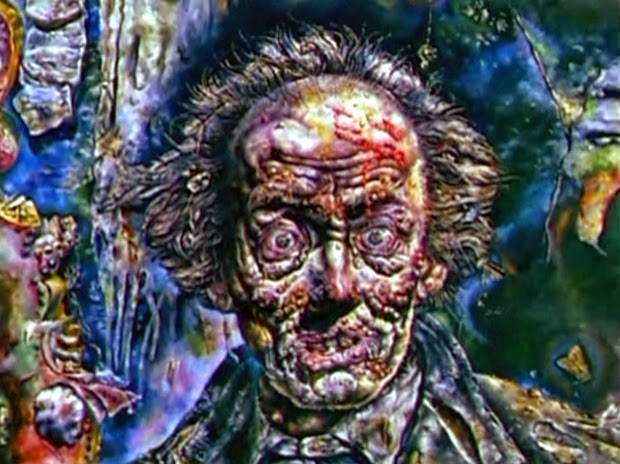
But more than just the few color inserts, I enjoyed the stylized cinematography during the first murder scene, with the hanging light swinging violently, creating intense chaos in a dance of light and shadows on the walls. It’s beautiful and creepy and I love it.
And that encapsulates my feelings about this movie. If you haven’t seen it, go check it out!!
So I’m closing out the 1940s, but for Day 10 tomorrow, Kelley will be reviewing the 1953 movie It Came from Outer Space, so come on by and check it out!!
The post Day 9: The Picture of Dorian Gray (1945) first appeared on It's Just Awesome DOT com.]]>I have to admit: Outside of that Warren Zevon song, I had never heard of Werewolf of London and had absolutely no idea there was any other werewolf film in Universal’s classic monster movies, outside of The Wolf Man series. That franchise (especially the first one) is so iconic, and casts such a long shadow over every other werewolf movie ever made, that is it almost unfathomable to even consider that Werewolf of London came first (and by half a decade at that!). It’s a shame, really, because this movie actually created many of the tropes that we now associate with werewolves, including the association with the full moon and being infected from a bite. This film even had the same makeup artist (Jack Pierce) work on both films, although he didn’t quite get to create the makeup he wanted to use for this one, so the two movies don’t actually look all that similar in that regard.
Nor is the plot all that similar either.
In this movie, Botanist Dr. Wilfred Glendon is in Tibet searching for a rare flower. Just as he discovers it, however, he is suddenly attacked and bitten by a werewolf who had been watching him from afar. Dr. Glendon is able to make it back to London where he attempts to do research on the flower (although to what end, I’m not entirely sure), but is having trouble getting it to bloom in his lab. He is soon visited by Dr. Yogami, who tells him that the flower is the only thing that can cure him of his “Lycanthropy” that was passed on to him when he was bit. But he must take it before the next full moon or there will be blood on his hands. It seems Dr. Yogami personally knows a great deal about this subject, but Dr. Glendon blows him off anyway.
Sure enough, on the next full moon, he turns into a werewolf (in a very effective transformation sequence that surprisingly rivals that of anything in The Wolf Man), and goes on a murderous spree in London.
If I’m being honest, I don’t actually love this movie, and it all has to do with Henry’s Hull portrayal of Dr. Glendon. He’s a jerk, through-and-through, and he’s far too obsessed with his work, and far too jealous of his wife and her ex-lover. Lon Chaney Jr. really sold the tortured aspect of his character in Wolf Man, which in turn made his character sympathetic. You got the sense that he couldn’t control what he was doing, and that he also didn’t want to hurt anyone. That’s not really the case here. In fact, it’s outright shown that Dr. Glendon is still somewhat human because even after he’s transformed into a werewolf, he takes time to put on a coat before he steps outside. I thought it was a goofy touch and totally counterintuitive to the dire circumstances that Dr. Yogami spoke of previously. This does, however, seem to suggest that being a werewolf in this film is more an expression of your inner demons and desires rather than a physical transformation into a completely different, out-of-control animal. Dr. Glendon is in control and yet wants to go attack specific people. It’s an interesting concept that I don’t think is fully explored.
And then there are the two older women who rent him a room while he lays low. I don’t understand why this zany type of humor is needed at all, but it reminds me an awful lot of Una O’Connor’s character in both The Invisible Man and Bride of Frankenstein. Over-the-top doesn’t even begin to describe it, and like her, the two women here nearly ruin the entire movie for me every time they’re onscreen (which is way more than they should be anyway).
I should point out that I don’t love The Wolf Man, either, but I think the reason it’s remembered more clearly is because it’s, by almost all accounts, a better movie. Still, Werewolf of London has contributed significantly to werewolf mythology and that alone makes it a worthwhile film to check out.
For Day 7 tomorrow, Kelley will kick off the 1940s by reviewing Dr. Jekyll and Mr. Hyde, so be sure and check that out as we continue 31 Days of Horror!!
The post Day 6: Werewolf of London (1935) first appeared on It's Just Awesome DOT com.]]>It’s an interesting movie because it’s sort of an enigma by seemingly being all things at once. It’s a documentary and history lesson about witchcraft but it’s also a fictional horror narrative with “reenactments” of the torture methods used on those found guilty of being witches. It’s both very tame and approachable, yet it also could never have been released in the US at the time it was made due to the sexuality, violence and nudity on display (even in Sweden, where it was made, film censors forced numerous cuts to it). It’s a critique of religion and the role it played in torturing innocent people, yet it seems to suggest that witches and demonic possessions are real. And it all feels outdated and yet ultra-modern at the same time.
So, how can a movie from 1922 be so many things at once? And is it any good?
I’ll answer the last part first: Yes, it is quite good, although it’s not particularly scary. And the pacing feels plodding, especially in the first chapter (yes, there are actual chapters in the film, with 7 in total) where we learn about the history of witches through a book on screen. And yes, that is intended to sound every bit as dull as I can make it. Being a silent film, the way we are told about this book is through titles on screen that seem to stay on FOREVER.
Eventually, it moves into the reenactment part and this is where the movie really comes to life. Christensen himself actually plays the devil in these scenes where witches dance around a campfire with demons, and must kiss the devil’s butt (literally). The makeup, lighting and effects are simply INCREDIBLE and light years ahead of anything made in the same time frame. The visuals alone make this a classic, as far as I’m concerned, and one of my favorites is of several witches flying across a nighttime sky.

Later, as we see religious officials putting witches on trial, the film shifts and begins to become more of a behind the scenes documentary, even showing some of the actor’s testing the torture devices out of curiosity. It’s the breaking of that fourth wall that felt unique to me, even nearly 100 years later. Christensen lets us know that we are watching a movie, even going so far as to point out objects with a pencil on screen. This technique is how I believe he was able to make such a strange movie that still works today, and on many different levels.
The more modern stuff (well, modern for 1922) feels a little flat, but it examines modern medicine and psychiatry and brings into question whether or not demonic possession is real, and whether that could account for some of our strange behavior now-a-days. Again, while interesting, it doesn’t quite have the impact that it should, and seems a bit disjointed from the rest of the film. Still, it’s all worth your time to at least check it out. I read somewhere that the film is public domain, so I’m sure you can find it on YouTube (legally).
Tomorrow, Kelley will be reviewing The Monster starring Lon Chaney, so be sure and check that out as we move through our 31 Days of Horror!!
The post Day 1: Häxan (1922) first appeared on It's Just Awesome DOT com.]]>Same rules as the previous years: Classics mixed with lesser known films that are all organized chronologically by their release date beginning with the 1920s. Some of them I’ve seen and some of them I haven’t. Also, no film from the previous lists will be on here (2013, 2014, and 2015 for those interested in catching up), and IMDB must classify the movie as “horror” for it to qualify (so, unfortunately that still means no Jaws or Silence of the Lambs).
This year, as I said, I am mixing it up a bit. For starters, Kelley is joining me and that’s a big deal because she really doesn’t like scary movies at all… so it will be interesting hearing her perspective on the ones she is reviewing. Also, we are making introduction videos for each decade that will serve as an overview of that decade’s horror movies and themes and we’ll be posting them both on the site and on social media. They’ve been fun making them and we really hope you enjoy them. These videos influenced our decision to spread the films a bit more evenly this year, so there will be at least THREE films from each decade.
So, having said all that… ready to begin? Be sure to check back each night in October to read our reviews!!
If you’d like to follow along, this is the list (which we will begin on October 1st):
Here are the films:
Snow White and the Seven Dwarfs (1937)
The Little Mermaid (1989)
Brave (2012)
Here are the films:
Chasing Amy (1997)
Cop Out (2010)
Tusk (2014)
Here are the films (now in chronological order):
Rhinestone (1984)
Pure Country (1992)
Walk the Line (2005)
Here are the films:
Independence Day (1996)
Independence Day: Resurgence (2016)
Here are the films:
All About Eve (1950)
Dead Ringer (1964)
Jezebel (1938)
Here are the films:
Armageddon (1998)
Meteor (1979)
Seeking a Friend for the End of the World (2012)
Here are the films:
Love Affair (1939)
Love Story (1970)
Stella Dallas (1937)
Here are the films:
Junior (1994)
Juno (2007)
Nine Months (1995)
Here are the films:
Bridget Jones’s Diary (2001)
From Justin to Kelly (2003)
Gigli (2003)
Pretty Woman (1990)
Sextette (1978)
So I Married an Axe Murderer (1993)
When Harry Met Sally (1989)
You’ve Got Mail (1998)
Here are the films:
Dark Shadows (2012)
Ed Wood (1994)
Pee-wee’s Big Adventure (1985)
Here are the films:
Casino Royale (2006)
Quantum of Solace (2008)
Spectre (2015)
Here are the films:
Christmas Vacation (1989)
Jingle All the Way (1996)
Saving Christmas (2014)
Here are the films:
Episode I – The Phantom Menace (1999)
Episode II – Attack of the Clones (2002)
Episode III – Revenge of the Sith (2005)
Episode IV – A New Hope (1977)
Episode V – The Empire Strikes Back (1980)
Episode VI – Return of the Jedi (1983)
The Star Wars Holiday Special (1978)
“Mater is mistaken for a spy. It’s kind of like that Bill Murray movie, The Man Who Knew Too Little.”
“So, so far, Cars and Cars 2 have been rip-offs of early ’90s movies. Got it.”
“This is The Man Who Knew Too Little meets Chevron… with no Bill Murray.”
In this episode, we talk about Pixar movies!!
Here are the films:
Cars (2006)
Cars 2 (2011)
Toy Story (1995)
“Mae West… take her or leave her. Like no matter what you think… whether you think she’s just totally ridiculous, which, let’s be real, she kind of is, we’re still talking about her today. I mean, she is a straight up icon.”
“You picked the topic, though. Of course we’re talking about her!”
“All right, all right. Touché, sir.”
In this episode, we talk about the movies of Mae West!! Happy Thanksgiving!!
Here are the films:
I’m No Angel (1933)
Sextette (1978)
She Done Him Wrong (1933)
“Was it not ridiculous that she was stabbed right in the boobs? I was thinking, ‘what makeup guy had to put the makeup on her breasts?’ It was just ridiculous looking.”
“It was just cleavage power right there.”
“Out of all the places he could have stabbed her…”
“Because it needed to slice through the laces of the corset to reveal more of the boobage!”
In this episode, just in time for Halloween, we talk about zombie movies!!
Here are the films:
House of the Dead (2003)
Shaun of the Dead (2004)
Survival of the Dead (2009)
“I knew it was going to be my bad pick when… five minutes into the movie, it cuts to him in his kitchen, and he’s on the phone, and he’s shirtless for some reason! And it’s awkward shirtless.”
In this episode, we talk about time travel movies!! Happy Back to the Future Day!!!!!!!!
Here are the films:
Back to the Future (1985)
Bill & Ted’s Excellent Adventure (1989)
Time Chasers (1994)
Happy Back to the Future Day!!!!!!!!
The post Episode 23 – Time Travel Movies first appeared on It's Just Awesome DOT com.]]>“I almost lost it when you said, ‘Vampiric problems.’ “
“There are a lot of them!”
“You mean like sparkling in the sunlight?”
In this episode, we talk about vampire movies!!
Here are the films:
Bram Stoker’s Dracula (1992)
Let The Right One In (2008)
Twilight (2008)
“Post Home Alone, the whole world changed, right?”
“We live in a post Home Alone world now.”
“It’s a pivotal moment in human existence.”
In this episode, which kicks off our 2nd season, we talk about movies directed by Wes Craven!!
Here are the films:
A Nightmare on Elm Street (1984)
Scream (1996)
Vampire in Brooklyn (1995)
Same rules as the previous years: Classics mixed with lesser known films, all organized chronologically by their release date, with at least one film from each decade beginning with the 1920s. Also, no film from the previous lists will be on here (2013 and 2014 for those interested in catching up), and IMDB must classify the movie as “horror” for it to qualify (so, unfortunately that means no Jaws or Silence of the Lambs).
This year, I also wanted to pay tribute to Wes Craven, Christopher Lee and Roddy Piper since they all definitely shaped the horror film genre, so you’ll be seeing some of their films here, as well.
So… shall we begin?
If you’d like to follow along, this is the list (which we will begin on October 1st):
“If it’s gonna come on in the afternoon, I would rather watch Texas Rangers than A.I. because at least I can go about the rest of my day with a smile on my face and A.I., I feel like I have to, you know, cry in a pillow.”
It’s our first year anniversary and we’re discussing the best, worst and ugliest movies we reviewed last year!!
(Originally recorded and broadcast live on Periscope on August 31, 2015)
(Originally recorded live and broadcast on Periscope on August 31, 2015)The post Episode 20 – First Year Anniversary first appeared on It's Just Awesome DOT com.]]>
Now, to make it extra fun, I have hidden whose list is whose. Think you know us? Let’s find out!!
(When you’re ready to know, just click on the spoiler button below and all will be revealed!!) [su_spoiler title=”Who wrote each list?” style=”fancy” icon=”caret”]List A is Micah’s.
List B is Kelley’s.
List C is Charles’.
Who do you agree with the most?[/su_spoiler]
List A:
- 500 Days of Summer (2009)
- Citizen Kane (1941)
- The Dark Knight (2008)
- Dr. Strangelove (1964)
- The Good, The Bad and The Ugly (1966)
- Jaws (1975)
- The Lion King (1994)
- Office Space (1999)
- Pulp Fiction (1994)
- Terminator 2: Judgment Day (1991)
List B:
- The African Queen (1951)
- All About Eve (1950)
- Casablanca (1942)
- Double Indemnity (1944)
- The Godfather (1972)
- To Have and Have Not (1944)
- The Philadelphia Story (1940)
- Psycho (1960)
- The Seven Year Itch (1955)
- When Harry Met Sally (1989)
List C:
- Dances with Wolves (1990)
- The Empire Strikes Back (1980)
- The Godfather (1972)
- Inglourious Basterds (2009)
- Mr. Smith Goes to Washington (1939)
- Raiders of the Lost Ark (1981)
- Rear Window (1954)
- LOTR: The Return of the King (2003)
- Schindler’s List (1993)
- The Silence of the Lambs (1991)
“This is perhaps Jane Wyman at her most saintly… to the point where it’s almost laughable. Throughout the entire movie, everything she says is backed up by a chorus of angels singing in the background.”
In this episode, we talk about doctor movies!!
Here are the films:
Dead Ringers (1988)
Doctor Zhivago (1965)
Magnificent Obsession (1954)
“You said, and I agree with you, that the Quint speech in Jaws made that movie. I think the airplane scene makes this movie. That is one of my favorite scenes of all time…”
“Oh, my god!”
“…and I know a lot of people agree with me.”
In this episode, we talk about shark movies!!
Here are the films:
Deep Blue Sea (1999)
Jaws (1975)
Mega Shark vs. Giant Octopus (2009)
“And it’s not even cheesy ’cause of Nicolas Cage. He’s okay.”
“What? He’s okay?! Oh, no!”
“Is he ridiculous in this movie to you?”
“Yeah, Nicolas Cage… he’s a phenomenon because he’s a good actor but he’s also… kind of a bad actor.”
In this episode, we talk about car movies!!
Here are the films:
Gone in 60 Seconds (1974)
Gone in 60 Seconds (2000)
Smokey and the Bandit (1977)
“The entire length of this movie, I just wanted to grab her by her cardigan and be like, ‘Girlfriend, get yourself some self respect!'”
In this episode, we talk about 80s coming of age movies!!
Here are the films:
Some Kind of Wonderful (1987)
St. Elmo’s Fire (1985)
Teen Witch (1989)
“I think this is our longest episode ever, if I’m looking at this right.”
“And you know what? It works because Tarantino really draws out his movies sometimes. In fact, we were thinking about having a section where we just all stare at each other to horns blaring.”
“I think we just did.”
“There we go! So now, it is a full Tarantino episode.”
In this episode, we talk about movies directed by Quentin Tarantino with special guest star Mike (not to be confused with Stuntman Mike)!!
Here are the films:
Death Proof (2007)
Inglourious Basterds (2009)
Pulp Fiction (1994)
Pixar is one of those movie companies that always seems to get your attention in an ad.
“Oh, is that a Pixar movie?? Awesome! I’ll have to check that out.”
They can do that because their name is synonymous with quality and they have a proven track record of great films (Cars 2 aside). So, even though I wondered how the (admittedly funny) trailer for Inside Out could be stretched into a full length movie, I decided to see it anyway.
And I’m glad I did, as it’s one of the most complex and amazing animated films I’ve seen in a long time. It’s also one of Pixar’s best, which is saying quite a lot.
(I should also add that I was initially hesitant about this movie because the trailer reminded me of an animated version of a segment from Woody Allen’s Everything You Always Wanted to Know About Sex But Were Afraid to Ask, and that seemed like a strange fit to me. But while there are some similarities, the overall tone and style of these two movies couldn’t be more different.)
The story revolves around a young girl named Riley who has just moved to San Francisco with her family. She’s going through all of the usual things young people go through (such as fitting in and finding yourself) but rather than a traditional narrative where we see and hear her the entire time, the story is told by characters representing her different emotions. It’s interesting what Pixar has done here because they’ve broken these emotions into five distinct categories: Joy, Sadness, Anger, Disgust and Fear. This approach allows us to see the unique purpose of each emotion, and, much like mixing primary colors, their combinations can lead to wonderful discoveries. It can also cause quite a bit of trouble, and that is the crux of this story. These are her dreams, her personality, and this is her growing up. There is a lot of nuance to this microcosm inside Riley and it’s all quite unexpected and all quite remarkable.
Amy Poehler leads the group as the voice of Joy, while Bill Hader plays Fear (in perhaps the most clichéd character). Phyllis Smith adds some emotional complexity as Sadness and Mindy Kaling gives some spunk to Disgust (They’re both seemingly doing riffs on their Office characters). But it’s Lewis Black’s portrayal of Anger that stands out the most of these five. Seriously, can you imagine anyone else portraying angry rage in a more hilarious way? Yes, he may be playing himself, but who cares because he’s absolutely perfect and provides most of the film’s biggest laughs.
Still, my absolute favorite character here is Bing Bong. Richard Kind is able to inject so much life into this imaginary friend role and turn what could have been a silly, forgettable part into something so much more. The scene where he and Joy find themselves in the (literal) pit of forgotten memories is, perhaps, one of my favorite scenes in any Pixar movie and truly elevated the whole experience. In a sense, this scene made the movie for me.
Inside Out reminded me most of Monsters, Inc, combined with the emotional weight of Up (you know exactly which scene I’m talking about) and it’s no wonder: Pete Docter directed all three. I think he just has a way of getting to the bittersweet emotional core of life in a way that feels… real. That’s no small feat for a computer animated film.
So, go check it out but be prepared for all the feels. I can’t wait for whatever is next on Pixar’s plate, and how many movie companies can you say that about?
The post Inside Out first appeared on It's Just Awesome DOT com.]]>“I wanted to see Oskar Schindler punch a wolf in the freakin’ face! That’s what I wanted, but I didn’t get it.”
“That’s really all we want out of the cinema is to see Oskar Schindler punch a wolf in the face.”
In this episode, we talk about Survival Movies with special guest star Mike (who happens to be a doctor)!!
Here are the films:
Cast Away (2000)
The Grey (2011)
Swiss Family Robinson (1960)
Here are the films:
Dances with Wolves (1990)
Texas Rangers (2001)
Wild Wild West (1999)
Here are the films:
The Lady Eve (1941)
Night Nurse (1931)
Walk on the Wild Side (1962)
Thanks!!!
– Micah
The post Special Mini Episode: Marvel Cinematic Universe first appeared on It's Just Awesome DOT com.]]>Here are the films:
Captain America: The Winter Soldier (2014)
The Fantastic Four (1994)
Spider-Man 3 (2007)
Here are the films:
History of the World: Part 1 (1981)
Life Stinks (1991)
Young Frankenstein (1974)
As I watched this movie, one thought kept occurring to me: This is what A.I. might have looked like had Stanley Kubrick directed it himself. Despite my feelings toward both Kubrick and to Spielberg’s flawed version of A.I., I knew this thought wasn’t a bad thing, or at least I wasn’t associating it with a criticism of Ex Machina. And it certainly wasn’t a knock against Alex Garland, who makes his directorial debut here.
No, in fact, it was quite the opposite.
This is a film that deals with artificial intelligence in a realistic and frank manner that is rarely seen onscreen. It’s not an action movie about cybernetic machines sent back in time to take over the world, and it’s not a look at the distant future of what society will become if we don’t change course immediately.
Rather, it’s a movie about now. It’s about the birth of something, not the death of it, and that is quite refreshing.
Domhnall Gleeson plays Caleb, a programmer who wins a contest at his company and is given the chance to take part in a top secret experiment. He is to live with his extremely eccentric CEO, Nathan (played by Oscar Issac) for a week and determine if the artificial intelligence system Nathan has created could ever pass itself off as human. This system is in the form of a beautiful woman named Ava (Alicia Vikander) and Caleb is immediately drawn to her, more so than he could ever imagine. To say more would spoil this beautiful film for you, so I’ll just leave if at that.
Everything comes together incredibly well. The writing is as amazing as the intriguing effects and, on a surprising note, there’s actually quite a bit of humor. That’s something these types of movies don’t usually have and maybe that’s why they often drown in their own bleakness.
Definitely check if out, especially if you were let down by the wasted potential of A.I.
The post Ex Machina first appeared on It's Just Awesome DOT com.]]>
When I found out there was going to be a super secret surprise midnight screening of Furious 7 at The Paramount Theater during SXSW, I completely changed my movie watching plans for that day and made sure that I got a great spot in line. I ended up with a fantastic seat in one of the coolest theaters in Austin (although, my heart will always be with Alamo Drafthouse, but I digress).
Anyway, I mention all of this because I’m sure it will taint my view of this film. It’s hard to separate a great experience from a film, and boy, was this a great experience. First, producer Neal Moritz came out and explained to us how special this movie was to him. He also asked that we not spoil the fate of Paul Walker’s character. I will most certainly honor that request (although I will say that I think they handled it with a lot of respect) and I will also try to be as spoiler free as possible.
Mr. Moritz then introduced writer Chris Morgan, director James Wan and… Tyrese!!
My friend (and fellow SXSW attendee) Chris actually filmed all of this (WARNING: CONTAINS STRONG LANGUAGE) so check it out:
So, as I said, this was certainly a great experience and one that I’ll never forget.
Now, at this point, you already know if you’re a fan of The Fast and Furious films. They’re all ridiculous and over-the-top, but they’re also all extremely entertaining. I think, however, that the best thing the franchise ever did was bring back the cast from the first movie and put them in a heist movie instead of a racing film for the fourth movie. That changed things and made it much more interesting. It also kept the franchise going, because things weren’t looking too good after 2 Fast 2 Furious and Tokyo Drift (even though I really liked that one).
Then, they added Dwayne Johnson to the mix in Fast Five and suddenly, this became one of the most successful franchises of all time, despite the insane amounts of absurdity and machismo on display. It was a series that could almost do no wrong. Give credit to director Justin Lin for that because he has helmed the last four of these.
For this one, however, there is a new director: James Wan. He is known mostly for directing horror films like Saw, Insidious and The Conjuring and I wondered how all of that would translate to this particular series. Now that I’ve seen it, I have to say that I think he did an incredible job of keeping everything the fans love about the series while also adding his own unique flare to it.
His Furious film seemingly takes itself even less serious than those before it and is even more ridiculously absurd. Two men crash their cars head on into each other, completely smashing them, and then get out and shake it off like nothing happened. Then they continue their fight. On foot. This is normal in their world.
But somehow, it strikes just the right tone.
Every bad line is delivered in just the right way and every camera angle captures the cool action that we all want to see. Everything is perfectly handled and it’s all just a lot of fun.
The plot is pretty straight-forward: Vin Diesel and his crew are out for revenge after one of their guys is killed by the brother of the bad guy they defeated in the last movie. Kurt Russell plays a government agent who wants to help them out with their revenge if they’re willing to help him out. So, the crew accepts his offer and travels to many different countries where they have some of the best fight / action sequences of the entire franchise along the way. Jason Statham, Ronda Rousey, Tony Jaa and Djimon Hounsou make up the toughest adversaries they’ve ever had to face.
So, those awesome actions scenes plus the overall fun tone and nature of this film definitely put this one towards the top of the franchise for me. I really appreciated that it didn’t take itself serious at all. I’d say if you’re a fan at all, you need to check it out. It comes out on April 3rd and I hope they continue to make more!
The post Furious 7 first appeared on It's Just Awesome DOT com.]]>Here are the films:
The Bodyguard (1992)
Crossroads (2002)
The Way We Were (1973)
Here are the films:
Burn After Reading (2008)
Dead Man on Campus (1998)
Dr. Strangelove (1964)
Here are the films:
Planet of the Apes (2001)
Psycho (1998)
The Thing (1982)
Here’s what we talk about:
French Kiss (1995)
Prelude to a Kiss (1992)
When Harry Met Sally (1989)
In any case, that’s not the story being told in American Sniper.
This is not a look at war and how there are various shades of grey to good and evil. This is not a look at country and religion and the perception that neither are infallible. No, this is a movie about one man’s point-of-view in a modern war and how that war changed him forever. It’s about not being able to ever completely turn the soldier side of yourself off even when you are back at home and safe. Truly, the question being asked here is what would killing over a hundred people do to you as a person, not whether you were justified in those killings in the first place.
Bradley Cooper plays Kyle in this film from Clint Eastwood, and while it’s clear that both men wanted to honor and respect Mr. Kyle for his bravery, this is not a particularly political film. Eastwood’s subtle and unassuming style works wonders in that regard and I especially like his choice of not showing Kyle’s death, but rather the actual footage of his funeral. Those images are powerful, even if you didn’t like the man. And while I am partial to his character in Silver Linings Playbook, this may be Cooper’s best role to date. His reluctance and uneasiness with some of the impossible choices he’s forced to make really elevate this movie. Also, for what it’s worth, his Texas accent never once bothered me and that’s saying quite a lot.
So, if you remove some of the more controversial areas of a man and choose to only see war as he did, does that make for a compelling movie? In this case, I’d say so, but I still prefer Eastwood’s Letters from Iwo Jima as a more complex and complete war film. If you haven’t seen that, I’d definitely recommend checking it out.
On a side note, can soldiers actually call home during missions? It repeatedly happened here and every time it took me out of the movie.
The post American Sniper first appeared on It's Just Awesome DOT com.]]>Now, with that out of the way, I’ll cut to the chase: This is not a good movie.
I had heard that test audiences hadn’t been kind to it, but I enjoyed Seth Rogen and Evan Goldberg’s first effort at directing, This is the End, and in general, I like Rogen and James Franco as actors, so I figured I’d still give it a shot.
The plot, such as it is, revolves around Franco as a talk show host who craves celebrity gossip and big, juicy scoops. So, when he and his producer, played by Rogen, unexpectedly find themselves in a position to interview Kim Jong-un (who is a big fan of their show), he jumps at the idea. The CIA, however, decides to use the opportunity to assassinate the North Korean leader. Hi-jinks ensue.
One of the problems I have with The Interview is that it relies on too many strange, awkward setups for jokes that never really pay off later on. Does “honey potting” really need to be a recurring gag? Or how about hearing a Katy Perry song over and over again only to have it be used in a more literal way during the film’s climax? Is that funny or is it just lazy writing? It’s as if they’re saying, “Hey, remember when we said that thing earlier? Well, we’re referencing it now! Aren’t we clever?”
Still, as bad as the paper-thin plot is, it’s not even the worst thing about this movie; that would be Mr. Franco. He’s so over-the-top and ridiculous that you can’t believe this is someone who has been nominated for an Oscar. Every note he hits is false and he really tested my patience with his obnoxious behavior. I’m not sure if that’s due to the way his character was written or if it’s just him improvising, but whatever it is, it’s absolutely terrible. Ironically, Randall Park as Kim Jong-un made me laugh the most. Read into that what you will.
I know many of you will probably see this movie simply because of the controversy surrounding it, but you’ll most likely walk away disappointed. If you want a better example of the kind of film this one wants to be, or if you are trying to be patriotic or something, then rewatch Team America: World Police. The puppets give much better performances.
The post The Interview first appeared on It's Just Awesome DOT com.]]>Here are the movies we discuss:
Miracle on 34th Street (1947)
Santa Claus (1959)
Santa Claus Conquers the Martians (1964)
Here are the movies:
A.I. Artificial Intelligence (2001)
Terminator 2: Judgment Day (1991)
Transformers: Revenge of the Fallen (2009)
And that difference is that the main character is actually likable.
It’s no secret that I don’t care for Into the Wild. In many ways, I felt like it was a tedious experiment in Oscar Bait. I’m not terribly familiar with Christopher McCandless’ real life, but the character as presented in Sean Penn’s movie always struck me as self absorbed, someone out to prove something that didn’t need to be proved. Someone so incredibly stubborn, they only realized they needed others in their lives as they lay dying alone. Tragic yes, but not a relatable character for most.
Wild is based on Cheryl Strayed’s book of the same name, in which she documents how she hiked the PCT for months after her mother died of cancer and she found herself spiraling out of control in the wake of it all. The hike was her way to force herself to change, by going out of her element and pushing herself to her limits. She’s determined to make her goal despite many setbacks and the constant fear of being raped or assaulted. She’s not rejecting society so much as trying to find her way back in it. Reese Witherspoon plays Cheryl here and I must say, it’s a fantastic performance from her and I wouldn’t be surprised at all if she’s nominated for several awards next year.
As good as Reese is, however, it’s Laura Dern who steals the show as Cheryl’s mom. She is the heart of this film and you can feel (and sometimes see) her character resonate throughout every scene, despite only appearing briefly in flashbacks. Even when faced with certain death, she is more concerned for the well being of others and maintains a positive spirit that’s more than just a facade, more than just allowing herself to be naive. She’s strong, like her daughter.
Director Jean-Marc Vallée garnered some much deserved critical acclaim last year for Dallas Buyers Club and he brings that same level of gritty, stripped down realism here. It works much to the film’s favor and is very different from the approach that Sean Penn took.
By my standard, Wild is so much more than Into the Wild and succeeds in nearly every way I thought that filmed failed, but especially with compelling, relatable characters. I also found it interesting that it deals with issues that a man would never have to face if they chose to go on a journey like this, namely other men choosing to see them as objects.
Don’t write it off as knock-off. It’s so much more than that.
The post Wild first appeared on It's Just Awesome DOT com.]]>Here are the movies we discuss if you’d like to get more familiar:
Halloween (1978)
Halloween: Resurrection (2002)
Silent Night, Deadly Night Part 2 (1987)
Here are the movies we talk about:
Double Indemnity (1944)
Kiss Me Deadly (1955)
Niagara (1953)
These are the movies he picked:
The Chase (1994)
Into the Wild (2007)
The NeverEnding Story (1984)
Can you guess which film is which?
The post Episode 1: Journey Movies first appeared on It's Just Awesome DOT com.]]>…which is why I’m back this year for the sequel!
Same rules as last year: Classics mixed with lesser known films, all organized chronologically by their release date, with at least one film from each decade beginning with the 1920s. Also, no film from last year’s list will be on this one, and IMDB must classify the movie as “horror” for it to qualify (so, unfortunately that means no Jaws or Silence of the Lambs).
So, having said all of that… are you ready?
If you’d like to follow along with us, this is the list (which we will begin on October 1st):
**2014 WINNER: 3RD PLACE AWARD**
Genre: Slasher Movie
Prop:
Blindfold
Character:
Rip or Roxy Van Horn, collector
Line of Dialogue:
“Just wait. I promise you won’t be disappointed.”
Joining me this time around will be Micah and Kelley, two of my very good friends who just so happen to love movies as much as I do. Now, we don’t all love the same movies, of course, and sometimes, our discussions can get quite heated but we always have a good time none-the-less! The format for this show will also be slightly different than the previous one with the hopes that we can always be current and fresh. For instance, we are no longer using an IMDB list from years ago to choose our movies; instead, we will take turns choosing a specific topic for each show and then discussing a (drumroll, please) GOOD example of that topic, a BAD example of that topic, and an example of that topic that you know is horrifically UGLY yet you can’t look away.
Good. Bad. Ugly. No cliches here.
Now, these topics will range from something pretty general like genre (horror, comedy, etc.) to more specific things like director or actor. Our first episode, which will be coming soon (I promise!), will be about road trip / journey movies. This was Micah’s pick and so we will discuss the three movies he has picked and see if we all agree or not.
So, fret not for the future of this podcast ’cause I’m not going anywhere.
As always, have a good one!
The post New & Improved Podcast Coming Soon first appeared on It's Just Awesome DOT com.]]>Good luck on your picks!
The post 2014 Oscar Predictions first appeared on It's Just Awesome DOT com.]]>**2013 WINNER: 1ST PLACE AWARD**
Genre: Romantic Comedy (Zom-Rom-Com)
Prop:
Baby Doll
Character:
Ivan Santos, exterminator
Line of Dialogue:
“Stop. It hurts to laugh.”
I know, I know. Original, right?
Anyway, I wanted classic horror films as well as some lesser known films to make the cut. I also wanted some films I’d seen a million times on there as well as others that I had somehow missed along the way. And then, I decided I wanted to organize them chronologically and have at least one film from each decade on my list, starting with the 1920s.
So, without further ado, here is my list (which I will begin on October 1st):
Our team won 2nd place and the audience award in The Hollywood Division!!
REQUIREMENTS FOR THE FILM:
Theme – Recycling
Prop – A phonebook
Location – “B” & “G” signs in Dallas
Line of dialogue – “Ask not what your country can do for you, ask what you can do for your country.”
Guerilla Division
REQUIREMENTS FOR THE FILM
“We can do that tomorrow” – Line of dialogue
A ball – Prop
A garden – Location
A day to remember – Theme
Directed by: Charles Mills
Filmed by: Charles Mills, Peter Marsh, & Matt Haines
Story by: 80s Children
Music by: Matt Haines
FULL CAST & CREW
Mariska Bomer
Micah Sapaugh
Doug Eberman
Abi Saafir
Charles Mills
Matt Haines
Peter Marsh
Pete Hammer
Sal Navarette
Jeff Martin
CREATED BY: Chris Anderson, Brian Clark, Kent Kincannon, Jack McWilliams, Austin Miller, Charles Mills, Jesse Moorefield, Marlo Nespeca, Mike Perry, Nick Robinson, Michael Simpson, Joshua Stroud and Bruce Tazakkol.
The post Dos Blokes first appeared on It's Just Awesome DOT com.]]>