
Welcome back for Day 6 of the Clint Eastwood Spotlight Series, where we’ll be talking about one of the actor/director’s biggest modern triumphs: Million Dollar Baby (2004).
First of all, this is an amazing movie. It’s the kind that elicits a physical reaction at the core of your being, like the chambers of your heart might legitimately be torn asunder. Think I’m being dramatic? Watch the movie. You’ll see.
As far as plot goes, Baby seems relatively straight-forward on the surface. Frankie Dunn (Eastwood) is an aging, emotionally hardened boxing trainer who is going through a painful estrangement from his daughter, Katie. We never find out why the two are estranged, but Frankie’s priest, Father Horvak, offers up this comment on the situation:
“Frankie, I’ve seen you at Mass almost every day for 23 years. The only person who comes to church that much is the kind who can’t forgive himself for something.”
This small insight, as well as the fact that all Eastwood’s letters to Katie return to him unopened, are the only semblances of light that are ever shed on Frankie’s separation from his daughter. Yet, oddly enough, it almost doesn’t matter that we don’t know what’s going on there, because Maggie Fitzgerald (Hilary Swank) soon walks into Frankie’s life, and eventually his heart.
Maggie hails from southwest “Missoura” (among the hills, according to Morgan Freeman’s character, situated “somewhere between nowhere and goodbye”), and somehow manages to be both exceptionally tough and extremely adorable. She is hopeful, hard-working, and all she wants out of life is to become a boxer–she says it’s the only thing she’s ever felt good doing. Her family is trashy and classless at best, and she knows that if she can’t chase down her boxing dream, she will be limited to scraping plates in the trailer park with them for the rest of her days. Frankie doesn’t want to train her as one of his fighters–he never trains women–but eventually, her work ethic and stubborn willpower successfully wear him down. He agrees to take her on.
As the film progresses, we see that both Frankie and Maggie are filling the lonely void in each other’s lives. Neither has realized just how much they needed the other, but as time and training go by, Maggie becomes like a daughter to him. She slowly but surely rises to the top of her boxing class under his tutelage, even though he is initially hesitant to arrange any big fights for her. Finally, after much wheedling and insistence from Maggie that she’s ready, Frankie sets up a match against a top-ranked UK opponent. Right before the fight, he gifts her with a beautiful, green silk robe, embroidered with the Gaelic words “Mo Cuishle” on the back. She asks him what it means, and he gruffly/shyly tells her he doesn’t know. Emboldened by the gesture, as well as some tough-love feedback from Frankie in the middle of the fight, Maggie goes on to win by K.O. that night. She becomes a scrappy, crowd favorite, grinning from ear to ear as chants of “Mo Cuishle! Mo Cuishle!” fill the arena.
Maggie soars higher and higher in the rankings, until she finally accepts a match with Billie “The Blue Bear” (a German ex-prostitute with a nasty reputation for dirty fighting) for the WBA women’s welterweight championship title. It starts to look like Maggie might actually win, but then things take an unexpected turn. If you haven’t seen the movie, I don’t want to go much further and risk spoilers…but suffice it to say that that sound you’re hearing is the sound of hearts across America cracking in two. Oh, and here is a picture of my face when Frankie finally tells Maggie what “Mo Cuishle” means:

Million Dollar Baby took home four Oscars that year: Best Picture, Best Director (Eastwood), Best Actress (Swank), and Best Supporting Actor (Freeman, whom I didn’t talk about much in this review, but he is excellent as Eddie “Scrap-Iron” Dupris). It’s easy to see why, because everyone who was a part of this film clearly poured their heart and soul into its production. Having a close relationship with my own dad, this story and the incredible father-daughter chemistry between Eastwood and Swank really speaks to me. I’m pretty sure I experienced every possible human emotion while watching Baby, and I can honestly say it’s one of the best movies I’ve ever seen.
Tomorrow, join me again for the final day of our Clint Eastwood Spotlight Series! I’ll be discussing Gran Torino (2008), so be sure to come on back as we wrap things up.
The post Day 6: Million Dollar Baby (2004) first appeared on It's Just Awesome DOT com.]]>
Welcome back for Day 5 of our Spotlight Series on the films of Clint Eastwood! Today we’re going to be talking about a movie that is different than any we’ve discussed so far this week–heck, it’s different than most other films he made in the entirety of his decades-long career. Grab the tissues and get ready to experience a lot of feelings, because we’re diving into the 1995 romantic drama (adapted from the novel of the same name), The Bridges of Madison County.
Bridges is another film directed by Eastwood, co-starring everyone’s favorite feminine powerhouse, Meryl Streep. The pair have pretty incredible chemistry, and several scenes are downright steamy. A far cry from the “where’d my glasses go?” humor of a charmingly middle-aged Alec Baldwin/Diane Keaton movie, this gem pits two legit movie titans, no longer in the dewy bloom of youth, together against the world. Streep is 46, Eastwood is 65, but both are still incredibly sexy. I don’t fully know how to describe it, but there just…aren’t a lot of movies like this. Hollywood doesn’t tell a ton of nuanced love stories about people over the age of 35, and when those movies DO come along, it’s as if they can’t stop themselves from pointing out how out of touch the couple is with whatever youth culture is popular at the time. Either that, or it’s a Nicholas Sparks adaptation, and you know damn well someone’s going to die in a mudslide or be diagnosed with melanoma. Bridges, however, wastes no time on maudlin deathbed soliloquies, or cheap “come help me figure out my iPad!” jokes (or, you know, the 90s equivalent). What separates this movie from others that people will be tempted to lump it with, is just how serious the film is. There are brief snatches of joy and tender comedy interspersed throughout, but mostly, the word I’d use to describe it is aching. It’s a gorgeous story about two real people who fall into real love. It’s not a tawdry affair between two bored, unhappy souls; it’s two people meeting, expecting nothing, but sensing down in their bones that they’ve met the person they should have been with, had circumstances been different.
The story takes place predominantly on a farm in rural Iowa, where Francesca (Streep), an Italian war bride, lives with her husband and two young children. She is content with the simple life she leads, and while her marriage is not one of joyful camaraderie and earth-shaking passion, her husband is a kind, well-meaning man. Then, when he takes the kids away to the State Fair for a few days, Francesca happens upon photographer Robert Kincaid (Eastwood). Robert is in town on assignment from National Geographic, planning to shoot a series on some beautiful, historic bridges in the area. Without intending anything scandalous, the two get to know one another, and over the course of a few days they fall deeply in love. I know, I know. Four days isn’t enough time, blah blah blah. But there’s just something about these two characters, these two actors, that makes you believe it. They each know they’ve found a life’s companion in the other, but Francesca already has a family that she can’t justify leaving. Robert wants to run away together and seize happiness for themselves, but Francesca believes that she has to prioritize the life she already has–that it’s too late to start again.
I love this movie. The ONLY reason I deducted half a star in my rating is that there’s kind of a stupid framing device running throughout, which rears its head every time you think you’ve forgotten about it. Basically, at the beginning of the movie, Francesca has died and her two adult children are summoned to the Iowa farmhouse to hear the reading of the will, as well as her final wishes for her remains. They’ve lived their lives knowing nothing of their mother’s infidelity, so it’s quite a shock to them when they learn, not only of its existence, but that she wants to have her ashes scattered over one of the famed, covered bridges in Madison County. Two guesses why. All of the interactions we see between Francesca and Robert are taking place in flashback– they’re memories recorded in diaries by Francesca, and serve as a way of explaining her wishes for cremation to her two surviving children. Which brings me to the annoying part of this framing device: Francesca’s son, Michael. I mean, I get that his disbelief and outrage are the catalyst for the story (every time he learns a new piece of information, he’s all like “Whaaaaaaaat?! How could she feel this way/do this thing?!”, and the sister has to placate him with inane comments like “Calm down, let’s just hear a little bit more!”), but it gets extremely tiresome. I think certain parts of the device work–the items Robert leaves to Francesca in his own will, and the fact that they don’t die in each other’s arms, but instead pass on separately, of natural causes, many years apart– but mostly, the kids just make me want to punch them.
That aside, if you haven’t already, do yourself a favor and seek this movie out. Yes, it’s a romantic drama, and yes, you might need a few Kleenex to sustain you. But this is a beautiful, extremely well-crafted movie, and if the man in your life won’t watch it with you…WATCH IT WITH YOURSELF. As Richard Corliss from TIME Magazine puts it: “Madison County is Eastwood’s gift to women: to Francesca, to all the girls he’s loved before– and to Streep, who alchmizes literary mawkishness into intelligent movie passion.”
Tomorrow, join me again as I delve into the film that won Eastwood his second Oscar for Best Director: Million Dollar Baby (2004). This one’s a doozy, so don’t miss it!
The post Day 5: The Bridges of Madison County (1995) first appeared on It's Just Awesome DOT com.]]>
Welcome back for Day 4 of our Clint Eastwood Spotlight Series! Today I have the privilege of discussing with you (what I consider to be) the greatest modern western made to date: Unforgiven (1992).
According to Eastwood at the time, Unforgiven would be the last western he made, because he did not want to risk repeating himself or imitating someone else’s work. Boy, did he go out of the genre in style.
Not only did the film win Best Picture that year, but it also earned Eastwood his first win for Best Director. He wasn’t exactly working with untested unknowns–when a cast includes Morgan Freeman, Gene Hackman, and Richard Harris as supporting characters, you know the movie cannot possibly be subpar– but you can still feel Eastwood’s distinctive hand guiding the film. It has all his signature touches: the underdog vs. the many, the visceral pull of the scenery, the minimalistic (yet lovely) musical score, the rawness of the emotion his characters feel. Eastwood’s films stay with you long after the credits have rolled, and Unforgiven is a perfect example.
It’s a movie about reputation in all its forms, and the questions posed remind me of that internet meme that was in circulation for a while: What My Mom Thinks I do, What My Friends Think I do, What Society Thinks I Do, What I Actually Do, etc. The film is unapologetic with regard to what these characters have already done, but it also explores the idea of whether or not people can change. When you’ve already done a thing hundreds of times, can you really give it up? If you do give it up, will people let you forget about it? What toll has it already taken on you, and when you look in the mirror are you ever fully free of what society thinks?
Eastwood’s character, the grizzled and timeworn William Munny, grapples with the weight of his own legend throughout the entirety of the film. He’s haunted by the evil deeds of his youth, and the fact that all anyone remembers or wants to talk about is his reputation for murder and meanness. He wants desperately for people to see him, not as he was, but how he currently is. In classic Western fashion, he’s been remade by the love of a good woman– he’s abandoned the whiskey, the killing, the ruthlessness. Now, he’s a solemn widower, looking after his two children and a pig farm in the wake of his wife’s death from smallpox. He lives a simple life, and he’s grateful for the change, but when the much-younger Schofield Kid rides into town one day, promising him a hefty reward for partnership in one final killing, Munny can’t help but accept. His farm is limping along at best, and he needs the money to provide for his children’s future. Not to mention, the lethal justice at hand will be in retribution for two men viciously slashing a woman’s face to shreds after she giggled at the size of one’s penis. So…yeah. It’s probably not going to keep him up at night.
Another interesting angle to the storyline (and further evidence to support Eastwood’s love of the underdog) is that the woman whose face was slashed, as well as the collective group of women offering the reward, are prostitutes. The “madam” of the operation, Strawberry Alice (Frances Fisher), is so enraged by the sheriff’s tepid, initial punishment of the offenders, that she pools the girls’ money and offers up a $1,000 reward to anyone who will kill the two cowboys responsible. Usually, and this is especially the case in Westerns, ladies of the evening aren’t necessarily part of the protagonist set. They play minor roles, or they tempt the wholesome cowboys to ruin. Yet, strangely, the gaggle of prostitutes and the craggy, old cowboys are the heroes of this movie. I love it. It drives home the fact that Clint Eastwood was constantly searching for ways to freshen and reinvestigate old cliches. He didn’t make a movie about women “keeping their place” and allowing injustices to be perpetrated around them; he didn’t even make a movie about two white men attempting to get away with harming a prostitute. He made a movie about two humans harming other humans, and getting their just deserts.
If you think you’re not a big fan of Westerns in general, I highly recommend that you seek out this movie and give it a chance. It’s poignant, beautiful…dare I say majestic? No matter what other adjectives you put in front of it, it’s just a good, good movie. One of Eastwood’s best, and deserving of the Oscar win.
Tomorrow, join me again as we take a look at Eastwood’s softer side in the Meryl Streep weepie, The Bridges of Madison County (1995). You won’t want to miss it!
The post Day 4: Unforgiven (1992) first appeared on It's Just Awesome DOT com.]]>
Welcome back to Day 3 of our Clint Eastwood spotlight where we’re talking about Dirty Harry from 1971.
It’s hard to imagine a more iconic role for an actor, but it’s just one of many for Mr. Eastwood in his long and illustrious career. And even though it would eventually become cliched through many knockoffs and bad movies, his anti-hero renegade cop character really broke the mold here.
The movie follows that title character as he tries to stop a serial killer named “Scorpio” in San Francisco. It’s loosely inspired by the real life serial killer “Zodiac” (which was more meticulously followed in David Fincher’s great film), but unlike in real life, we know who this killer is almost from the get-go. It takes away much of the potential suspense and inherent drama, and I think it’s to the determent of this film. It also doesn’t help that Scorpio is rather mundane and not especially powerful or menacing. He seems to stumble and get away on technicalities or by just dumb luck, and it makes much of the movie seem especially dated and laughable.
But that’s why the movie isn’t called “Scorpio,” I suppose.
To that end, Harry Callahan is great and very entertaining to watch. He has so many quotes, but perhaps the most famous one is the “Do you feel lucky, punk?” line. It’s fairly early on in the movie and unfortunately, it’s probably also the film’s best moment. The rest of the movie is mostly him being hampered by routine police work and being blamed for everything that goes wrong. It’s pretty tedious after awhile.
Still, for his character alone, I’m giving this movie three stars.
Come back here tomorrow when Kelley reviews the modern western Unforgiven.
The post Day 3: Dirty Harry (1971) first appeared on It's Just Awesome DOT com.]]>
Welcome back for Day 2 of our Spotlight Series on Clint Eastwood! Today we’ll be discussing Mr. Eastwood’s directorial debut: a fascinating, eye-poppingly uncomfortable little thriller called Play Misty For Me (1971).
I use the word uncomfortable, not because the acting or directing is poor, but because Jessica Walter (whom you may recognize from Arrested Development) is REALLY good at playing a woman unhinged. Her character, Evelyn Draper, calls to mind Glenn Close cooking rabbits in Fatal Attraction, and even possesses shades of the hapless Barbra Streisand in The Way We Were (guess it’s a good thing K-K-K-Katie wasn’t a p-p-p-psychopath). It’s just…eesh.
But, alas, I’m getting ahead of myself.
Misty opens with the effortlessly cool Eastwood cruising along a gorgeous, rocky stretch of California coastline. His character, Dave Garver, is a disc jockey for a local jazz radio station (which, by the way, I’d totally believe with a voice like his), where he whisperingly croons poetry and takes on-air calls in between spinning Duke Ellington records. Garver is, in many ways, a typical Eastwood character: wolfishly handsome, aloof, a loner by day and…not a loner by night. He fills his midnight hours with women, and yet he still finds himself pining for one so-called “nice girl” that no amount of recreational love can replace. Shortly after reflecting upon these secret dreams of monogamy, his ex-girlfriend and archetypal One That Got Away, Tobie (Donna Mills), suddenly breezes back into his life– but not before Dave unwittingly becomes involved with a beautiful female fan of his show.
Evelyn Draper, the aforementioned craz-o, meets Dave one night (ostensibly by chance) in one of his favorite bars. She’s attractive, he’s attracted, and before you know it they’re stoking a fire and sipping whiskey cocktails at his place. She coyly drops a few hints, and Dave correctly guesses that Evelyn is the woman who has been calling the radio station every night, requesting he play the Errol Garner classic, “Misty”. This is the first in a litany of red flags, but it’s also a perfect example of what Barney Stinson (Neil Patrick Harris) refers to as the “Hot/Crazy Scale” on the show How I Met Your Mother. According to this scale, a woman can be a certain amount of crazy, as long as she is correspondingly hot. Evelyn is pretty hot, so, unfortunately for Dave, she gets away with a lot of seriously questionable behaviors that I suspect she would not have pulled off with slightly less enticing lounging pajamas.
From this point onward in the story, things get a bit hairy. Evelyn takes their casual sexcapades to mean that they are now romantically entwined forevermore. Dave, on the other hand, tries to brush Evelyn off in favor of pursuing a real relationship with Tobie, to which, as you might guess, Evelyn does not respond well. She’s been teetering on the precipice of a complete mental breakdown for some time, and when she spies Dave growing googly over Tobie’s icy blue eyes and Carol Brady hair…well, it’s curtains for Tobie, and anyone else who stands in her way. Cue Psycho stabbing music.
Here’s the thing about Play Misty For Me. It’s not a great movie–some of the dialogue is a little stilted, the blood isn’t the least bit realistic, and I think the chemistry between Eastwood and Mills as Tobie could have been better–but it IS very suspenseful and well worth your time. It’s obvious that Eastwood has a natural understanding of the camera, and he knows how to set up his shots well. Particularly for a first crack at directing, it’s a really good movie. I’ve seen it multiple times now, and each time I have to watch certain scenes in between my fingers. As I mentioned before, Jessica Walter is downright compelling as the scorned-woman-turned-killer, and it is hard to look away from any scene she is in. There are scares a-plenty, and if you’re looking for a good, eerie slasher flick on a Saturday night, this one’s a great choice (especially if you’re interested in exploring Eastwood’s early career).
Tomorrow, Charles will be reviewing perhaps Eastwood’s most well-remembered and quotable role, in the film that launched the “rogue cop” genre: Dirty Harry (1971). Be sure to come back and check that one out, as well as the rest of our 7 essential Clint Eastwood movies for this month’s Spotlight Series!
The post Day 2: Play Misty For Me (1971) first appeared on It's Just Awesome DOT com.]]>
Welcome back for the second monthly Spotlight Series from ItsJustAwesome.com! This week, to honor his birthday on May 31st, we’ll be reviewing 7 essential films starring everybody’s favorite outlaw: the inimitable Clint Eastwood.
Kicking things off in style, today we’ll be discussing one of Eastwood’s most iconic roles in the Sergio Leone classic, The Good, the Bad & the Ugly (1966).
The Good, the Bad & the Ugly is the third, and arguably the most famous, installment in Leone’s “Man with No Name” trilogy. Throughout the trilogy, Eastwood’s character is never named– he is identified only by nicknames others have given him. In this film, he’s referred to simply as “Blondie” by his reluctant frenemy, Tuco Ramirez (Eli Wallach). Don’t let that fool you; what he lacks in personal identification and elaborate backstory, Blondie via Eastwood embodies a new kind of American cowboy. He is the clear protagonist of the story, but he is somewhat morally ambiguous himself. Unlike many of the more common cowboy archetypes we’re accustomed to, Blondie is not necessarily goodness incarnate. It’s more like he’s good…ish. He shows himself to be compassionate towards his fellow man on more than one occasion, BUT he is also a bit of a mercenary, and has no problem with shooting first and asking questions later. It’s a fascinating combination of traits that makes Blondie much more an anti-hero than a traditional hero, and this type of role would become the trademark of Eastwood’s career.
Sergio Leone loved his sprawling, Western epics, and GBU is no exception. Clocking in at a whopping 2 hours and 58 minutes, this is not a brief film. It manages, however, to captivate the viewer’s interest right from the opening credits, aided spectacularly by an amazing original score from Ennio Morricone. Truly, this movie has one of the best, most iconic scores of all time–right up there with The Godfather, Gone with the Wind, The Third Man, and basically everything penned by John Williams. The music is almost a character in and of itself, and it supports the rest of the film with unforgettable panache. Listen to the clip below, and I guarantee you’ll immediately recognize the main theme, even if you haven’t seen the actual movie:
The Good, the Bad & the Ugly is set against a backdrop of the American Civil War, and focuses on the tenuous partnership between Tuco (the “Ugly”) and Blondie (the “Good”), who each possess one half of a secret. Before dying, a fugitive named Bill Carson bequeaths an enormous cache of stolen Confederate gold to Tuco (a tidy sum of $2,000), which he has buried somewhere in the desert. Unfortunately for Tuco, Carson only tells him one piece of the puzzle to the gold’s location– he tells Blondie the other. Realizing that neither of the two outlaws will be able to find the gold without the other, they warily strike up an alliance. Along the way, they encounter a brutal, sociopathic Union officer known as Angel Eyes (the “Bad”, played by Lee Van Cleef), who is also attempting to track down Carson’s illicit fortune. Tensions mount as the bizarre trio essentially race each other to the remote cemetery where the gold is buried, culminating in a three-way duel and one of the best movie endings I can recall seeing in quite some time.
This is a great movie, despite some minor stylistic quirks inherent to Spaghetti Westerns. For instance, because it was filmed in Spain and Italy with mostly non-English-speaking actors, much of the dialogue is actually dubbed over in English. It’s a bit jarring at first, but surprisingly it doesn’t really bother you for long. The story, the cinematography, the Ennio Morricone score, and even the gunfighting scenes are all so well-done that it’s easy to let yourself get sucked into Leone’s world, forgetting all about the weird dubbing.
It goes without saying that Eastwood’s performance here is a classic…but I’ll say it anyway, because it is. His trademarks are all there: the squint (apparently a sexy, sexy byproduct of his horse allergy mixed with the ever-present cigarillo), the laconic wit, the gravelly voice, the quiet confidence. Eli Wallach does chew his share of scenery as Tuco Ramirez, but it’s Eastwood’s picture from the get-go. If you haven’t already, check this movie out– it’s a much snappier take on the Western, and it’s easy to see why the “Man with No Name” trilogy is credited with reinvigorating the entire genre.
Tomorrow, I’ll be back again with Eastwood’s first foray into the world of directing: Play Misty For Me (1971). Be sure to join me for that one, because who would want to miss Eastwood dodging the knife-waving antics of a deranged Jessica Walter?!
The post Day 1: The Good, The Bad & The Ugly first appeared on It's Just Awesome DOT com.]]>
Welcome to our final day of our study in the life and work of Marlon Brando. Today we look into the film Apocalypse Now…that word film doesn’t truly describe Apocalypse Now though. It is more of an experience. It has surpassed the realm of mere movie and more a thing of obsession for many people. Trust me…you can go way too far down the rabbit hole with this thing! Not only is there the theatrical version of “Apocalypse Now” but there is also a “Redux” cut which is longer and denser AND there is a full making of documentary. Not to mention the original source material “Heart of Darkness” and countless reviews and dissections of this film (add one to the list).
The plot is very simple: During the height of Vietnam, Captain Willard (Martin Sheen) is sent on a mission to take a small platoon on a boat into the thick of Cambodia to assassinate a defective Colonel Kurtz (Brando). To simplify it even more: it’s like the Saving Private Ryan if they were setting out to kill Ryan. But of course along the journey, the platoon encounters numerous morally-grey situations and tragedies befall. As they get deeper in the jungle, the darker their interactions become and the darker their souls turn. A common comparison/theory I have heard many times is that the journey is similar to Dante’s Inferno and the seven layers of Hell.
Like the “Godfather“, the film has so many iconic moments you almost forget they are all from Apocalypse Now. Wagner’s Flight of the Valkaries playing over the speakers of the helicopters, Sheen’s almost dismal narration through out the film, “I love the smell of napalm in the morning” are so parodied its almost unrecognizable as original when watching the movie. And, of course, the superb acting of Brando as the melodramatic, philosophical, and humid Col. Kurtz. I defy you to not be rapt by his droning (even non-sensical) monologue in the sparsely lit, “ladle-drenching” scene in which Willard is captured and finally meets the mysterious Col. Kurtz. The way he elongates his thoughts is mesmerizing.
“You are an errand boy…sent by grocery clerks…to collect a bill.”
This statement alone sums up not only Kurtz’s philosophy on the U.S. military but also his apathy toward his soon-to-be-murderer and his own mortality. Although, Brando is sparsely used in the movie, the build up to the grandeur of Col. Kurtz could not be executed by any other actor working at the time.
Even more interesting than the film itself is the infamous chaos surrounding it. The first line of the documentary Heart of Darkness is a quote from Francis Ford Coppola:
“This movie is not a film about Vietnam…it was Vietnam.”
Among the typhoons, disease and Martin Sheen almost dying (no lie y’all), in steps Brando and his diva-like personality. For starters, when the casting for Col. Kurtz began, he was described to be a formidable man both of stature and personality. Think A Street Car Named Desire but with salt and pepper hair. So it was much to everyone’s surprise when off steps the plane a chubby, unkempt Brando. He also refused to work with the originally written scenes, requiring he and Coppola to hide themselves away in a trailer for two days as they hammered out the lines that are in the film today. As infuriating as this must have been at the time, the results are perfect for this story.
This concludes our look into the great Marlon Brando! What are your thoughts on our picks? Did we leave one out? Did you go into Superman (1978) dying to see his take on Jor-El (I mean who doesn’t love floating-head Brando)? Are you a fan of Apocalypse Now>The Island of Dr. Moreau? Are you the only one who likes that movie? If so, let us know! You can check us out on FaceBook and Twitter! If you have any suggestions for who we should Spotlight next – actor, director, writer, cinematographer, composer – let us know that too!
Thanks, y’all!
The post Day 7: Apocalypse Now (1979) first appeared on It's Just Awesome DOT com.]]>
Welcome back! For Day 6 of our Marlon Brando spotlight series, we’ll be talking about the racy, NC-17 film from director Bernardo Bertolucci: Last Tango in Paris (1972).
You may be wondering why a movie we’ve named as one of Brando’s 7 most essential would garner a measly two-star rating from me (which is a fair question). In my defense, I found this film is incredibly difficult to rate. I think it deserves to be included in the list for its sheer infamy, and because Brando’s acting really does sear itself onto the back of your brain here. AND YET.
I have to be honest– I kind of hate this movie. Hate may be too strong a word, but I just…don’t get its appeal. Yes, I understand that Bertolucci is known for his raw, voyeuristic shooting style, and that there’s something to be said for the uniqueness and gutsiness of the concept. I can even appreciate the artfulness of it (though whether it is “high art” or “low art”, I am still unsure). But, those things aside, it’s just gross. Not in a prudish, “gasp, they’re naked!” kind of way, either; it’s legitimately disturbing. Unspeakable, butter-related moments aside (I don’t know if I can even bring myself to comment directly on that), the relationship between Paul and Jeanne is just plain abusive. Brando, as usual, gives a bold performance filled with gravitas and gusto, but I loathe his character.
But let me back up. Paul (Brando), an American expatriate living in Paris, finds himself swimming in rage and confusion after the tragic suicide of his wife, Rosa. She’s left him utterly alone, struggling with the knowledge of her previous affair with a man living in their hotel. They seem to have had, at best, an unconventional marriage, but in the wake of Rosa’s death, Paul is so shaken that he seems to blame all of womankind for his wife’s transgressions. This is one of the aspects I do appreciate about Last Tango— Brando pours himself into the role, as he always does, and it’s really quite chilling. Excuse for his actions or not, this is a sad, sad person. It is at this point, during the height of his depression, that Paul encounters a young Parisienne (about 25 years his junior), Jeanne, with whom he strikes up an immediate, carnal relationship.
I have to admit, Brando still looks great in this movie, despite pushing 50 and being so much older than his female co-star (Maria Schneider). At first, you can understand why Jeanne would be magnetically attracted to Paul– he’s sexy, he’s mysterious, and then there’s the Florence Nightingale-flavored desire to be the balm for his tortured soul. So, I get it. I really do. BUT it’s at this point that the film starts to lose me.
By the way, Jeanne is engaged to an extremely goofy, aspiring filmmaker. I don’t even remember what his name is, and I’m not going to bother looking it up because he’s such a blip on the plot radar. Clearly, he’s the kind of weak romantic rival that is supposed to make us sympathetic to the fact that she’s cheating on him with Brando. “Who wouldn’t?”, they imply. “His biceps are so scrawny!”, says Bertolucci.
At any rate, it’s just awkward. Whatshisname is shooting some kind of strange, ambiguous biopic about Jeanne– an idea which she could not be less into. There are so many scenes where he’s chasing her around a shrubbery, or dramatically following her as she traipses, listless, through an empty apartment. To me, the movie could have easily been solely about Jeanne and Paul (there is more than enough conflict to spare), and The Fiancé wouldn’t have been needed at all. But, I digress.
As Jeanne silently confronts her sexual dissatisfaction with Monsieur Filmmaker, she is presented with his polar opposite in Paul/Brando. The perhaps too-virile Paul tells her repeatedly that their relationship will based exclusively on sex. They will meet in this dingy apartment, they will hop on the good foot and do the bad thing, and they will UNDER NO CIRCUMSTANCES reveal their names, or anything personal, to each other. It’s hypocrisy at its finest, because 20 seconds after shrieking at Jeanne for accidentally mentioning something about HER childhood, Paul launches into a five-minute monologue about his OWN childhood. He yells at her, he shoves her naked body onto the revolting mattress; he so clearly uses her as a physical outlet for his own pain. He doesn’t want to hear what she has to say, he doesn’t want to venture outside the apartment together, but he DOES want her available to serve as the vessel for his every perverted whim. He violently curses at her, and rape is a regular occurrence in their “relationship”. It’s disgusting and inexcusable, no matter what personal turmoil he’s going through.
Bertolucci tries to counter these horrifying scenes of abuse with bizarre moments of levity: Brando and Schneider cackle and caper around the room like patients of an insane asylum. They make zoo animal noises to each other, and we get the distinct sense that it’s supposed to be funny and heartwarming. Maybe it is for some, but it didn’t land at all for me– it just comes across as weird and uncomfortable.
So…I don’t know. I don’t know what to do with this movie. Robert Pattinson cited Last Tango in Paris as one of the films he repeatedly watched to get into the role of Edward for the Twilight series, and to that I say: You would. Before I watched this movie, I just thought he was being pretentious, but now that I’ve seen it all I can do is laugh nervously to myself.
What are your thoughts about Last Tango? Do you agree? Disagree? I’d love for you to let me know in the comments below.
Tomorrow, we will be closing out our Brando spotlight series with a review from Micah on the wartime classic, Apocalypse Now (1979). Be sure to check that one out, and stay tuned for more Spotlight Classics at ItsJustAwesome.com!!
The post Day 6: Last Tango in Paris (1972) first appeared on It's Just Awesome DOT com.]]>
It’s Day 5 on our Marlon Brando spotlight and we’re talking about one of the best, if not the best, film of all time, The Godfather!!
It’s the story of an Italian-American crime family (led by Brando’s Don Vito Corleone) and a war that breaks out between them and the other “families” of New York. It’s about the American Dream, family, Hollywood, corruption, capitalism and so much more.
Scene after scene is fantastic, with each one somehow topping the last.
Here’s the opening one that sets up the story so perfectly:
Currently, it sits at #2 on IMDB’s Top 250 list (with The Shawshank Redemption at #1) while its sequel is right behind it at #3. It was nominated for 11 Academy Awards and won 3 of them, including Best Picture. It also connected well with audiences and was the highest grossing film of 1972.
To say it was an unmitigated success would be an understatement.
But, of course, as many of you already know, the production was oftentimes a nightmare and very chaotic. The studio didn’t want Al Pacino or Marlon Brando and they fought with director Francis Ford Coppola constantly over them as well as nearly every other issue they could find.
It seemed no one thought the movie would be a success.
At the time, Brando was definitely in a career slump. Despite all his accolades, he had become better known for his antics and behind-the-scene quarrels than for his performances and as a result, there were very few people that wanted anything to do with him. The studio only reluctantly agreed to hire him if he met three conditions, as explained by Coppola:
https://youtu.be/r49QSsGxNtk?t=44s
These were insulting to him, no doubt, but he ended up playing what would become one of cinema’s all time great characters and giving one of the best acting performances in the history of film. The rest of the cast is great (perfect, actually) but Brando steals the show and gives the movie its much needed emotional core. That you can root for the Coreleone family is a testament to his acting. Many of you may think of him as being older when this film was made, but it’s only because of the incredible makeup he wore for the part; in fact, he was only 47 years old during production. That makes the performance even better, even more nuanced.
This is Brando at his finest, and his career was resurrected.
We’re winding down our Spotlight, but Kelley will return tomorrow with one of her favorite Brando films, Last Tango in Paris. Or is that one of her least favorite Brando films? I can never remember.
The post Day 5: The Godfather (1972) first appeared on It's Just Awesome DOT com.]]>
Welcome back for Day 4 of our Marlon Brando spotlight series! Today we’ll be talking about one of my favorite movies, the film that earned Brando his first Oscar win: Elia Kazan’s On the Waterfront (1954).
I waxed on about the merits of A Streetcar Named Desire in Day 1 (another Kazan/Brando pairing–clearly they knew how to complement each other’s strengths) and Waterfront is just as good, albeit for different reasons.
In a role completely different from the hot-headed Stanley Kowalski, Brando’s Terry Malloy is quiet, introspective, and only fights when he’s pushed to his limits. Malloy is a former boxer, and was largely “sponsored” in his short career by the shady dealings of his older brother, Charlie The Gent, and the corrupt boss of the dock-worker’s union (laughably nicknamed Johnny Friendly). Charlie is Friendly’s right-hand man, and together the duo controls the cash flow of imports/exports along the waterfront. As the story unfolds, we learn that Malloy’s boxing career was incredibly promising until Charlie and Friendly started paying him to take dives in his fights. Friendly’s greed is limitless, and unfortunately, what Friendly wants, Friendly gets. You’ve all probably heard some portion of Brando’s “I coulda had class, I coulda been a contender!” speech (*chills*), chastising Charlie for choosing Friendly over family. As a result of the mob’s betting, Malloy’s rising talent is wasted and he resigns himself to working on the waterfront as a longshoreman: bitter and alone.
Despite his own personal misgivings, Malloy can’t seem to shake the influence of Friendly and the mob. They essentially run the town, and particularly with his brother’s lofty position in the ranks, Malloy remains a reluctant participant in their schemes. To that effect, the film opens with Malloy unwittingly leading a young longshoreman, Joey, to his death at the hands of Friendly’s flunkies. He thinks they merely plan to rough Joey up a bit (to keep him from testifying to the group’s unsavory activities in court), but much to his horror, Joey is pushed from the rooftop in cold blood.
While he’s still processing his own role in the murder, Malloy meets Joey’s sister, Edie (played touchingly by Eva Marie-Saint). This is a turning point for him, and while the “I coulda been a contender!” speech is indeed fantastic, I think the best part of the movie for me is the burgeoning on-screen relationship between Brando and Saint. One of my favorite classic movie bloggers, Anne Helen Petersen, perfectly describes the change that comes over Edie during the course of the movie: “A woman made of Catholicism, shrillness, pointy edges, and buttoned up jackets becomes sexy before our eyes. Part of the transformation can be credited to good directing, lighting, costuming, etc., but as Brando falls in love with her, the way he looks at her — all lusty with those eyelids that fold over on themselves — somehow becomes the way we look at her.” It’s SO true, and you can see a glimpse of the transformation in the clip below:
Brando’s friendship and tender attentions soften her, and while they don’t diminish her thirst for justice on her brother’s behalf, they do open her eyes to the fact that situations in life are rarely black and white.
With the help of Edie and a local priest named Father Barry (Karl Malden, who also co-starred with Brando in Streetcar), Malloy finally gathers the grit and the courage he’s needed to take on Friendly’s organization. He knows the cost of such an action, but he’s come too far to turn back now–redemption awaits by doing the right thing.
The final scene of this movie is one of the most powerful in all of cinema, and makes On the Waterfront a must-see classic (along with, you know, all the other amazing things about it). If you haven’t come across it before, seek it out. Now. Today. Right this minute. It’s one of Brando’s absolute best, and exemplifies the subtle, emotive acting that made him such a one-in-a-million star.
Tomorrow, Charles will be reviewing another stone-cold classic: Francis Ford Coppola’s The Godfather (1972). I can already hear the mandolins. Don’t miss it!
The post Day 4: On the Waterfront (1954) first appeared on It's Just Awesome DOT com.]]>
For Day 3 of our Spotlight on Marlon Brando, we’ll be discussing The Wild One from 1953.
Brando plays Johnny, the rough-and-tough leader of a motorcycle gang. They ride from town to town and cause all kinds of ruckus and mayhem, though generally, they leave before it gets too crazy. In one particularly small town, however, a rival gang shows up and tensions begin to mount. That gang’s leader, Chino (played by Lee Marvin), has a history with Johnny and after a brawl in the street between them, Chino ends up being arrested. At this point, all Hell breaks loose. Both gangs are destroying the city in retaliation for the arrest, while Johnny is torn because he’s fallen for the sheriff’s daughter, Kathie (Mary Murphy), and he can’t quite decide whether to do the right thing and help or just leave the city behind like he always does. It’s the classic question of can the “good girl” tame the “bad boy.”
This is one of those movies that I feel straddles the line between popular and being lost to the ages. It certainly feels like it should be well known, but it hasn’t aged well at all. There’s a certain amount of sensationalism that may have been shocking in the 50s, but comes across as mild and… dare I say… cheesy. The opening even has a title card that reads:
“This is a shocking story. It could never take place in most American towns – but it did in this one. It is a public challenge not to let it happen again.”
Knowing this is a 50s movie, my natural proclivity is to roll my eyes and expect a ridiculously campy story with strong morals and bad effects. “A public challenge??” Yes, I have a certain amount of disdain for this kind of high judgement thing, and the opening narration that immediately begins after certainly doesn’t help (especially since there’s no other narration throughout the rest of the film):
So, why am I still giving this movie 3 stars?
Well, Brando, of course (though, to be fair, I do also love that the motorcycle almost hits the camera in that opening shot. Not sure if that was on purpose or not, but it did temporarily make me think the movie might actually be, you know, shocking).
Brando alone makes this movie worth watching. He plays Johnny as a kind soul, someone who knows right from wrong, someone who is introspective and thoughtful, but doesn’t always allow himself to do the right thing. He’s had bad experiences with cops and that has tainted so much of his life that even when the best solution is staring him in the face, he can’t force himself to compromise on silly stubborn ideal he’s created for himself. But Kathie is more than just the average girl to him, and he can see that she really wants to get out of the town, too. For her, it’s too small and too suffocating. She’s certainly a big fish in a small pond and that presents an interesting dynamic because she is shown to be strong and knows exactly what she wants out of life. Johnny, on the other hand, is apparently rebelling just to rebel, unsure of what he’s doing with his life.
That, of course, is one of the movie’s most famous lines (and maybe the only famous line from it) making it perhaps Brando’s version of Rebel Without a Cause (which is ironic because he auditioned for that movie and didn’t get the part).
Still, watch this one only for Brando… and maybe the restrained and nuanced ending (which actually surprised me a bit).
For Day 4 tomorrow, Kelley will be back with her review of On the Waterfront as we continue our spotlight on Marlon Brando!!
The post Day 3: The Wild One (1953) first appeared on It's Just Awesome DOT com.]]>
It’s Day 2 of our Spotlight on Marlon Brando and I have the pleasure of writing about Julius Caesar. If you can’t tell from my score up there, I love this movie.
And why not?
It’s one of Shakespeare’s greatest and most famous plays (who here didn’t have to recite Mark Antony’s speech in high school??), directed by the Oscar winning Joseph L. Mankiewicz (of All About Eve fame), and starring some of the finest actors ever, including James Mason, Deborah Kerr, and, of course, Mr. Brando.
With a pedigree like that, one would have to work especially hard to muck it up, but I suppose stranger things have happened.
Still, that is certainly not the case here.
Oddly enough, I had never before questioned the historical accuracy of the plot… and I was perfectly okay with that. Caesar’s last words just had to be “Et tu, Brute?” didn’t they?? Well, as it turns out, maybe they did. Shakespeare’s account of the betrayal and murder of Caesar by his peers and protégés is (mostly) based on Plutarch’s Lives of Noble Greeks and Romans, and while we will never know for sure, it does make it all the more impressive and all the more tragic that these events likely went down in a similar way in real life.
Brando plays Mark Antony, and though he receives top billing, his character is largely absent for the first half of the movie. But when he finally does appear, man, is it one of the most dynamic and exiting moments in all of cinema. It’s the turning point; you see, Antony was not part of the group that betrayed Caesar, and yet, for whatever reason, he is not murdered despite knowing the truth. In fact, Brutus even allows him to speak at Caesar’s funeral, a mistake that changed the course of history, because Antony is able to get all of Rome on his side in a show of solidarity for Caesar. They are united against the “noble” Brutus and war is started.
Brando is simply electric here, delievering his speech with such gusto that you’re likely to be standing up and yelling at your television by the end, cheering with the good people of Rome.
But this is actually why I’m giving the film 3.5 stars instead of 4.
Antony’s speech is easily the best part, and it never again reaches such heights. That’s not to say the rest isn’t extremely well done, but it just pales in comparison. Still, I definitely recommend this movie, especially if you’re only vaguely familiar with the play. The words really come off the screen and it remains one of Hollywood’s best Shakespeare adaptations.
Tomorrow, I’ll be returning for Day 3 with my review of The Wild One, so come back and check it out!!
The post Day 2: Julius Caesar (1953) first appeared on It's Just Awesome DOT com.]]>
On this day in history, screen legend Marlon Brando was born. The world didn’t know it then, but here was a man (/baby) who would shake up Hollywood to such an extent that the “rules” for what constituted a performance would never be the same. Brando didn’t care two figs about what was expected socially or professionally– he wore dirty jeans instead of then-fashionable high-waisted trousers, had three children with his housekeeper, bought a South Pacific island (?!)…the list goes on. In other words, he charted his own path, and steamrolled through the studio system like the bull-in-a-china-shop that he was. In later years, his hubris and laissez-faire attitude about his health and professional relationships would cause his star to dim a bit, but none of that can take away from the genius of his work.
To celebrate the life and impact of such an American movie icon, we at ItsJustAwesome decided to dedicate an entire week to reviewing (what we consider to be) his 7 most essential films. Today, on Day 1, we’ll be talking about one of Brando’s earliest triumphs: Elia Kazan’s take on the Tennessee Williams play, A Streetcar Named Desire (1951).
Aptly named, Streetcar is a sultry, sticky, bourbon-soaked doozy of a film. You can practically feel the stifling heat rising off the pavement of The Quarter, as bawdy New Orleans jazz floats through the open window of the apartment where Blanche and Stanley circle one another like cage fighters. Gone are the moonlight and magnolias of earlier Southern films like Gone With the Wind and Jezebel—Streetcar is an onion of emotional and psychological traumas, and it’s not until the final scene that we realize just how many layers must be peeled away and tearfully dissected to reach the core. Nobody can pen a seedy, disturbing family drama quite like Tennessee Williams, and, if nothing else, his story makes you thankful that you have the family you do.
This is an incredible movie, there’s no question about it. It won 4 Oscars, and was nominated for another 8. Vivien Leigh is pitch-perfect in her role as the emotionally fragile, high-minded Blanche DuBois, and she absolutely deserved her Best Actress win. If you ask me, Brando should have won for his explosive performance as Stanley Kowalski as well (sorry, Humphrey, I still love you–and The African Queen), but alas, it was not his time yet.
The film opens with Blanche arriving in New Orleans, by way of the titular streetcar named Desire. She has taken a leave of absence from her job as a high school English teacher in Auriol, Mississippi, and plans to stay in The Big Easy with her sister Stella…indefinitely. Unfortunately for Blanche, she knows nothing of Stella’s living situation before she arrives in town– or of Stella’s husband, Stanley, for that matter. As we’re caressed by a decadent horn soundtrack, we see the city of New Orleans through Blanche’s eyes: torrid, dirty, baked in sin. The aristocratic Blanche is horrified even further when she sees Stella’s graceless, ground-floor apartment in the the French Quarter. She can’t fathom why her sister would live in such a place, until she meets the equally graceless, animalistic Stanley.
Enter a sweat-soaked, T-shirt-clad Marlon Brando. Brando’s Stanley Kowalski is brutish, bull-headed, volatile…but DAMN, is he sexy. I say this because, not only is it difficult to deny as a person with eyes and the ability to see, but it is also integral to understanding the hypnotic hold he has on Stella. He shoves people around, rips his clothes under the agony of his own emotions, hurls dishes against the wall (“Oh, Stanley has always smashed things”); he’ll be tender and caressing one minute, then savagely dangerous the next. Yet, Stella has no interest in leaving him. She is utterly mesmerized by the magnitude of his sex appeal, and powerless to resist her own desire for him. This photo pretty much says it all:
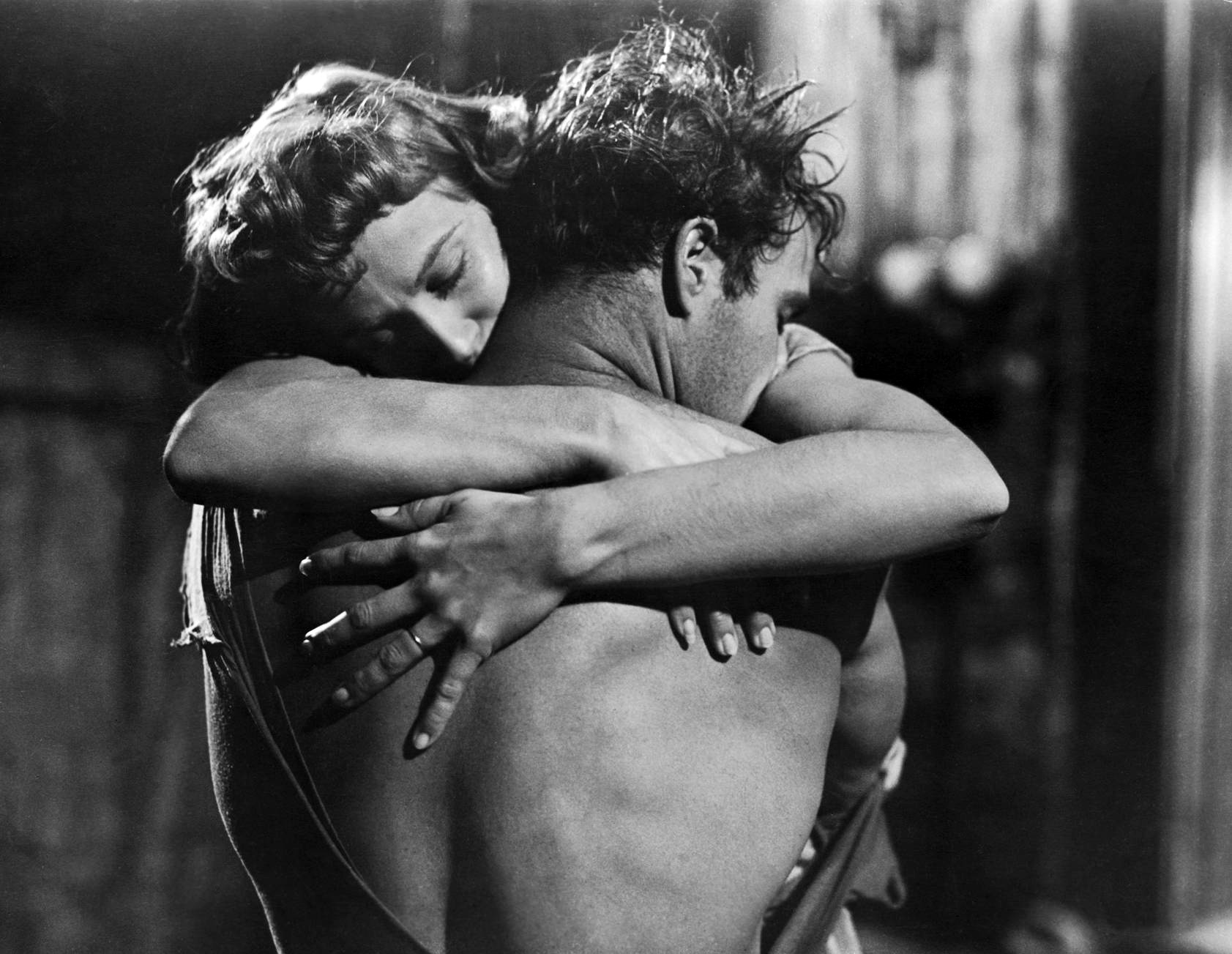
In one of many examples of Streetcar‘s excellent dialogue, Blanche gets up the gumption to comment on Stella’s abusive relationship:
Blanche: You’re married to a madman.
Stella: I wish you’d stop taking it for granted that I’m in something I want to get out of.
Blanche: What you are talking about is desire– just brutal Desire. The name of that rattle-trap streetcar that bangs through the Quarter, up one old narrow street and down another.
Stella: Haven’t you ever ridden on that streetcar?
Blanche: It brought me here. Where I’m not wanted and where I’m ashamed to be.
Stella: Don’t you think your superior attitude is a little out of place?
Blanche: May I speak plainly? If you’ll forgive me, he’s common. He’s like an animal. He has an animal’s habits. There’s even something subhuman about him. Thousands of years have passed him right by, and there he is. Stanley Kowalski, survivor of the Stone Age, bearing the raw meat home from the kill in the jungle. And you– you here waiting for him. Maybe he’ll strike you or maybe grunt and kiss you, that’s if kisses have been discovered yet. His “poker night”, you call it. This party of apes.
Therein lies the central conflict of the movie. Blanche is immune to Stanley’s charms (if they can be called that), and sees him for the brute that he is. On the other hand, Stanley also sees through the carefully-crafted backstory that Blanche has invented for herself. She’s clearly hiding the true reasons she has for being in New Orleans, and he won’t rest until he has brought them into the light. At first, the cracks in her story seem innocent enough, but as time wears on and the threat of discovery looms, Blanche’s neuroses become more and more apparent. Stella, in dismay, finds herself torn between defending her husband’s actions and protecting her sister’s fragile grip on reality.
Again, this is a fantastic movie. The one con for me personally is that it feels very much like a play at times (which I guess it should, because it is), and I’m not always in the mood to watch that type of film. With that said, however, I do revisit this gem every 1-2 years, and it gets me every time. The performances from everyone involved give me chills, but I think my eyeballs would need to be surgically removed from the screen during any scene with Brando. It’s no wonder at all that this became one of the most iconic roles of his career–it’s a truly unforgettable performance.
Tomorrow, Brando trades a T-shirt for a toga in his performance as Mark Antony in Julius Caesar (1953). Be sure to come back for Charles’ review on that one, as well as the rest of our Brando reviews this week at ItsJustAwesome.com!!
The post Day 1: A Streetcar Named Desire (1951) first appeared on It's Just Awesome DOT com.]]>