Warning: Undefined array key 2 in /homepages/22/d426668184/htdocs/clickandbuilds/WordPress/ItsJustAwesomeDOTcom/wp-includes/feed.php on line 486
Warning: Undefined array key 1 in /homepages/22/d426668184/htdocs/clickandbuilds/WordPress/ItsJustAwesomeDOTcom/wp-includes/feed.php on line 496
- La Llorona (1933)
- The Uninvited (1944)
- House on Haunted Hill (1959)
- 13 Ghosts (1960)
- The Innocents (1961)
- The Haunting (1963)
- Burnt Offerings (1976)
- The Amityville Horror (1979)
- The Fog (1980)
- The Changeling (1980)
- The Shining (1980)
- The Evil Dead (1981)
- Ghost Story (1981)
- The Entity (1982)
- Poltergeist (1982)
- Ghostbusters (1984)
- The Sixth Sense (1999)
- House on Haunted Hill (1999)
- What Lies Beneath (2000)
- The Others (2001)
- Thir13en Ghosts (2001)
- The Ring (2002)
- Ju-on: The Grudge (2002)
- 1408 (2007)
- Paranormal Activity (2007)
- Lake Mungo (2008)
- Insidious (2010)
- The Woman in Black (2012)
- The Conjuring (2013)
- Doctor Sleep (2019)
- Host (2020)
Many of you may not know this, but The Visit is an M. Night Shyamalan film. I imagine when I say his name, there’s a good chance you’re rolling your eyes and thinking back on some of his… shall we say… lesser films, but the truth of the matter is that he is a great filmmaker. When you’ve got The Sixth Sense, Unbreakable, and Signs as back-to-back-to-back films you’ve created on your résumé, you’re clearly doing something right. It’s a shame that he’s taken such a beating recently (so much so that Sony buried his name in all the marketing for After Earth), but I believe The Visit (which was created under Blumhouse) is a return to form for him and should hopefully win him back the respect he deserves.
If you read my review for [Rec], you know my contempt for “found footage” movies. I realized after I wrote it that I actually have enjoyed a few, if I’m being completely honest. I think the Paranormal Activity movies have been pretty great, and I even liked V/H/S and Creep, so the genre CAN work on me. And it did for The Visit, as I didn’t find myself annoyed with the gimmicky approach at all and was genuinely creeped out in quite a few scenes.
It’s basically about a brother and sister who go to spend a week with their grandparents. That may sound perfectly normal, but they’ve never actually met their grandparents, so they have no idea what they look like. Years ago, their mother had a falling out with them and she left home, ever looking back. Despite that, everything is good… at first. As the days pass, however, they notice their grandparents doing strange things, especially after 9:30pm each night. Despite multiple warnings about being in bed before that time, the two never are as their curiosity gets the better of them. Eventually, they think their grandparents might even be trying to kill him!! Oh no!!!!!!
What I like most about this movie is how, despite a very straightforward premise where something is obviously wrong, it doesn’t quite play out like you think it should. It also pushes the boundaries of the PG-13 ratings system, and not even with gore, but with disturbing subject matter. I think that has a lot to do with M. Night Shyamalan’s “classic” directing sensibilities (and maybe also because his goriest film to date, The Happening, happened to be one of his worst ones. It is his only R-rated film, too, so I’m sure that factors in). It seems like he has always tried to be this generation’s Hitchcock, especially by doing cameos in his films, but he certainly does know how to ratchet up the suspense in each scene and then let it play out at its own pace. And that definitely works for this movie. It’s a mystery throughout, but some of the creepiest scenes actually happen early on (like the grandmother eerily chasing after them in the crawlspace). By the time all is revealed, it certainly feels earned and isn’t cheap at all (even if my wife and I saw it coming… something our friend Toby did not), and that’s saying a lot for a film these days. I’m actually really excited to see how he will approach Split now.
All of that’s not to say this is a perfect film, however, as there were a few goofy moments here and there (namely the main kid rapping in the film, and then doing an extended rap during the credits), but it can be easily forgiven because the film is so good in other areas. Overall, it just works.
Well, that just about does it for this year’s 31 Days of Horror. We sincerely hope that you’ve enjoyed our picks and have expanded your horror cinema knowledge by watching our overview videos. I know we’ve had a blast!!
So, on behalf of all of us here at It’s Just Awesome DOT com, we’d like to say thanks and… HAPPY HALLOWEEN!!!!!!!!!!
The post Day 31 (Happy Halloween!!): The Visit (2015) first appeared on It's Just Awesome DOT com.]]>I need to point out that I consider Insidious to be one of the scariest movies of this decade so far. I bring that up because it’s also from director James Wan and shares many of the same styles (and even actors) as The Conjuring. Insidious scared the heck out of me when I watched it in theaters and I had a hard time sleeping for days. I really wanted to see The Conjuring in theaters, but I just never got around to it. This was much to the chagrin of my friend Robert because he loves horror films, too, and we share many of the same tastes in movies.
This year, after he remembered that I hadn’t seen it, he decided he’d buy me the blu-ray version of it for my birthday (as well as a few other scary films, including the 3D version of Dial M for Murder) and wanted to watch it with me at my house. This meant that my wife would also be watching it and as you may recall, she HATES scary movies. But she agreed because it was for my birthday.
Now, after having watched it… wow.
Wow!!!!!
But first, a synopsis.
It follows a couple of real life case files from the Warrens, who were actual paranormal investigators in the 1960s and 70s. The first case (and the opening of this film) is the story of a possessed doll named Annabelle. The second case (and main storyline) is about the event that eventually inspired The Amityville Horror. It’s about a family that begins experiencing supernatural occurrences, including strange noises and freaky apparitions, not long after they move into an older house. They hire the Warrens to investigate it and well, to say much more would spoil a lot of the fun. James Wan really understands horror films, and knows that long takes and fluid camera movements can really amp up the suspension, which is then released with a sudden loud noise or movement on screen. These often catch you off guard and make you laugh at yourself for screaming out loud.
This movie is AT LEAST as scary as Insidious, and when you take into account the “inspired by true events” aspect of it, it may, in fact, be the better movie. It’s also a bit leaner and doesn’t have an ending that feels out slightly of left field (as some people felt was the case with Insidious. I disagree with those people, however). Needless to say, I thoroughly enjoyed The Conjuring (and my wife thoroughly hated it, natch). It reminded me a lot of Poltergeist and other haunted house films, too (maybe even The Haunting). It seems very much rooted in a more classic style of filmmaking and that makes it stand out to me. It’s impressive on every level and I loved it. There’s little gore on display here, and that really works for this material. Thanks to my friend Robert for turning me on to this movie. I’ve got to catch up and watch The Conjuring 2 and the spin-off film Annabelle.
Tomorrow, we will close out this whole thing with M. Night Shyamalan’s The Visit!!
The post Day 30: The Conjuring (2013) first appeared on It's Just Awesome DOT com.]]>[Rec] is a Spanish film that was later remade into Quarantine, but they’re both found footage movies and… I don’t like either one of them.
I have to be upfront: I just don’t like found footage movies. The gimmick quickly wears thin and I grow impatient as the filmmakers constantly come up with new excuses for a person to be recording what’s happening instead of just abandoning the camera and running away (like any normal person would do). I also get annoyed at the characters on-screen yelling at the cameraman. That seems to be a huge staple in these kinds of movies, and only exaggerates the generally poor acting that is typical in this genre. It also distracts and reminds you that you’re watching a movie and totally takes you out of the moment. [Rec] is certainly no different, and when I heard, “GET THAT CAMERA OUT OF HERE,” about the 100th time, I wanted to throw my remote at the screen. And that’s not even counting all of the ways they have to cheat the footage to provide cuts, because, after all, they’re not actually going to do any of this in real time despite what the commercials say. Oh? What’s that? A character in [Rec] wants to check out the footage we just watched so we’re literally going to see it being rewound and then played again? Awesome. You know, for a movie that’s not even an hour and half, that feels like a great way to pad the time (while wasting more of mine).
Even La casa muda, while not a found footage movie, used digital techniques to hide their cuts so that the movie appeared as one long shot. It’s similar to what Hitchcock did practically in Rope, so it can be done, and I think these movies would work so much better if they did. I mean, I guess they could always do it for real but then it might turn out as boring as Russian Ark, so maybe that’s not such a great idea, either.
Then there’s the cinephile in me who wants the cinematography to serve the story in a meaningful way, with a variety of beautiful shots instead of this nausea inducing, shaky-cam garbage. I get it. It makes it seem real and raw and in your face. But it’s a freakin’ movie!! We know it’s fake and you don’t have to give us all motion sickness just because you’re trying to (over)act like it’s not. I didn’t like it in Cloverfield or The Blair Witch Project and I don’t like it in this movie. If you read my review for 28 Days Later, then you know my disdain for crappy, digital video. Think of how beautiful and atmospheric this movie could have been with the right cinematography.
The basic plot of [Rec] is that a television reporter is doing an extended report on firefighters and tags along with them on a call to a local apartment building. It’s not long after they arrive that the whole place is quarantined by a government agency and they’re all trapped inside as a zombie-like apocalypse begins to happen, with any dead residents coming back to life and attacking the living. Yes, it’s a found footage zombie movie (or is it a found footage movie about demonic possession? I’m not sure). And yes, it is claustrophobic and frightening in key places. Admittedly, this could be due (at least in part) to the found footage approach, but again, it wears out its welcome and is much more of a con than a pro.
But [Rec] is also an extremely slow-burner of a film, with nothing really happening in the first hour, and then everything sort of crammed in the finale. I did enjoy the night vision during this end sequence, and it did remind me a lot of the similar scene in The Silence of the Lambs, but not nearly enough to make me enjoy the movie. I’d say avoid this one and its many sequels (as well as Quarantine and its many sequels). But if you must watch this movie, please, please, please don’t watch the English dubbed version. It makes the gimmick even worse because the voices don’t match the characters at all and it comes across as horrendously bad (and laughable) due to the huge disconnect.
Tomorrow, Kelley will be back with Hammer Films’ The Woman in Black as we start our last decade of this year’s 31 Days of Horror!!
The post Day 28: [Rec] (2007) first appeared on It's Just Awesome DOT com.]]>It’s not exactly accurate to call this a “zombie” movie, as many of the usual tropes aren’t on display here. Instead, there’s an Ebola-like disease called Rage that infects people and causes them to be much more aggressive and animalistic than they would otherwise be, granting them what appears to be superhuman speed and agility (I wonder if this movie started the whole “fast” zombie thing?) But then again, there’s obviously many zombie elements on display here, especially what happens if one of these Rage fueled people bite you.
The movie starts out as an animal activist group breaks in a laboratory with the intent to release caged lab monkeys. One of the workers there pleads for this not to happen because, according to him, the monkeys have been infected (most likely through various lab tests and studies) and doing so will cause a massive epidemic. The group doesn’t listen, and one is immediately killed in an attack. Flash forward 28 days later, and Jim (played by Cillian Murphy) wakes up all alone in a hospital, extremely confused (I’m not sure if The Walking Dead was inspired by this or not). As he leaves the empty hospital, he discovers that all of London is completely deserted. When he finally discovers people in a church, he’s surprised to discover that they’re all infected, and they all seemingly want to kill him. Even a priest tries to attack him!
As Jim tries to outrun these red-eyed crazy people, he is suddenly aided by Selena (Naomie Harris) and Mark (Noah Huntley). They help him out and bring him up to speed, though details are sketchy. It seems no one knows the true scope of the virus just yet, and whether or not it’s contained just to England or if it has spread to America. This is their new bleak world, where surviving is all you can do and happiness is a luxury they no longer have. Eventually, they run into Frank (Brendan Gleeson) and his daughter Hannah (Megan Burns) and form a family of sorts. When they hear a broadcast, sent from what is apparently a safe haven, they decide to make their way to it, hoping against hope things will be different once they get there.
There are a lot of things I like about this movie. The acting is solid all around, and I really love the idea of a social rage as the culprit rather than just some generic explanation we usually get in zombie movies. It’s more realistic and really works overall. But my favorite part, by far, is the opening scenes in an abandoned London. It’s haunting and really separates this film from nearly all others. It’s not an effect either; they legitimately closed off sections of London to film their scenes. It’s quite remarkable.
What’s not so remarkable, and something I have never understood, is the way this movie was shot, which was on inexpensive, prosumer digital cameras (mainly the Canon XL-1, I believe). Now, digital video has come a LONG way since 2002 and in many cases, can be nearly identical to film, but here, it was still new technology and is extremely distracting. These are standard definition cameras, with a low dynamic range, and it’s just an awful mess visually. If Danny Boyle wanted more realism, he could have gone the route of Michael Mann in Public Enemies and made the sound design be awful as well. Again, I think Public Enemies is a terrible, terrible movies but at least it sucks consistently on video and audio. Here, Boyle still uses professional audio equipment, coupled with all kinds of expensive gear to physically move the cameras, so he didn’t really stay true to a documentary type feel, if that’s even what he was going for. Essentially, it sounds like a big budget movie and has some professional camera tricks, but is marred by horrendous imagery and low resolution, muddy textures. It adds nothing to the movie for me what-so-ever and was especially problematic when I saw it in theaters because blown-up, it looks even worse. The style basically dates this movie to a time before inexpensive HD cameras were a thing, let alone something we carry around in our pockets. The sequel, 28 Weeks Later, was shot on 16mm and looks 1000x better, while still maintaining a gritty, raw texture so it could have worked here as well. In fact, imagine if those empty streets of London had been captured on 16mm, or Heaven forbid, 35mm. I think we’d have been talking about the Oscar winning cinematography at that point.
Still, the bleak tone of the film works quite well, and the imagery of London is impressive, so I’d say check it out for those reasons alone. Just don’t say I didn’t warn you about the look of it.
Tomorrow, I pass it back to Kelley as she reviews The Grudge (which is the American remake of Ju-on: The Grudge)!!
The post Day 26: 28 Days Later (2002) first appeared on It's Just Awesome DOT com.]]>Today we’re talking about Ringu, which is the Japanese movie that was remade into The Ring. These films have nearly identical plot points and key scenes, but this is the rare occasion where I actually STRONGLY prefer the remake, and it’s mostly due to the small changes made, as well as a key few differences in style. As such, I’ll be (sort of) reviewing them together.
Both movies are about a mysterious VHS tape that contains a creepy, surreal video of unknown origins. The story goes that if you watch it, you will get a phone call telling you that you have 7 days to live. And it appears that the people who have received that call actually do die a week later in horrific, unexplainable ways. A reporter investigating the story watches the tape for herself, and then brings along her ex-husband to help her solve the mystery of it before her time runs out.
Maybe that doesn’t sound all that scary to you, but here’s that video from Ringu (and The Ring’s version as well, just for comparison):
To this day, I still feel guilty showing people that video. I feel like I’m sentencing them to their death or something.
Anyway, I should tell you right off the bat that the American version scared the crap out of me the first time I watched it (which, by the way, was long before I saw the Japanese one). My friends knew I was particularly freaked out, and so waited until the middle of the night to call me and say, “7 DAYS!!” when I answered groggily. Needless to say, I couldn’t sleep much that night and actually turned my tube T.V. away from me. True story. Pathetic, but true.
I digress (I do that a lot). Where was I?
Oh, yeah.
I love both movies for the mystery that unravels as you watch them. They’re both great detective stories that happens to feature terrifying images, but still a mystery at their core none-the-less. And they both do a great job of keep you on the edge of your seat with constant reminders of what day it is and how long the characters have to live. What I happen to like more about the American version is that they don’t shy away from showing what happens after those 7 days are up. The Japanese version more or less goes black-and-white and freeze frames during these supernatural moments, but the American shows you so much more. It’s a much better effect, and has a lasting impact.
I also strongly prefer the ferry scene in the American one, where we see a horse jump off the ferry and turn the waters red. I can’t get that image out of my head nearly 15 years later, and probably never will.
And finally, the differences in the characters bugs me. In Ringu, it seems both main characters can read the thoughts of others and see into their past. It’s not really explained too terribly well, and seems like a gimmicky, cheap way to throw in some exposition via flashbacks. The Ring doesn’t even have a hint of that and is all the better for it. I also don’t understand the characters’ reactions in Ringu when they’re in the well at the end, because neither one of them seem too terribly frightened or grossed out to be in the murky water with a corpse; in fact, it’s downright cheesy in this scene when the corpse is finally found.
So, honestly, for all of these reasons, I would say skip Ringu and go straight for The Ring. It’s one of the best horror films ever made, even if the technology in it is dated (I seriously don’t know anyone that owns a VCR anymore). Also, stay away from The Ring Two (which, interestingly enough, was directed by Ringu’s director, Hideo Nakata).
Oh, and there’s a new Ring movie coming out next year that looks pretty scary, too.
Tomorrow is Day 26, and I’ll be back with 28 Days Later. Hope to see you soon!!
The post Day 25: Ringu (1998) first appeared on It's Just Awesome DOT com.]]>We haven’t been using movie posters as the title graphic for our reviews, but this one was too amazingly awful to ignore. Does that strike you more as a horror film or a softcore porno you might catch late night on Cinemax? What are they marketing here exactly?!
“Love brought out the animal in her.”
Where to even begin??
You know, I was discussing this movie with Kelley, and I couldn’t quite figure out what I would say about it. She, of course, quickly realized that everything I was telling her sounded like an “ugly” movie. If you listen to our podcast, then you know an “ugly” movie often defies logic and is usually so bad it’s good, and this movie certainly qualifies. Damning praise, to be sure, but accurate none-the-less.
Let me back up a bit and give a synopsis taken directly from IMDB: “A young woman’s sexual awakening brings horror when she discovers her urges transform her into a monstrous black leopard.”
Much like the 1942 original, the plot does indeed revolve around a young woman named Irene who is worried that having sex will turn her into a leopard, but that’s about where the similarities end. The Irene from 1942 doesn’t want this to happen and is startled by it and how she might harm others. Irene from 1982 doesn’t seem all that concerned with it, seemingly aroused by the thought of it (despite being a virgin).
Early on, when she reconnects with her long lost brother (who also has this ability), he tries to sleep with her (telling her it’s the only cure) but instead settles on a local prostitute, who he promptly kills. This sets up the film’s basic rule that sex will transform you in a big cat.
So, this is essentially a werecat movie, according to my lovely wife, but with sex instead of a full moon.
Anyway, he’s captured (as a leopard) and gone for days and days, but Irene doesn’t seem all that concerned with this either. She never wonders where he went… which is curious since, you know, she’s living with him. But, apparently, once you become a leopard, you must kill again to become human, though you are still fully in control no matter which body you happen to be using. You are well aware of your actions.
So, these are the rules that are established, but they’re seemingly not enforced at all because Irene is able to become a leopard and stalk Alice and then transform back into a human before she has sex with anyone, so who knows? I’m very confused about the whole matter and it totally complicates the ending (which I won’t spoil), but I guess they can transform just by being horny??
By the way, that stalking scene is one of the few sequences that is directly inspired by the original. The 1942 version created a new kind of “jump scare”, where a loud, innocuous sound catches you off guard because of the suspense that led up to it. It’s actually a bus that makes the sound in the original, and this horror technique has since become known as the “Lewton Bus,” named after the film’s producer, Val Lewton.
This newer version, though, decides to have Alice go for a naked swim to throw in a little gratuitous nudity. Why not, right?
And speaking of nudity (how often do I get to say that?), Irene seems to spend the second half of the movie in an almost constant state of undress. Like I said, she doesn’t seem too concerned with the violent consequences of having sex, so it seems to change the message and tone of the original quite a bit. Maybe that works for you, but it doesn’t really for me. The film is beautifully shot, though, and there are some really intriguing moments, but it’s so corny and ridiculous and over-the-top that it’s hard to take seriously. That’s why I’m all over the place on this review.
But the one area I’m sure on is the ending. As I also mentioned, it doesn’t really gel with the rules laid out, but I find it awful for an entirely different reason. Much like the film’s poster, the cheese factor is incredibly high. David Bowie (!!) provides the film’s closing credit song, but the absurdly long freeze frame of the leopard that then roars just as Bowie yells “GASOLINE!!!!!” made me laugh out loud. It’s perhaps the film’s finest moment.
https://youtu.be/pBkmPZWH4KA?t=50s
Kelley will be reviewing David Cronenberg’s remake of The Fly tomorrow for Day 22, which is also the last 1980s movie on our list this year, so take a moment to be sad about that, and then come back by and check it out!!
The post Day 21: Cat People (1982) first appeared on It's Just Awesome DOT com.]]>Now, I suspect many of you aren’t familiar with the “Giallo” style. To be honest, I wasn’t either. But it seemed that everytime I began doing serious research into horror film history, certain movies kept popping up again and again. Suspiria is one of those films, as well as Blood and Black Lace and Deep Red.
And they’re all attributed to this Italian “Giallo” genre.
So, what were these films from Italy? And why are they constantly cited?
Well, “giallo” means “yellow” in Italian, and it refers to the color of the cover of certain crime / mystery paperback novels in Italy. These novels often shared many similar elements with these “giallo” movies, including masked killers and a certain amount of eroticism, even if the stories weren’t directly adapted into the movies. The movies themselves were usually quite gory, or at least shockingly violent, and they had a really beautiful cinematic style which included bold color palettes and creative camerawork. The music often felt disorientating because it was often juxtaposed with what was occurring on screen, meaning it might have had happy or cheerful music playing while someone was being stabbed to death. But they almost always had a mysterious killer attacking people one-by-one, and it was often women that were being attacked while particularly vulnerable (nude, for example). If that sounds familiar, it’s because these movies heavily inspired the American “slasher” film genre, in particular films like Halloween and Friday the 13th.
The plot for Deep Red falls right in line with “Giallo” films. An English musician in Italy witnesses the gruesome murder pf a clairvoyant woman (who previously had visions of the murderer) one night while he’s out with his friend. He teams up with a reporter to try and figure out who the killer is, and in doing so, the killer begins to go after both of them, while also continuing on a murder spree. Where will this murderer strike next? And can anything be done before it’s too late?
I have to say, I REALLY enjoyed this movie.
My wife and I watched it with our friend Toby, and shortly into the movie, he proclaimed it was literally one of the worst movies he’s ever seen (in his best Chris Traeger impression, no less).
Granted, it does take a while to get into it, and the music is very odd (even if it is popular) but I flat-out disagree with him.
There are moments of pure brilliance here, including some fantastic camera movements. For instance, in one particularly wide shot, we are watching a couple discuss details of a murder that had just occurred in the house they’re in. It’s all in one long take, and at the conclusion of the conversation, the lady, who is at the end of the hallway, looks up in our direction right at the camera. The camera quickly moves to the left to duck out of her view, and at that moment we realize that we have been staring through the eyes of (presumably) the killer the entire conversation. It literally gives me chills just thinking about it.
Another moment like that? When a man is playing piano at home by himself and hears someone in the other room. As he knows the killer has been after him, he continues to play while also quietly reaching for an object to hopefully defend himself. The phone suddenly goes off and he rushes to the bedroom door to slam it shut. Just as he does so, he hears the killer whispering to him from the other room that he’ll kill him another time. Eeeesh!!!
I also love that the movie messes with us. It’s revealed in a flashback that the movie actually showed us who the killer was immediately after the first murder. Since this whole thing plays out like a whodunnit (complete with a twist ending), having seen the killer’s face that early would have instantly given it away, but somehow, this movie did just that and we were none-the-wiser. I even watched it again to see if it was lying to us during that flashback, but sure enough, the killer is actually revealed and quite clearly, too. That’s confident filmmaking at its finest.
Then there’s the whole aspect of the mechanical doll that is used as a distraction. It is very clearly the inspiration for the similar device in Saw and it was amazing to see it here, nearly 30 years earlier.

So, absolutely check out this movie as well as the other “Giallo” films. They’re worth your time, especially if you already enjoy slasher movies.
On a complete side note: Why do the background extras stand perfectly still in certain scenes during Deep Red? Is there any significance to that? Because it can be quite distracting at times (and is another reason Toby didn’t like this movie). There’s even a bar in the background of one shot that resembles that Nighthawks painting by Edward Hopper… and again, the extras are all completely and eerily frozen.

Tomorrow, Kelley will be reviewing Ridley Scott’s Alien so you’ll want to be here for that as she closes out the 1970s!!
The post Day 17: Deep Red (1975) first appeared on It's Just Awesome DOT com.]]>If you’re a listener of our podcast, then you’ll recall we’ve done an episode over Bette Davis (who is the star of this movie) and an episode over Hag Horror (which is the genre of this movie). Both of those episodes were picked by Kelley, so she’s clearly a fan. She also didn’t pick this movie as her “good” choice for that Hag Horror episode; instead, she chose What Ever Happened to Baby Jane?, which is quite surprising to me because Hush…Hush, Sweet Charlotte is far and away the better film, even if the two are very, very similar.
Oddly enough, though, Kelley wasn’t the one who added this movie to our list this year. I was, and I didn’t include it to appease or amuse Kelley, either. I added it because years ago, my good friend Buzz tried to get me and my wife to watch it as his house late one night. Having never heard of it, I was skeptical but I will pretty much watch any movie anytime, so I agreed. After the opening scene, which is quite shocking and horrific, I was hooked. My wife, however, is not a night person, and neither is Buzz, so both fell asleep not too far into the movie. I decided I would try and finish it with them later, only later never really happened. Every time it seems we’re actually going to meet up to watch it, we end up doing something else or we get sidetracked or life happens or whatever. But I take 31 Days of Horror seriously, and I knew if it was on the list, I would watch it no-matter-what, even if that meant without Buzz, and unfortunately, that’s exactly what it meant. I suppose it just wasn’t meant to be, but I still owe it to him for turning me on to this film (and I suppose for having good taste in movies in general), but I digress.
The plot revolves around a man named John who is cheating on his wife with Charlotte in 1927 Louisiana. The two plan to elope after a lavish party, but when Charlotte’s father gets wind of their plan, he is furious and privately tells John he must call it off. John reluctantly does so, and Charlotte does not take it well. The next thing he knows, he’s being attacked with a butcher knife and loses a hand… as well as his head (this is that shocking thing I mentioned earlier). Charlotte returns to the party all covered in blood, and the people there freak out, naturally. Flash forward to 1964, and the tale has become somewhat of an urban legend. Charlotte nows lives alone as a recluse at her father’s house (where the murder occurred) and except for her housekeeper Velma, she hardly ever sees anyone. Complications arise because it seems there’s a road that needs to be built where the house stands, and she apparently has no say in the matter. The whole place will be torn down, forcing her to find somewhere else to live and start fresh, though that is the exact opposite of what she wants… mostly because she has never recovered from that horrible night. And when her cousin Miriam shows up to help with the whole situation, Charlotte begins to lose touch with reality, seeing strange visions around the house.
That may not sound much like What Ever Happened to Baby Jane, but the two movies both revolve around a horrific accident that took places years earlier, leaving the title character (played by Bette Davis in both films) isolated and insane in her father’s house. They both involve a housekeeper who learns too much and eventually pays the price for it. They both play out as sort of a whodunnit with a twist ending that changes our perception of said title character. And they both nearly starred Bette Davis and Joan Crawford; in fact, Joan Crawford was originally cast to play the part of Miriam, and even shot several scenes, but for various reasons (including an illness), she was replaced with Olivia de Havilland.
I think this movie works better because Bette Davis’ Charlotte character is much more sympathetic than her character of Jane in Baby Jane, where she essentially played the villain. She may be crazy, but we in the audience knowd where she’s coming from and can feel her pain. She lost the love of her life and we’re able to go along with her spooky visions of him because we understand her sorrow. I really enjoyed her performance overall and don’t feel like she hit a wrong note, which is quite an accomplishment considering all of the crazy things going on.

Also, I think the effects are quite good, and seeing a severed hand on the floor, and a decapitated head rolling down the stairs, really caught me off guard. The film opens on that murder sequence and is able to maintain its creepiness throughout.
The one thing I did not like was Agnes Moorehead as her housekeeper. I think she’s way too over-the-top to be taken seriously, especially with her put on New Orleans accent. I may be in the minority, though, because she was nominated for an Academy Award for this!! It reminds of me of Anne Ramsey being nominated for Throw Momma from the Train. Both terrible performances that were somehow praised at the time. I suppose I’ll never understand.

For tomorrow, Kelley will close out the 1960s with her review of Roman Polanski’s Repulsion!!
The post Day 14: Hush…Hush, Sweet Charlotte (1964) first appeared on It's Just Awesome DOT com.]]>Godzilla has remained popular throughout the years, what with the recent Gareth Edwards version and the new Shin Godzilla, so it’s hard to imagine that there’s many of you out there that don’t know the plot, but here’s a synopsis anyway: A Japanese ship suddenly goes missing, and then another one as well. Japanese Authorities are baffled until they realize that the ships are actually being destroyed by a giant radioactive dinosaur from the Jurassic Period who has been brought to life by atomic bomb testing. This dinosaur, Gojira / Godzilla (which, I guess, are used interchangeably??), soon begins to wreak havoc on Japan, and the military struggles to come up with a solution.
Professor Yamane wants to take a more scientific approach and observe Godzilla instead of killing him. He wants to learn everything about this creature (especially the radioactive bit) even at the expense of many more people dying. Meanwhile, Navy man Hideto Ogato thinks they should defeat Godzilla by any means necessary. He also wants to marry Yamane’s daughter, Emiko, but when he begins to bring it up with Yamane, the two get in a huge argument and nothing is resolved. The whole situation looks hopeless, and after a few different attempts by the military to destroy him, it seems Godzilla is unstoppable. It turns out, however, that Dr. Serizawa (with whom Emiko is betrothed) actually has an experimental device that could eliminate Godzilla once-and-for-all, but he doesn’t want to use it for fear that it would be used to harm people after Godzilla is defeated.
This is the part of the movie that intrigued me the most. Take a step back for a second, and look at what Godzilla represents: The consequences of nuclear fallout in a country that, less than a decade earlier, had seen first hand just what an atomic bomb could do. Dr. Serizawa’s reluctance to use a weapon, even to save his own country, arguably sounds like a critique of the United States (specifically President Harry Truman) and it raises the question: Does the end ever justify the means? Ultimately, in this movie, Serizawa figures out a way to defeat Godzilla and keep others from using his weapon again by sacrificing himself, but that also has strong implications and raises some other questions (Namely: Why couldn’t his device be remotely detonated??). Professor Yamane even gives a speech about it in the closing lines of the film, ominously warning about using atomic bombs to create other Godzilla monsters. It’s brilliantly intriguing and philosophical at the same time without really offering up a good answer. Maybe there isn’t one?
And this is all why I think believe Gojira is a better film than the American version. That movie stripped away most of the atomic bomb implications and focused more on the monster / creature feature aspects. It also dubbed over many of the original Japanese actors, but very inconsistently because sometimes they’re dubbed in English and sometimes they’re subtitled while speaking Japanese. It’s a strange blend. So, I would skip that one (assuming you haven’t already seen it) and seek this one out. It’s a gem of a movie with a message that still resonates today.
It’s Day 12 tomorrow and Kelley will be reviewing Tarantula, so be sure to come back and check it out!!
The post Day 11: Gojira (1954) first appeared on It's Just Awesome DOT com.]]>I’m sure it would pain Mark to know this, but I must confess that I have never read the book by Oscar Wilde.
I’m sure it would also pain Kelley to know this, but I must confess that I have never seen any cinematic adaptation of it, of which there have been quite a few.
Now, that doesn’t mean I’m completely ignorant of the subject. This particular piece of literature has become so ingrained in pop culture that it was even used a punch line to insult Meg on Family Guy (When she asks how she looks in her new glasses, Stewie tells her, “In an attic somewhere, there’s a portrait of you getting prettier.”) but it does mean that right upfront, you should know that I have no idea this version compares to the book or if it’s better or worse than other Dorian Gray movie, but having said all of that, I loved this movie. That’s all longwinded to be sure, but yes, I really did love this movie.
So, for those that don’t know the plot, it is set in London during the late 1800s, and is about a young man named Dorian Gray (played by Hurd Hatfield) who is having his portrait done. He muses that he wishes his portrait could age instead of him, and thanks to an Egyptian cat sculpture, Gray’s wish comes true. But this is a horror film, after all, so there has to be a catch, right? Of course there does!! And this particular catch is that Gray’s inner ugliness will be exposed through the portrait itself, as the portrait changes over time instead of Gray, who completely stops aging. Those around him find this disconcerting to say the least, and it ultimately isolates him and drives him mad.
Lord Henry Wotton (George Sanders, who I always best remember as the voice of Shere Kahn in The Jungle Book) plays a sort of devilish character who talks Gray into living life to the fullest and giving in to his wildest dreams and desires. It’s through Lord Wotton’s advice that Gray passes on the opportunity to be with Sibyl Vane (a VERY young Angela Lansbury), a singer that he falls in love with early on. His rejection causes her to commit suicide, and this is the point of no return for Mr. Gray. After that, it’s vague as to what exactly he does that is so horrible in his life (aside from the onscreen murder, of course), but I rather like that aspect of the story. It’s almost a mirror to the audience, asking us to imagine our worst qualities and our worst actions and what it would be like to have a painting displaying them for all the world to see. Perhaps you’d cover it up just as he does, but would that ever be enough? It still exists. The psychosis on display feels gradual and thus, natural. It’s handled extremely well.
I also particularly love the cinematography of this film. It’s a black and white film, but a select few shots of the portrait are in full technicolor and they are GORGEOUS!! They’re also extremely jarring, which is perfect for a horror movie, and can be used to shocking effect in what otherwise might have fallen flat. It also helps that the portrait itself is growing more and more hideous each time it is revealed.
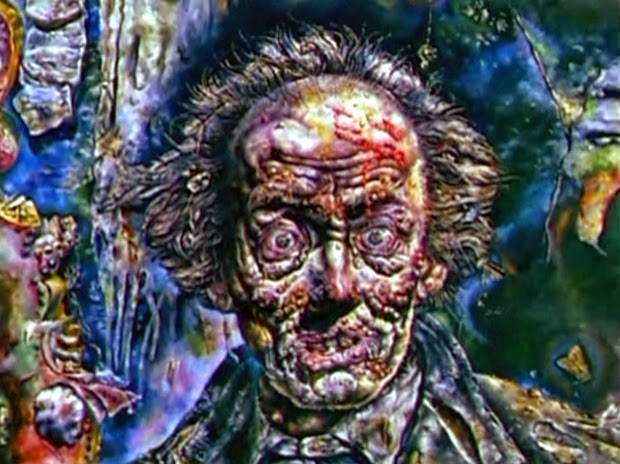
But more than just the few color inserts, I enjoyed the stylized cinematography during the first murder scene, with the hanging light swinging violently, creating intense chaos in a dance of light and shadows on the walls. It’s beautiful and creepy and I love it.
And that encapsulates my feelings about this movie. If you haven’t seen it, go check it out!!
So I’m closing out the 1940s, but for Day 10 tomorrow, Kelley will be reviewing the 1953 movie It Came from Outer Space, so come on by and check it out!!
The post Day 9: The Picture of Dorian Gray (1945) first appeared on It's Just Awesome DOT com.]]>I have to admit: Outside of that Warren Zevon song, I had never heard of Werewolf of London and had absolutely no idea there was any other werewolf film in Universal’s classic monster movies, outside of The Wolf Man series. That franchise (especially the first one) is so iconic, and casts such a long shadow over every other werewolf movie ever made, that is it almost unfathomable to even consider that Werewolf of London came first (and by half a decade at that!). It’s a shame, really, because this movie actually created many of the tropes that we now associate with werewolves, including the association with the full moon and being infected from a bite. This film even had the same makeup artist (Jack Pierce) work on both films, although he didn’t quite get to create the makeup he wanted to use for this one, so the two movies don’t actually look all that similar in that regard.
Nor is the plot all that similar either.
In this movie, Botanist Dr. Wilfred Glendon is in Tibet searching for a rare flower. Just as he discovers it, however, he is suddenly attacked and bitten by a werewolf who had been watching him from afar. Dr. Glendon is able to make it back to London where he attempts to do research on the flower (although to what end, I’m not entirely sure), but is having trouble getting it to bloom in his lab. He is soon visited by Dr. Yogami, who tells him that the flower is the only thing that can cure him of his “Lycanthropy” that was passed on to him when he was bit. But he must take it before the next full moon or there will be blood on his hands. It seems Dr. Yogami personally knows a great deal about this subject, but Dr. Glendon blows him off anyway.
Sure enough, on the next full moon, he turns into a werewolf (in a very effective transformation sequence that surprisingly rivals that of anything in The Wolf Man), and goes on a murderous spree in London.
If I’m being honest, I don’t actually love this movie, and it all has to do with Henry’s Hull portrayal of Dr. Glendon. He’s a jerk, through-and-through, and he’s far too obsessed with his work, and far too jealous of his wife and her ex-lover. Lon Chaney Jr. really sold the tortured aspect of his character in Wolf Man, which in turn made his character sympathetic. You got the sense that he couldn’t control what he was doing, and that he also didn’t want to hurt anyone. That’s not really the case here. In fact, it’s outright shown that Dr. Glendon is still somewhat human because even after he’s transformed into a werewolf, he takes time to put on a coat before he steps outside. I thought it was a goofy touch and totally counterintuitive to the dire circumstances that Dr. Yogami spoke of previously. This does, however, seem to suggest that being a werewolf in this film is more an expression of your inner demons and desires rather than a physical transformation into a completely different, out-of-control animal. Dr. Glendon is in control and yet wants to go attack specific people. It’s an interesting concept that I don’t think is fully explored.
And then there are the two older women who rent him a room while he lays low. I don’t understand why this zany type of humor is needed at all, but it reminds me an awful lot of Una O’Connor’s character in both The Invisible Man and Bride of Frankenstein. Over-the-top doesn’t even begin to describe it, and like her, the two women here nearly ruin the entire movie for me every time they’re onscreen (which is way more than they should be anyway).
I should point out that I don’t love The Wolf Man, either, but I think the reason it’s remembered more clearly is because it’s, by almost all accounts, a better movie. Still, Werewolf of London has contributed significantly to werewolf mythology and that alone makes it a worthwhile film to check out.
For Day 7 tomorrow, Kelley will kick off the 1940s by reviewing Dr. Jekyll and Mr. Hyde, so be sure and check that out as we continue 31 Days of Horror!!
The post Day 6: Werewolf of London (1935) first appeared on It's Just Awesome DOT com.]]>It’s an interesting movie because it’s sort of an enigma by seemingly being all things at once. It’s a documentary and history lesson about witchcraft but it’s also a fictional horror narrative with “reenactments” of the torture methods used on those found guilty of being witches. It’s both very tame and approachable, yet it also could never have been released in the US at the time it was made due to the sexuality, violence and nudity on display (even in Sweden, where it was made, film censors forced numerous cuts to it). It’s a critique of religion and the role it played in torturing innocent people, yet it seems to suggest that witches and demonic possessions are real. And it all feels outdated and yet ultra-modern at the same time.
So, how can a movie from 1922 be so many things at once? And is it any good?
I’ll answer the last part first: Yes, it is quite good, although it’s not particularly scary. And the pacing feels plodding, especially in the first chapter (yes, there are actual chapters in the film, with 7 in total) where we learn about the history of witches through a book on screen. And yes, that is intended to sound every bit as dull as I can make it. Being a silent film, the way we are told about this book is through titles on screen that seem to stay on FOREVER.
Eventually, it moves into the reenactment part and this is where the movie really comes to life. Christensen himself actually plays the devil in these scenes where witches dance around a campfire with demons, and must kiss the devil’s butt (literally). The makeup, lighting and effects are simply INCREDIBLE and light years ahead of anything made in the same time frame. The visuals alone make this a classic, as far as I’m concerned, and one of my favorites is of several witches flying across a nighttime sky.

Later, as we see religious officials putting witches on trial, the film shifts and begins to become more of a behind the scenes documentary, even showing some of the actor’s testing the torture devices out of curiosity. It’s the breaking of that fourth wall that felt unique to me, even nearly 100 years later. Christensen lets us know that we are watching a movie, even going so far as to point out objects with a pencil on screen. This technique is how I believe he was able to make such a strange movie that still works today, and on many different levels.
The more modern stuff (well, modern for 1922) feels a little flat, but it examines modern medicine and psychiatry and brings into question whether or not demonic possession is real, and whether that could account for some of our strange behavior now-a-days. Again, while interesting, it doesn’t quite have the impact that it should, and seems a bit disjointed from the rest of the film. Still, it’s all worth your time to at least check it out. I read somewhere that the film is public domain, so I’m sure you can find it on YouTube (legally).
Tomorrow, Kelley will be reviewing The Monster starring Lon Chaney, so be sure and check that out as we move through our 31 Days of Horror!!
The post Day 1: Häxan (1922) first appeared on It's Just Awesome DOT com.]]>Same rules as the previous years: Classics mixed with lesser known films that are all organized chronologically by their release date beginning with the 1920s. Some of them I’ve seen and some of them I haven’t. Also, no film from the previous lists will be on here (2013, 2014, and 2015 for those interested in catching up), and IMDB must classify the movie as “horror” for it to qualify (so, unfortunately that still means no Jaws or Silence of the Lambs).
This year, as I said, I am mixing it up a bit. For starters, Kelley is joining me and that’s a big deal because she really doesn’t like scary movies at all… so it will be interesting hearing her perspective on the ones she is reviewing. Also, we are making introduction videos for each decade that will serve as an overview of that decade’s horror movies and themes and we’ll be posting them both on the site and on social media. They’ve been fun making them and we really hope you enjoy them. These videos influenced our decision to spread the films a bit more evenly this year, so there will be at least THREE films from each decade.
So, having said all that… ready to begin? Be sure to check back each night in October to read our reviews!!
If you’d like to follow along, this is the list (which we will begin on October 1st):