
Welcome back for Day 4 of our Marlon Brando spotlight series! Today we’ll be talking about one of my favorite movies, the film that earned Brando his first Oscar win: Elia Kazan’s On the Waterfront (1954).
I waxed on about the merits of A Streetcar Named Desire in Day 1 (another Kazan/Brando pairing–clearly they knew how to complement each other’s strengths) and Waterfront is just as good, albeit for different reasons.
In a role completely different from the hot-headed Stanley Kowalski, Brando’s Terry Malloy is quiet, introspective, and only fights when he’s pushed to his limits. Malloy is a former boxer, and was largely “sponsored” in his short career by the shady dealings of his older brother, Charlie The Gent, and the corrupt boss of the dock-worker’s union (laughably nicknamed Johnny Friendly). Charlie is Friendly’s right-hand man, and together the duo controls the cash flow of imports/exports along the waterfront. As the story unfolds, we learn that Malloy’s boxing career was incredibly promising until Charlie and Friendly started paying him to take dives in his fights. Friendly’s greed is limitless, and unfortunately, what Friendly wants, Friendly gets. You’ve all probably heard some portion of Brando’s “I coulda had class, I coulda been a contender!” speech (*chills*), chastising Charlie for choosing Friendly over family. As a result of the mob’s betting, Malloy’s rising talent is wasted and he resigns himself to working on the waterfront as a longshoreman: bitter and alone.
Despite his own personal misgivings, Malloy can’t seem to shake the influence of Friendly and the mob. They essentially run the town, and particularly with his brother’s lofty position in the ranks, Malloy remains a reluctant participant in their schemes. To that effect, the film opens with Malloy unwittingly leading a young longshoreman, Joey, to his death at the hands of Friendly’s flunkies. He thinks they merely plan to rough Joey up a bit (to keep him from testifying to the group’s unsavory activities in court), but much to his horror, Joey is pushed from the rooftop in cold blood.
While he’s still processing his own role in the murder, Malloy meets Joey’s sister, Edie (played touchingly by Eva Marie-Saint). This is a turning point for him, and while the “I coulda been a contender!” speech is indeed fantastic, I think the best part of the movie for me is the burgeoning on-screen relationship between Brando and Saint. One of my favorite classic movie bloggers, Anne Helen Petersen, perfectly describes the change that comes over Edie during the course of the movie: “A woman made of Catholicism, shrillness, pointy edges, and buttoned up jackets becomes sexy before our eyes. Part of the transformation can be credited to good directing, lighting, costuming, etc., but as Brando falls in love with her, the way he looks at her — all lusty with those eyelids that fold over on themselves — somehow becomes the way we look at her.” It’s SO true, and you can see a glimpse of the transformation in the clip below:
Brando’s friendship and tender attentions soften her, and while they don’t diminish her thirst for justice on her brother’s behalf, they do open her eyes to the fact that situations in life are rarely black and white.
With the help of Edie and a local priest named Father Barry (Karl Malden, who also co-starred with Brando in Streetcar), Malloy finally gathers the grit and the courage he’s needed to take on Friendly’s organization. He knows the cost of such an action, but he’s come too far to turn back now–redemption awaits by doing the right thing.
The final scene of this movie is one of the most powerful in all of cinema, and makes On the Waterfront a must-see classic (along with, you know, all the other amazing things about it). If you haven’t come across it before, seek it out. Now. Today. Right this minute. It’s one of Brando’s absolute best, and exemplifies the subtle, emotive acting that made him such a one-in-a-million star.
Tomorrow, Charles will be reviewing another stone-cold classic: Francis Ford Coppola’s The Godfather (1972). I can already hear the mandolins. Don’t miss it!
The post Day 4: On the Waterfront (1954) first appeared on It's Just Awesome DOT com.]]>
On this day in history, screen legend Marlon Brando was born. The world didn’t know it then, but here was a man (/baby) who would shake up Hollywood to such an extent that the “rules” for what constituted a performance would never be the same. Brando didn’t care two figs about what was expected socially or professionally– he wore dirty jeans instead of then-fashionable high-waisted trousers, had three children with his housekeeper, bought a South Pacific island (?!)…the list goes on. In other words, he charted his own path, and steamrolled through the studio system like the bull-in-a-china-shop that he was. In later years, his hubris and laissez-faire attitude about his health and professional relationships would cause his star to dim a bit, but none of that can take away from the genius of his work.
To celebrate the life and impact of such an American movie icon, we at ItsJustAwesome decided to dedicate an entire week to reviewing (what we consider to be) his 7 most essential films. Today, on Day 1, we’ll be talking about one of Brando’s earliest triumphs: Elia Kazan’s take on the Tennessee Williams play, A Streetcar Named Desire (1951).
Aptly named, Streetcar is a sultry, sticky, bourbon-soaked doozy of a film. You can practically feel the stifling heat rising off the pavement of The Quarter, as bawdy New Orleans jazz floats through the open window of the apartment where Blanche and Stanley circle one another like cage fighters. Gone are the moonlight and magnolias of earlier Southern films like Gone With the Wind and Jezebel—Streetcar is an onion of emotional and psychological traumas, and it’s not until the final scene that we realize just how many layers must be peeled away and tearfully dissected to reach the core. Nobody can pen a seedy, disturbing family drama quite like Tennessee Williams, and, if nothing else, his story makes you thankful that you have the family you do.
This is an incredible movie, there’s no question about it. It won 4 Oscars, and was nominated for another 8. Vivien Leigh is pitch-perfect in her role as the emotionally fragile, high-minded Blanche DuBois, and she absolutely deserved her Best Actress win. If you ask me, Brando should have won for his explosive performance as Stanley Kowalski as well (sorry, Humphrey, I still love you–and The African Queen), but alas, it was not his time yet.
The film opens with Blanche arriving in New Orleans, by way of the titular streetcar named Desire. She has taken a leave of absence from her job as a high school English teacher in Auriol, Mississippi, and plans to stay in The Big Easy with her sister Stella…indefinitely. Unfortunately for Blanche, she knows nothing of Stella’s living situation before she arrives in town– or of Stella’s husband, Stanley, for that matter. As we’re caressed by a decadent horn soundtrack, we see the city of New Orleans through Blanche’s eyes: torrid, dirty, baked in sin. The aristocratic Blanche is horrified even further when she sees Stella’s graceless, ground-floor apartment in the the French Quarter. She can’t fathom why her sister would live in such a place, until she meets the equally graceless, animalistic Stanley.
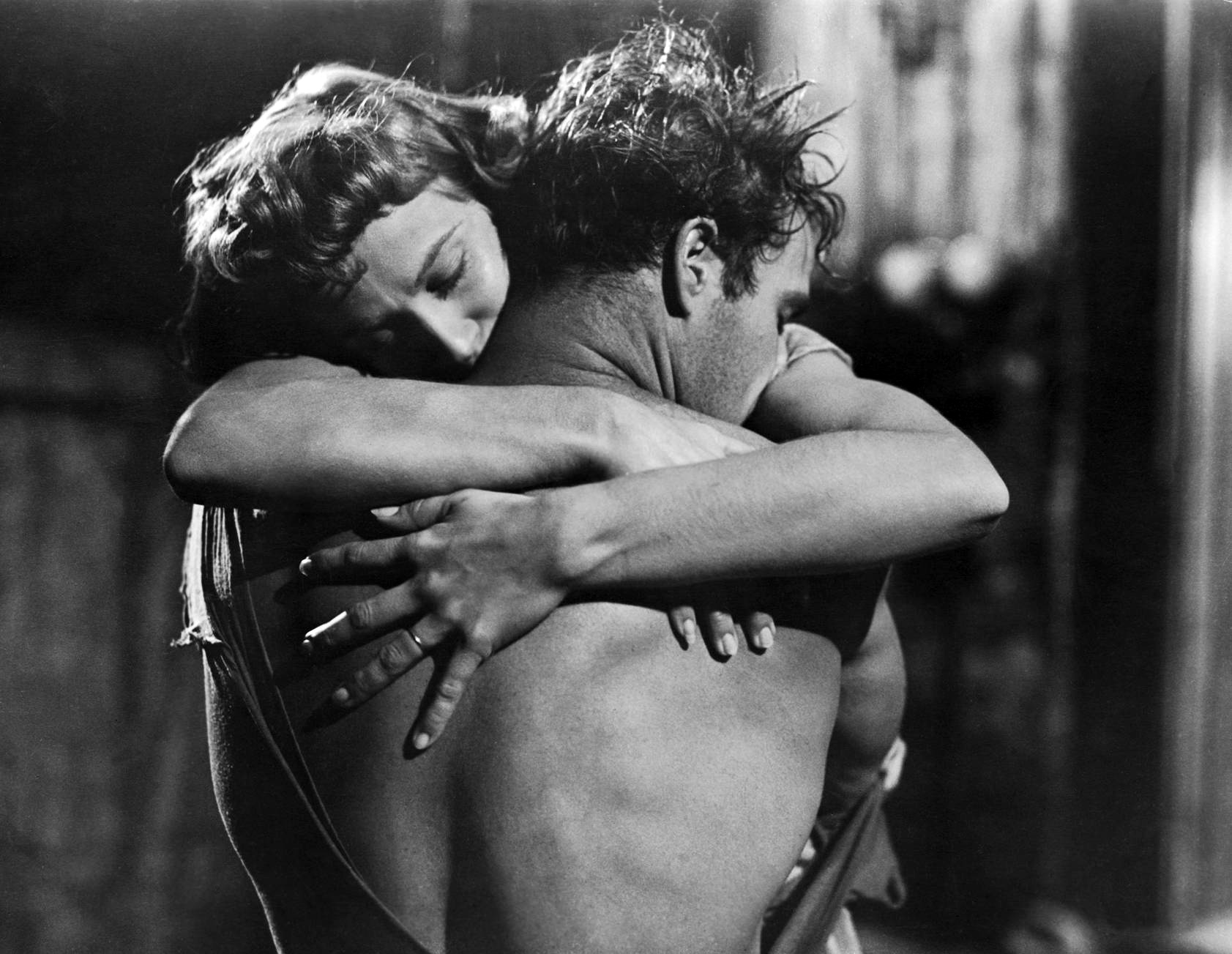
Enter a sweat-soaked, T-shirt-clad Marlon Brando. Brando’s Stanley Kowalski is brutish, bull-headed, volatile…but DAMN, is he sexy. I say this because, not only is it difficult to deny as a person with eyes and the ability to see, but it is also integral to understanding the hypnotic hold he has on Stella. He shoves people around, rips his clothes under the agony of his own emotions, hurls dishes against the wall (“Oh, Stanley has always smashed things”); he’ll be tender and caressing one minute, then savagely dangerous the next. Yet, Stella has no interest in leaving him. She is utterly mesmerized by the magnitude of his sex appeal, and powerless to resist her own desire for him. This photo pretty much says it all:
In one of many examples of Streetcar‘s excellent dialogue, Blanche gets up the gumption to comment on Stella’s abusive relationship:
Blanche: You’re married to a madman.
Stella: I wish you’d stop taking it for granted that I’m in something I want to get out of.
Blanche: What you are talking about is desire– just brutal Desire. The name of that rattle-trap streetcar that bangs through the Quarter, up one old narrow street and down another.
Stella: Haven’t you ever ridden on that streetcar?
Blanche: It brought me here. Where I’m not wanted and where I’m ashamed to be.
Stella: Don’t you think your superior attitude is a little out of place?
Blanche: May I speak plainly? If you’ll forgive me, he’s common. He’s like an animal. He has an animal’s habits. There’s even something subhuman about him. Thousands of years have passed him right by, and there he is. Stanley Kowalski, survivor of the Stone Age, bearing the raw meat home from the kill in the jungle. And you– you here waiting for him. Maybe he’ll strike you or maybe grunt and kiss you, that’s if kisses have been discovered yet. His “poker night”, you call it. This party of apes.
Therein lies the central conflict of the movie. Blanche is immune to Stanley’s charms (if they can be called that), and sees him for the brute that he is. On the other hand, Stanley also sees through the carefully-crafted backstory that Blanche has invented for herself. She’s clearly hiding the true reasons she has for being in New Orleans, and he won’t rest until he has brought them into the light. At first, the cracks in her story seem innocent enough, but as time wears on and the threat of discovery looms, Blanche’s neuroses become more and more apparent. Stella, in dismay, finds herself torn between defending her husband’s actions and protecting her sister’s fragile grip on reality.
Again, this is a fantastic movie. The one con for me personally is that it feels very much like a play at times (which I guess it should, because it is), and I’m not always in the mood to watch that type of film. With that said, however, I do revisit this gem every 1-2 years, and it gets me every time. The performances from everyone involved give me chills, but I think my eyeballs would need to be surgically removed from the screen during any scene with Brando. It’s no wonder at all that this became one of the most iconic roles of his career–it’s a truly unforgettable performance.
Tomorrow, Brando trades a T-shirt for a toga in his performance as Mark Antony in Julius Caesar (1953). Be sure to come back for Charles’ review on that one, as well as the rest of our Brando reviews this week at ItsJustAwesome.com!!
The post Day 1: A Streetcar Named Desire (1951) first appeared on It's Just Awesome DOT com.]]>