
Welcome back for Day 6 of the Clint Eastwood Spotlight Series, where we’ll be talking about one of the actor/director’s biggest modern triumphs: Million Dollar Baby (2004).
First of all, this is an amazing movie. It’s the kind that elicits a physical reaction at the core of your being, like the chambers of your heart might legitimately be torn asunder. Think I’m being dramatic? Watch the movie. You’ll see.
As far as plot goes, Baby seems relatively straight-forward on the surface. Frankie Dunn (Eastwood) is an aging, emotionally hardened boxing trainer who is going through a painful estrangement from his daughter, Katie. We never find out why the two are estranged, but Frankie’s priest, Father Horvak, offers up this comment on the situation:
“Frankie, I’ve seen you at Mass almost every day for 23 years. The only person who comes to church that much is the kind who can’t forgive himself for something.”
This small insight, as well as the fact that all Eastwood’s letters to Katie return to him unopened, are the only semblances of light that are ever shed on Frankie’s separation from his daughter. Yet, oddly enough, it almost doesn’t matter that we don’t know what’s going on there, because Maggie Fitzgerald (Hilary Swank) soon walks into Frankie’s life, and eventually his heart.
Maggie hails from southwest “Missoura” (among the hills, according to Morgan Freeman’s character, situated “somewhere between nowhere and goodbye”), and somehow manages to be both exceptionally tough and extremely adorable. She is hopeful, hard-working, and all she wants out of life is to become a boxer–she says it’s the only thing she’s ever felt good doing. Her family is trashy and classless at best, and she knows that if she can’t chase down her boxing dream, she will be limited to scraping plates in the trailer park with them for the rest of her days. Frankie doesn’t want to train her as one of his fighters–he never trains women–but eventually, her work ethic and stubborn willpower successfully wear him down. He agrees to take her on.
As the film progresses, we see that both Frankie and Maggie are filling the lonely void in each other’s lives. Neither has realized just how much they needed the other, but as time and training go by, Maggie becomes like a daughter to him. She slowly but surely rises to the top of her boxing class under his tutelage, even though he is initially hesitant to arrange any big fights for her. Finally, after much wheedling and insistence from Maggie that she’s ready, Frankie sets up a match against a top-ranked UK opponent. Right before the fight, he gifts her with a beautiful, green silk robe, embroidered with the Gaelic words “Mo Cuishle” on the back. She asks him what it means, and he gruffly/shyly tells her he doesn’t know. Emboldened by the gesture, as well as some tough-love feedback from Frankie in the middle of the fight, Maggie goes on to win by K.O. that night. She becomes a scrappy, crowd favorite, grinning from ear to ear as chants of “Mo Cuishle! Mo Cuishle!” fill the arena.
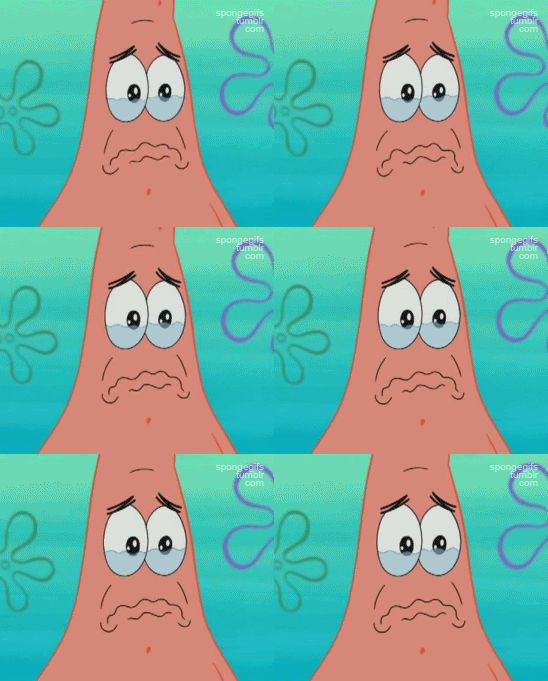
Maggie soars higher and higher in the rankings, until she finally accepts a match with Billie “The Blue Bear” (a German ex-prostitute with a nasty reputation for dirty fighting) for the WBA women’s welterweight championship title. It starts to look like Maggie might actually win, but then things take an unexpected turn. If you haven’t seen the movie, I don’t want to go much further and risk spoilers…but suffice it to say that that sound you’re hearing is the sound of hearts across America cracking in two. Oh, and here is a picture of my face when Frankie finally tells Maggie what “Mo Cuishle” means:
Million Dollar Baby took home four Oscars that year: Best Picture, Best Director (Eastwood), Best Actress (Swank), and Best Supporting Actor (Freeman, whom I didn’t talk about much in this review, but he is excellent as Eddie “Scrap-Iron” Dupris). It’s easy to see why, because everyone who was a part of this film clearly poured their heart and soul into its production. Having a close relationship with my own dad, this story and the incredible father-daughter chemistry between Eastwood and Swank really speaks to me. I’m pretty sure I experienced every possible human emotion while watching Baby, and I can honestly say it’s one of the best movies I’ve ever seen.
Tomorrow, join me again for the final day of our Clint Eastwood Spotlight Series! I’ll be discussing Gran Torino (2008), so be sure to come on back as we wrap things up.
The post Day 6: Million Dollar Baby (2004) first appeared on It's Just Awesome DOT com.]]>
Welcome back for Day 4 of our Clint Eastwood Spotlight Series! Today I have the privilege of discussing with you (what I consider to be) the greatest modern western made to date: Unforgiven (1992).
According to Eastwood at the time, Unforgiven would be the last western he made, because he did not want to risk repeating himself or imitating someone else’s work. Boy, did he go out of the genre in style.
Not only did the film win Best Picture that year, but it also earned Eastwood his first win for Best Director. He wasn’t exactly working with untested unknowns–when a cast includes Morgan Freeman, Gene Hackman, and Richard Harris as supporting characters, you know the movie cannot possibly be subpar– but you can still feel Eastwood’s distinctive hand guiding the film. It has all his signature touches: the underdog vs. the many, the visceral pull of the scenery, the minimalistic (yet lovely) musical score, the rawness of the emotion his characters feel. Eastwood’s films stay with you long after the credits have rolled, and Unforgiven is a perfect example.
It’s a movie about reputation in all its forms, and the questions posed remind me of that internet meme that was in circulation for a while: What My Mom Thinks I do, What My Friends Think I do, What Society Thinks I Do, What I Actually Do, etc. The film is unapologetic with regard to what these characters have already done, but it also explores the idea of whether or not people can change. When you’ve already done a thing hundreds of times, can you really give it up? If you do give it up, will people let you forget about it? What toll has it already taken on you, and when you look in the mirror are you ever fully free of what society thinks?
Eastwood’s character, the grizzled and timeworn William Munny, grapples with the weight of his own legend throughout the entirety of the film. He’s haunted by the evil deeds of his youth, and the fact that all anyone remembers or wants to talk about is his reputation for murder and meanness. He wants desperately for people to see him, not as he was, but how he currently is. In classic Western fashion, he’s been remade by the love of a good woman– he’s abandoned the whiskey, the killing, the ruthlessness. Now, he’s a solemn widower, looking after his two children and a pig farm in the wake of his wife’s death from smallpox. He lives a simple life, and he’s grateful for the change, but when the much-younger Schofield Kid rides into town one day, promising him a hefty reward for partnership in one final killing, Munny can’t help but accept. His farm is limping along at best, and he needs the money to provide for his children’s future. Not to mention, the lethal justice at hand will be in retribution for two men viciously slashing a woman’s face to shreds after she giggled at the size of one’s penis. So…yeah. It’s probably not going to keep him up at night.
Another interesting angle to the storyline (and further evidence to support Eastwood’s love of the underdog) is that the woman whose face was slashed, as well as the collective group of women offering the reward, are prostitutes. The “madam” of the operation, Strawberry Alice (Frances Fisher), is so enraged by the sheriff’s tepid, initial punishment of the offenders, that she pools the girls’ money and offers up a $1,000 reward to anyone who will kill the two cowboys responsible. Usually, and this is especially the case in Westerns, ladies of the evening aren’t necessarily part of the protagonist set. They play minor roles, or they tempt the wholesome cowboys to ruin. Yet, strangely, the gaggle of prostitutes and the craggy, old cowboys are the heroes of this movie. I love it. It drives home the fact that Clint Eastwood was constantly searching for ways to freshen and reinvestigate old cliches. He didn’t make a movie about women “keeping their place” and allowing injustices to be perpetrated around them; he didn’t even make a movie about two white men attempting to get away with harming a prostitute. He made a movie about two humans harming other humans, and getting their just deserts.
If you think you’re not a big fan of Westerns in general, I highly recommend that you seek out this movie and give it a chance. It’s poignant, beautiful…dare I say majestic? No matter what other adjectives you put in front of it, it’s just a good, good movie. One of Eastwood’s best, and deserving of the Oscar win.
Tomorrow, join me again as we take a look at Eastwood’s softer side in the Meryl Streep weepie, The Bridges of Madison County (1995). You won’t want to miss it!
The post Day 4: Unforgiven (1992) first appeared on It's Just Awesome DOT com.]]>