Today, though, we’re talking about James Watkins’ The Woman in Black (2012).
This movie, starring Daniel Radcliffe, is an adaptation of Susan Hill’s 1983 horror novella of the same name. Interestingly enough, The Woman in Black is also an immensely successful stage play in London–the second longest-running play in the history of the West End, after The Mouse Trap. Several years ago, my husband and I happened upon a production of the play in Fort Worth, TX, and it is EXCELLENT. At first, I was skeptical because there are only two actors and very few props. I thought it was going to be the kind of pretentious, overly-artsy production beloved by people who say “theatah” and no one else. Suffice it to say, I was completely delighted to be wrong. If you have the chance, I highly recommend buying some tickets and checking it out. It is scary as hell, and particularly impressive given the minimalistic approach.
But, alas, we are not here to talk about the play!
I did not enjoy the 2012 movie as much as the stage performance, but Watkins’ adaptation IS eerie and decently well done. The story is set in the late 19th century, and centers around young junior solicitor, Arthur Kipps (Radcliffe), who is still grieving over the beautiful wife he lost during childbirth. Serving as a painful reminder of that loss is Arthur’s young son, Joseph. It quickly becomes apparent that, despite his best efforts, Arthur’s grief has impeded his ability to perform at work, and his employer gives him one last case to prove his commitment to the law firm. For Joseph’s sake, Arthur agrees, and he proceeds by train to the gloomy Eel Marsh House. We learn that the former mistress of the house, Mrs. Alice Drablow, has passed away and Arthur’s assignment is to sort through the mountain of paperwork and tidy up the widow’s legal affairs.
After arriving in the remote English village where Eel Marsh House is located, Arthur is received with attitudes of wary suspicion (and outright hostility, in some cases) by the townspeople regarding his business with the late Mrs. Drablow. He cannot account for this, until superstitious ghost stories about the old manor reach his ears–namely, stories involving a malevolent woman in black. According to local folklore, each time the woman in black in seen by someone, a child from the village dies in a horrible, tragic fashion. Arthur is dismissive of this at first, but is later horrified to find that he DOES see a woman in black at Eel Marsh House, and children from the village DO begin dying violently, one by one.
This movie does a great job of weaving an eerie, uncomfortable feeling throughout. The horror is understated; it isn’t like The Grudge, where all the spine-tingling moments come from the visuals themselves. The Woman in Black takes a subtler approach to scaring the viewer, which I believe ultimately makes it more successful as a film. Yes, the ghostly appearances of the woman in black are extremely creepy, but it’s a combination of her unexpected presence, the camerawork, and the general sense of quiet unease that ultimately evokes fear in the viewer.
I do wonder if the movie would have been a bit stronger with slightly different casting. I like Daniel Radcliffe, don’t get me wrong, but he seems a bit out of place here. He has zero fatherly chemistry with his 4 year old son, and I just don’t ever fully believe him in this particular role. Maybe it’s a case of being pigeonholed as Harry Potter forevermore, but Radcliffe as Arthur Kipps did not work for me. The character is supposed to be young, but Radcliffe seems TOO young to be a great fit. I’m not sure who could have done it better…I’ll have to think about that.
Regardless, The Woman in Black is a decently executed horror flick, full of suspense and ridiculously unsettling dolls from the 1800s. A brief aside: why are old-timey children’s toys so frightening?!
Tomorrow, Charles will be reviewing The Conjuring (2013), so be sure to stick with us as we close out the final days of 31 Days of Horror!!
The post Day 29: The Woman in Black (2012) first appeared on It's Just Awesome DOT com.]]>I first saw this movie about 4 years ago, when my friend craftily talked me into watching it by taking advantage of my deep and abiding love for Sarah Michelle Gellar (there is no greater Buffy the Vampire Slayer fan than yours truly). In retrospect, I’m still a little surprised that I allowed myself to be hoodwinked in this manner, but I had convinced myself at the time that all adults should be able to watch scary movies. I have since abandoned that notion, as the years have proven that watching scary ghost movies never works out well for me. They absolutely always keep me up at night. On the evening in question, however, I foolishly thought maybe this time will be different!, even though I knew, KNEW, that it wouldn’t.
The always-hilarious Allie Brosh of Hyperbole and a Half says it best in her blog post about Expectations vs. Reality. The entire post is fantastic, but these two sentences resonate particularly strongly with my Grudge-watching experience:
“Immediately after I turned off the TV, a feeling of apprehension welled up inside of me. I could feel my psyche organizing what I had just seen into a highlight reel that will be freely embellished by my own imagination and then called upon to torture me for the rest of my life.”

So. True. While I was actually watching the movie, I was fairly proud of myself for how well I was handling it. The Grudge isn’t what I’d call a great film (a theory supported by its meager 5.9 stars on IMDb), so it was easy enough to write off what was happening on screen as being silly or unexplained while it was unfolding before me. But the visuals, you guys. THE VISUALS! That’s what gets me about this movie. The visuals are ridiculously disturbing, and they spring unbidden into my brain every time I close my eyes. Even my sweet, adorable dog, who follows me wherever I go, looked at me from a weird angle just now and made me want to run screaming from the room. So, despite some story-related weaknesses, it is creepy AF and just thinking about it makes every hair on the back of my neck stand up. Any time demon/ghost children are involved, or bloody spirits are crab-walking across the ceiling and making otherworldly creaking sounds, just…nope. Nope, nope, nope.
Instead of ending on that awful note, I will leave you with this fake Saturday Night Live commercial (starring Kristen Wiig, and drawing inspiration from both The Grudge and The Ring):
http://www.nbc.com/saturday-night-live/video/new-disney-show/n36749
Tomorrow, Charles will be reviewing the movie [Rec] from 2007. Be sure to come back and check it out–we’re in the final stretch of 31 Days of Horror!!
The post Day 27: The Grudge (2004) first appeared on It's Just Awesome DOT com.]]>I have to say: I’m not a big fan of this movie. I realize that this will be perceived by many as blasphemy (sorry, Charles and Micah…and Mike…and the rest of planet Earth), but I have a sneaking suspicion that I might just not be that into John Carpenter films. They are interesting, and revolutionary, and blah blah blah. The only one I can remember actually liking, however, is Halloween, and I even have certain beefs with that! It is admittedly a classic, and helped to pave the way for the Slasher genre…but I digress.
In the Mouth of Madness = thumbs down in my book.
The movie stars Sam Neill (in his best attempt to be Pierce Brosnan) as John Trent, an insurance investigator who believes he smells something fishy about the disappearance of superstar horror author, Sutter Cane. The script both pokes fun at, and pays homage to, the success of Stephen King–a man who has achieved tremendous acclaim by understanding that what most people want, beyond the incomprehensible phenomenon of 50 Shades of Grey, is to poop their pants in fright.
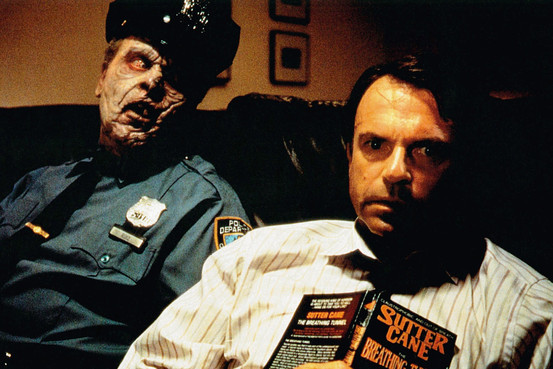
As Trent investigates Cane’s mysterious vanishing act, he enlists (read: is forced to accept) the help of his terrible Girl Friday, Linda Styles (played by a hopelessly lackluster Julie Carmen). Styles is Cane’s editor, as well as a fervent champion of the author’s work, and she assures Trent that Cane’s disappearance is no orchestrated PR stunt. As the pair wend their way through the creepily quaint town of Hobb’s End, Styles and Trent begin to realize that certain aspects of Cane’s novels are coming to life around them. To go a step farther, they believe that the entire TOWN has been forged from the sinister depths of Sutter Cane’s mind, and anybody foolish enough to remain will surely be a page-bound prisoner forevermore.
As the movie stares down one eerie rabbit hole after another, we are given to understand that anybody who reads Sutter Cane’s novels (or sees the movie adaptations) goes stark raving mad. There are some interesting things said here about our perception of reality, sanity, and what is normal…but it’s not enough to carry the film for me. It’s too weird.
That’s the word I keep circling back to: W-E-I-R-D. I’m trying to think of other things to say about the movie, or other ways I could possibly describe it, but that’s the word that continually springs to mind. In the Mouth of Madness is not bad, necessarily, it’s just freakin’ weird. I don’t recommend it, as I feel you probably have better things to do with your time; but it could be worth it if you’ve, say, just ingested a boatload of hallucinogenic mushrooms and are currently contemplating how crazy hands are.
Tomorrow, Charles will be reviewing a little film called Ringu (1998), which gives me the willies to even type. So, you’ll definitely want to come back for that one. In the mean time, be sure to catch up on any 31 Days of Horror movies you might have missed, and stay tuned for our final week!!
The post Day 24: In the Mouth of Madness (1994) first appeared on It's Just Awesome DOT com.]]>Today we will be talking about Bernard Rose’s 1992 slasher, Candyman.
First of all, I really enjoyed this movie. I wasn’t sure if I would, given that most scary movies past the year 1990 creep me out extensively. Candyman is indeed creepy–there are some excellent jump scares and chilling effects–but it effectively toes the line between scaring me in the moment and giving me nightmares later.
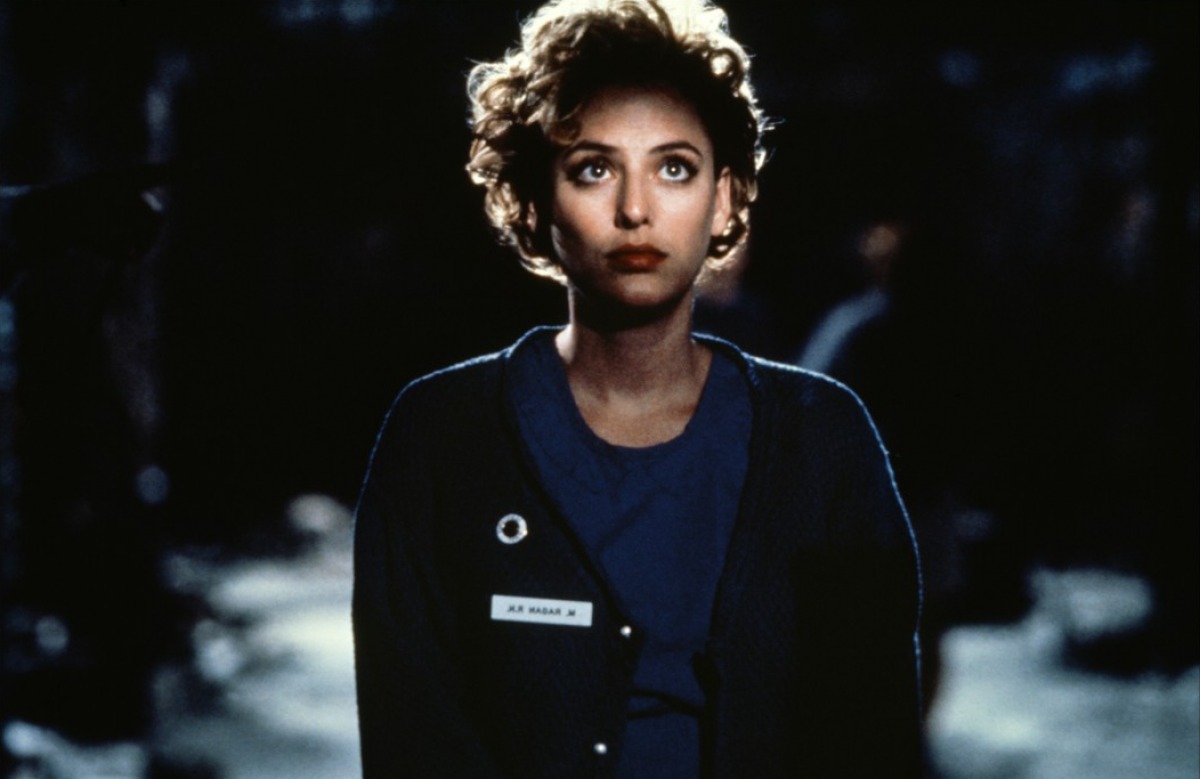
The story begins with graduate students Helen Lyle (Virginia Madsen) and Bernadette Walsh (Kasi Lemmons) conducting research interviews on urban legend for their thesis. The two friends gather all kinds of material from their undergraduate interview subjects, but most intriguing is a lead on what appears to be a real-life perpetrator of the “candyman” legend. Cabrini Green, a nearby Chicago housing project, has been the site of several recent, grisly murders–murders committed by a man with a hook, who appears to have come through the walls to slash apart his unsuspecting victims. Even more compelling is the fact that the residents of Cabrini Green genuinely believe that the murders were committed by the spooky, supernatural candyman, not just a flesh and blood man impersonating him.
Meanwhile, Helen is a skeptic (Bernadette is a little less so), and she continues to poke around Cabrini Green in an academic quest for answers. In so doing, she incurs the wrath of the candyman, and becomes a victim of both physical and psychological torment. There are some pretty disturbing scenes in this movie, and Bernard Rose does not shy away from gore when the situation calls for it.
Perhaps the strongest element of the film is Virginia Madsen’s performance. Madsen is classically gorgeous, and the filmmakers find creative ways to highlight that beauty through lighting and shot setup. It lends a very ethereal quality to the film, which I think supports the supernatural tilt of the story. Visuals aside, her character is an interesting combination of qualities that you don’t often see in female horror roles. She’s strong, she’s tough, she’s no-nonsense…but she’s also vulnerable and not immune to the terrors unfolding around her. Usually, in films like these, women seem to fall at one end of the spectrum or the other. In Candyman, though, Madsen is both the heroine and the victim, which I find fascinating.
Unfortunately, much like The Fly, I think Candyman has a significantly stronger first half than second. The beginning immediately reeled me in, and I was invested in the research that Helen and Bernadette were undertaking. I thought it was going to be a suspenseful thriller about a psychopath taking advantage of local belief in urban legend, but instead, we’re given a movie that can’t make up its mind about what it wants to be. (*SPOILERS AHEAD*) Is the candyman corporeal? I’m still not sure. He doesn’t show up on the hospital video feed, but he’s able to alter his physical surroundings time and time again (mostly to implicate Helen for his horrifying deeds). He’s also able to be killed…so does that mean he was formerly alive? There isn’t really an explanation for why Helen’s actions at the bonfire would work, so it just leaves you confused. I do like the final scene of the movie where Helen, as the new candyman, exacts her long-overdue revenge…but why would she have become the new candyman in the first place? After she’s killed the original, why wouldn’t it end there? The way the second half is handled isn’t necessarily a bad thing, but I do think they missed an opportunity to take the film in a stronger direction.
With so many of these horror movies, I get the sense that maybe they’re TRYING to confuse and befuddle– and if that’s the case, well done, filmmakers. At times it just feels lazy to me, though. It’s a way to not have to wrap anything up, and to get away with cramming in whatever odd plot tangents they feel like making. It may just be a matter of personal preference, but I prefer stories to have tidier endings. Or, at least, to have purposeful cliffhangers. I find all this “it’s whatever you want it to mean!” stuff to be a little unsatisfying.
Overall, though, I did really like this movie. The art of it is extremely well executed, and the acting is great. You can check it out on Netflix DVD, and I hope you’ll let me know what YOU think about the ending!
Tomorrow, join me again as I review John Carpenter’s In the Mouth of Madness (1994). You won’t want to miss it!!
The post Day 23: Candyman (1992) first appeared on It's Just Awesome DOT com.]]>If you’ve spent much time with me, either in person or via my internet ramblings, you know that I am in a committed relationship with Classic Hollywood. We are not exclusive, per se, but let’s face it–I’m not really interested in seeing other people. Charles may take every opportunity to rib me about my love of Barbara Stanwyck (we even did an episode about her on The Good, The Bad, and the Podcast!) and other 1940s actresses of a similar ilk, but I’m #sorrynotsorry. I’m of the firm belief that they don’t make ’em like they used to, and practically no one validates that theory more than Lauren Bacall.
(I know this isn’t strictly related to The Fan, but bear with me. I’ll get to it.)
For whatever reason, Lauren Bacall doesn’t seem to be as well-remembered today as she deserves to be. She is in certain circles, of course, but I don’t know that she’s a household name like some others from her heyday are: Clark Gable, Jimmy Stewart, Bette Davis, Katharine Hepburn, etc. I would venture a guess that, even if you’re not a big classic movie person, you know who those people are. I don’t think a lot of people who aren’t into the classics know who Lauren Bacall is, and that’s a shame. I hope I’m wrong, but there it is.
If you haven’t seen any of her early movies, I want you to to take the next possible opportunity to watch To Have and Have Not (1944). It is one of my top 10 favorite movies of all time, and I don’t think I’m exaggerating when I say that it will blow your freakin’ mind. The dialogue is electric, and the chemistry between Bacall and Humphrey Bogart is the stuff of cinema legend. Take a look at the clip below, and you’ll see what I mean.
Just, wow. Bogey and Bacall went on to make 3 more movies together, all of which are great, but this one is by far my favorite. It even launched an off-screen relationship between the two stars, despite a staggering age difference (she was 19 when they met, and he was 45). Theirs was one of the few Hollywood romances that actually lasted, and they remained happily married until Bogart’s death in the late 1950s.
I suppose I’ll rein myself in now and get back to the matter at hand, but I do hope you’ll take my advice and check out some of Bacall’s other work. You won’t regret it.
So, The Fan. As you might be able to guess by this point, Lauren Bacall is my favorite thing about this movie. It’s really just an okay film, skippable in the grand scheme of things, but her performance lends enough weight to make it enjoyable if you do happen to come across it whilst channel-surfing.
Bacall stars as Sally Ross, a formerly-glamorous and still-handsome actress of 50ish, who is trying to expand her horizons by breaking onto the stage musical scene. While rehearsing for a new part, she begins to receive a steady flow of passionate letters from one Douglas Breen (Michael Biehn): her self-appointed “biggest fan”. At first, Ross isn’t even aware of the letters, because her secretary responds in her stead. The correspondence grows more and more unseemly, however, and in one racy letter Breen tells Ross that “soon they will be lovers” and he “has all the equipment to make her very, very happy”…ew.
Eventually, Breen becomes impossible to ignore. Mentally unbalanced, furious that Ross will not respond to him personally, and still convinced that they are in a mutual relationship ordained by Heaven itself, Breen commits a series of vicious attacks on Ross’s friends with a straight-razor. When she STILL will not give him the attention he craves, Breen focuses his violent wrath on Ross. If he can’t have her, neither will anybody else. DUN DUN DUN.
We’ve seen similar stories both on-screen and off. The Bodyguard, Selena, the murder of John Lennon…it’s pretty disturbing that this is the kind of thing that really happens. But despite a legitimately haunting premise, The Fan just isn’t quite as powerful as it could be. Bacall does her part, but the rest of the film is missing something–I’m not quite sure what. Even James Garner, who is usually excellent, is slightly one-dimensional here. I don’t know, I guess I just wanted more from this movie. It’s still fairly decent, but it’s better to go in with moderate to low expectations.
Tomorrow, Charles will be discussing the 1982 remake of Cat People, which should be interesting to say the least. Be sure to check that out, as well as the rest of our selections for 31 Days of Horror!!
The post Day 20: The Fan (1981) first appeared on It's Just Awesome DOT com.]]>The Shining is based on the chilling novel by Stephen King, and it is yet another movie that has permeated pop culture to such an extent that it’s impossible not to have heard of it. Even if you haven’t seen the movie, there are certain unforgettable moments in it that I’ll wager have managed to filter into your subconscious. To name only a few:
“Heeere’s JOHNNY!”
“Red rum. Red rum. RED RUM.”
“All work and no play makes Jack a dull boy.”
“Hello, Danny. Come and play with us. Come and play with us, Danny. Forever… and ever… and ever.”
To say that this movie is iconic would be an understatement. It’s one of the scariest horror films of all time, and also one of the best. In fact, it’s probably one of my top 20 movies in general, horror or otherwise, which is saying a great deal (I’m usually a weenie about truly scary films).
Jack Nicholson stars, in one of his best-remembered roles, as Jack Torrance–a man who is slowly overtaken by forces of unspeakable evil. The film begins with Torrance accepting a position as winter caretaker of the remote Overlook Hotel, where he hopes to find the peace he needs to work on his writing. For five snowy, isolated months, he and his family will be the hotel’s only inhabitants.
At first, the Torrances enjoy the solitary quietude of the majestic Colorado mountains, but Jack’s son Danny soon begins to be haunted by gruesome premonitions. As it turns out, the Overlook has an eerie, unsavory history (to say the least): one of the previous caretakers went mad with cabin fever, and chopped his family to pieces with an axe. Through Jack’s own gradual decline into mania, and Danny’s increasingly horrifying visions, we start to suspect that the hotel itself is evil; it envelops those who enter with a dark, malignant presence.
This movie will creep the bejeezus out of you. It’s a well-executed thriller, yes, but the creepiness is magnified times ten by the stunning visuals and profoundly jarring soundtrack. There isn’t much of a standard musical score to The Shining–instead we’re given something much more terrifying. Throughout the film, a cluster of bows scrape discordantly across their violin strings, and you’re left with the sensation that you might now know what it would sound like to hear someone’s fingernails rake down the walls of Hell. That might seem like an overly dramatic description, but the noise is REALLY FREAKIN’ UNSETTLING. It’s genius, really, because it puts the viewer immediately on edge, and doesn’t release you until the movie is over.
The one thing that I find a little silly about The Shining is minor, but worth pointing out: Shelley Duvall’s cartoonish performance as Wendy Torrance. In both appearance and general movement across the screen, she is a combination of Olive Oyl, Tim Burton’s Corpse Bride, and a baby gazelle. I guess it kind of works for a horror movie, but it’s just odd to see when every other aspect of the film is so serious. Anyway, even Duvall’s goofy running and limp-wristed knife waving can’t tarnish this movie for me–it’s that good.
Watch it, if you haven’t already…just don’t do so alone.
Tomorrow, be sure to come back and check out my review of 1981’s The Fan, which features the always-classy star of my heart, Lauren Bacall (To Have and Have Not, The Big Sleep). Until then, it’s a great time to catch up on any 31 Days of Horror reviews that you might have missed! See you tomorrow.
The post Day 19: The Shining (1980) first appeared on It's Just Awesome DOT com.]]>I have no idea how this is possible, but up until now, I’d managed to go my entire life without ever having seen this movie. It’s not that I purposely avoided it, but I’m not a huge extraterrestrial/space movie person–I suppose I just never got around to it. Suffice it to say that I’m glad I finally did.
Y’all, Alien has 8.5 stars on IMDb, and it earns every single one of them. Do you know what else has 8.5 stars on IMDb? Casablanca. Citizen Kane. Sunset Boulevard. We’re talking some of the most famous, beloved movies of all time. It is unequivocally a classic, and I’d go so far as to say that it deserves to be seen by everyone. If, like me, you’ve been lazy about renting it thus far: Go do it. Right now. I’ll wait.
Alien centers around a 7-person crew aboard the space merchant vessel, Nostromo. At the film’s opening, the crew is prematurely awakened from cryo-sleep when the vessel responds to an unknown transmission from a nearby moon. The transmission is automatically perceived as a distress call, and despite some dissension within the ranks about the proper protocol, Nostromo lands on the moon to investigate and lend aid. During exploration of the moon’s surface, the team encounters a nest of mysterious alien eggs, one of which spontaneously bursts open. The life-form within the burst egg proceeds to penetrate crewman Kane’s helmet, and attaches itself to his face…shudder.
Ellen Ripley, warrant officer of the Nostromo, is deeply concerned about bringing Kane back aboard the spacecraft in his current, compromised state, but the crew defy her orders and bring him aboard anyway (alien still attached to his face and all). After a brief comatose period, Kane ultimately awakens and the creature is nowhere to be found–much to the crew’s dismay. They eventually find the body of the crab-like alien, believing it dead; what they don’t realize, however, is that its life cycle has only just begun.
This movie is just fantastic. The practical effects are amazing, as is the acting from all parties involved. This was Sigourney Weaver’s first leading role, and it’s easy to see why it catapulted her into stardom. Not only did it bring Weaver personal acclaim, but her portrayal of Ripley challenged traditional gender roles in both science fiction and horror genres for years to come. Ripley is not a slinky seductress or a boring do-nothing; she doesn’t wear spandex or makeup, and she doesn’t die immediately following a sexy interlude with her hardier male co-star. In fact, she doesn’t even HAVE any sexy interludes in this movie. It’s not what she’s about. Unlike so many other leading ladies of Sci-fi and horror, she’s not defined by the man she’s helping–she is her own boss, damnit, and she gets things done. Ripley isn’t a simpering yes-woman, and at times she can be rude and abrasive. But, more importantly, she’s a PERSON: a real one. I love when movies give us leads who are flawed as well as heroic; it just rings truer for me. Perhaps this is part of the reason why the American Film Institute named Ripley the 8th greatest hero of all time. Her character feels authentic, and I stand in awe of that even after the movie is over.
As I said before: if you haven’t already seen this film, please, please seek it out. It’s heart-pounding suspense at its best, and I was quite literally on the edge of my seat for the entire second half of the movie (not to mention the goosebumps that refused to recede into my flesh until the credits finished rolling). You can find it on Netflix DVD and Amazon Video, and you will absolutely not be sorry. If nothing else, you’ll feel a little more a part of pop culture, and you’ll finally get about a zillion subsequent TV and movie references. Who can put a price on that?
Tomorrow, join me again as I review Stanley Kubrick’s 1980 classic, The Shining. I have a feeling many of you have already seen this one, so be sure to come back and see if our thoughts line up on Day 19, as well as the rest of our 31 Days of Horror!!
The post Day 18: Alien (1979) first appeared on It's Just Awesome DOT com.]]>It’s a modern-day take on the tale of Hansel and Gretel, and Shelley Winters stars as the titular Auntie Roo. Man, poor Shelley Winters. Despite a colorful, decades-long career and numerous Oscar nominations/wins, she never seems to get to play somebody whom you actually like. To me, Winters will forever be the frumpy sad-sack, Alice Tripp, getting kinda-sorta-deservingly drowned by Montgomery Clift in A Place in the Sun. Terrible, I know, but the lady does odious, second-string broads pretty darn well. She plays a kooky weirdo yet again in Auntie Roo, although I will say that she’s much more palatable than usual here.
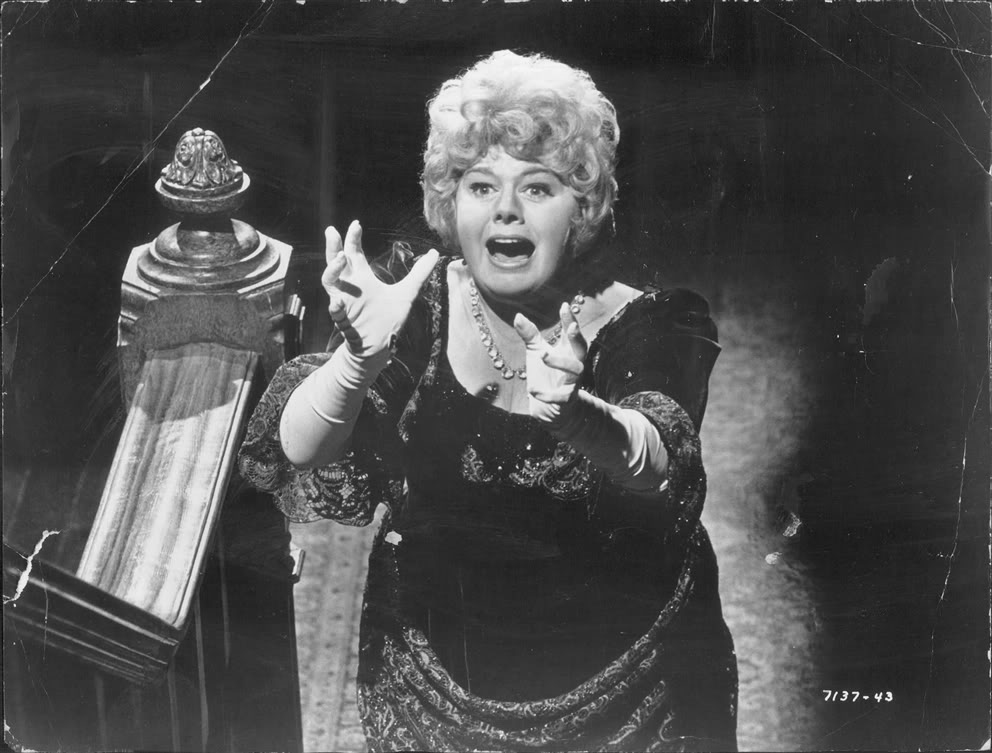
Something I found very interesting about the role of Rosie Forrest (aka Auntie Roo) in this movie is that she doesn’t quite fit the typical mold for Hag Horror. Yes, Ms. Winters is a formerly glamorous starlet who has been relegated to the Hollywood B Team for the unthinkable crime of aging (although she’s still not very old here, just a bit less physically fabulous), BUT the categorization of the “hags” in these films usually tilts one of two ways: A. The Predatory Older Woman, or B. The Older Woman in Peril. Sometimes, both categories will be filled in the same movie (What Ever Happened to Baby Jane?, Hush…Hush, Sweet Charlotte), but such an occurrence is rare. Anyway, in Auntie Roo, the character of Mrs. Forrest does not really fall in either camp. She never actually intends the children any harm–they just THINK she does. Granted, she has some severe mental hangups about the death of her daughter that she absolutely needs to seek therapy for. But as far as being a Predatory Older Woman…I don’t think so.
Alas, I’m getting ahead of myself again. Synopsis time!
Every year, the widowed Mrs. Rosie Forrest hosts a lavish, lovely Christmas party at her mansion for a select group of neighborhood orphans. This particular year, a sweet and sandy-haired brother and sister (Christopher and Katy Coombs) tag along to the party, despite not being selected by their chilly headmistress to attend. Mrs. Forrest, however, is delighted by their courtly manners and innocent presence. She urges them to stay, and to call her “Auntie Roo”. She even ends up taking a particular shine to Katy, who reminds her of her own deceased daughter (also named Katharine).
As the story unfolds, we learn that the late Katharine Forrest died in a heart wrenching accident while sliding down the bannister–an accident from which Auntie Roo has never recovered. We also learn that Roo regularly “communicates” with Katharine in the form of seances, as well as singing lullabies to her daughter’s decayed corpse every night in the nursery. Eesh. There is even a scene towards the end of the movie where Roo lovingly strokes the powdery, skeletal face, only to have it disintegrate into ash between her fingers. Talk about being scarred for life.
The central conflict of the movie is that Roo (a little too tenaciously, I’ll admit) wants to adopt the orphaned Katy and keep her at the mansion as a replacement for the daughter she lost. Unfortunately for Roo, Katy’s brother Christopher is part of the deal, and he is wise to her kidnap-flavored plans (and all the creepy, corpse-related moments he has witnessed while spying on her). He and Katy manage to escape Forrest Grange unharmed, but (*spoiler alert, as indicated by the movie’s title*) the same cannot be said for Auntie Roo.
The main problem with conflating this movie with Hansel and Gretel is that a direct comparison is rather misleading. In this story, Roo is an extremely sympathetic character overall. Her actions are misinterpreted by the children (Christopher, especially), therefore they see her as a force of evil when she is really not. Unlike in the original Hansel and Gretel tale, Roo isn’t a crazy, malevolent witch who wants to snatch up wayward children in order to eat them for supper. She genuinely loves kids. She is sad, she is unbearably lonely, she is perhaps mentally unstable…but never ill-intentioned. It’s a pretty tragic story when you get right down to it, and one that may even have a darker ending than the original fairy tale.
I think I would give this one a solid B grade. Shelley Winters’ theatrics can be a little much at times, but on the whole it’s an interesting spin on a classic story, with decent scares and legitimate suspense. You can find Whoever Slew Auntie Roo? available to stream on Amazon Video–give it a chance and let me know what you think!
Tomorrow, Charles will continue our exploration of the ’70s with a review on 1975’s Deep Red. Be sure to come back to check it out, along with the rest of this month’s reviews for 31 Days of Horror!!
The post Day 16: Whoever Slew Auntie Roo? (1972) first appeared on It's Just Awesome DOT com.]]>First of all, this is a weird, weird movie. There is so much symbolism, and so much psychological commentary, that it leaves the viewer unsure how to separate the real from the imagined. Even after watching, I still don’t know which aspects were exclusively happening inside the main character’s mind, and which aspects legitimately occurred. I’m certain that this is intentional on the part of Mr. Polanski, but it is a bit of a negative as well as a positive for me, personally.
The film mainly revolves around the inner anguish of innocently sensual Carol LeDoux. Carol is played by Catherine Denueve, who turns in a haunting performance as the sexually confused young woman. Something ugly in Carol’s past has clearly made her abhor men (and the idea of sex that they inherently represent), but we are not given any further insight as to the exact origins of her anxiety. Be that as it may, Carol is quite attractive (albeit a little childlike), so she finds herself fending off men’s advances at practically every turn. These repeated romantic stressors, coupled with the departure of her sister (and her sister’s lover, who is a completely separate source of consternation to Carol altogether), cause her to slowly lose her grip on reality and descend into homicidal madness. It is unsettling, to say the least.
Right from the opening credit sequence, Polanski builds an atmosphere of tense expectation– an unshakeable, claustrophobic feeling that something horrifying is about to happen. He never lets that feeling slip, either. The entire hour and forty plus minutes of the film are taut, well-paced, and highly suspenseful (even if a little confusing at times). Also contributing to the sense of anticipatory horror are the subtle, eerie sounds happening in the background of every scene: flies buzzing around the raw rabbit that Carol leaves out in the kitchen; the incessantly ticking clock; water slowly dripping from the faucet; the list goes on.
Repulsion is an extremely artistic movie, and very European in tone. The soundtrack, the heavy French accents of the two leading ladies, and the crisp black and white all contribute to the overall feeling that you’re watching a foreign film. Even the vacancy of Catherine Denueve’s Carol is reminiscent of a sad and beautiful mime. All that’s missing is a bicycle, a black turtleneck sweater, and moonlit shots of the Champs-Elysses. It may sound silly, but I actually favor these technical and mood-related aspects of the film over the story itself. I believe there is such a thing as trying too hard to make a movie open to interpretation, and in my opinion, that’s what Polanski was guilty of here.
Tomorrow, please join me again as we begin the 1970s with another entry from the “hag horror” genre: Whoever Slew Auntie Roo? (1971). Thanks for reading, and keep on comin’ back for more 31 Days of Horror!!
The post Day 15: Repulsion (1965) first appeared on It's Just Awesome DOT com.]]>Here’s the thing about House of Usher, though: it somehow manages to both exceed and fall short of my expectations. Vincent Price is, of course, fantastic as the sinister and hyper-sensitive Roderick Usher– he’s really the main reason to watch this movie. Everyone else…meh. Myrna Fahey as Madeline Usher simply isn’t given enough to do. Her storyline is arguably the most important, but since the tale is largely told from the perspective of her fiancé, she doesn’t even have that many lines. I don’t think she has more than two facial expressions during the first hour of the movie, either (which isn’t a knock on Fahey’s acting, it’s just that for the first few acts, her on-screen purpose seems solely to be embodying a delicate combination of loveliness and rue). Mark Damon, doing his best Ricky Nelson imitation, does have the bee-stung lips and ruffled shirt going on, but even his stylish pompadour and competent axe-wielding prove no match for the evil (and structural deficiency) of the house of Usher.
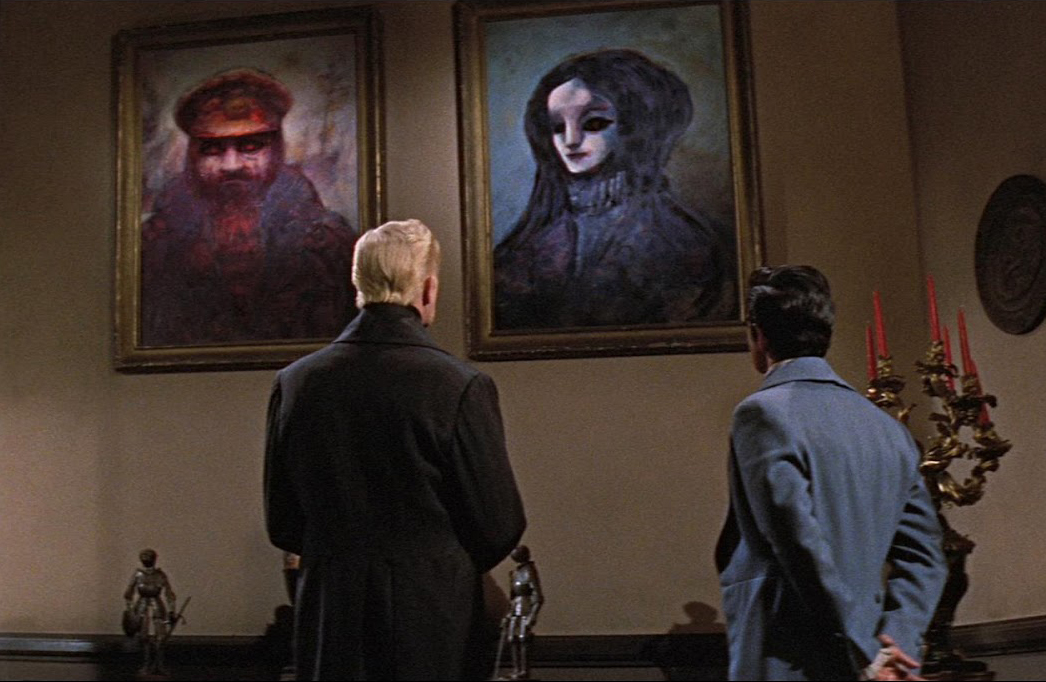
I’ll keep the synopsis short and sweet: Philip Winthrop (Damon) rides all the way from Boston on horseback to spend time with his lady love, Madeline Usher (Fahey). He has never been to her estate before, and upon entering, finds himself immediately accosted by shrouds of gloom and a melodramatic, lute-playing future brother-in-law, Roderick Usher (Price). After much pessimistic hemming and hawing, Usher explains to Winthrop that both he and Madeline are under a terrible family curse, and will be dying any moment now. Their family tree, he intones, contains over 200 years of bad apples that have resulted in some very poor Usher karma indeed. Winthrop is naturally skeptical of this morbid mysticism, but can’t resist being unnerved by the COMPLETELY TERRIFYING paintings in the family portrait gallery. Seriously, I do not know who was tripping on what when these were painted, but wow. Guess I’m not sleeping tonight.
Winthrop understandably tries to remove Madeline from the house as soon as possible, but an argument with Roderick over their departure causes her to descend into a catatonic state. Roderick believes her dead (or does he?), so he quickly and efficiently buries her while still alive (!!) in the family crypt. Once Winthrop discovers this, the rest of the movie is actually quite suspenseful as he frantically tries to find and free Madeline from her sealed coffin. The scares in this film are largely confined to the latter half, but when they deliver, they deliver big-time.
House of Usher‘s visuals remind me a bit of Francis Ford Coppola’s 1992 take on Bram Stoker’s Dracula— which is to say that the colors are hyper-saturated times ten, and are practically dripping off the screen. Price wears quite possibly the reddest overcoat ever imagined by man, and everything down to the tiniest minutia seems hellbent on singeing your retinas. It’s kind of cool, but also…ouch.
Overall, this film is good but not great. It’s an important entry in Vincent Price’s filmography, and demonstrates why he is so great in classic villainous roles such as these…but does anyone who doesn’t care about Vincent Price really NEED to see it? No, probably not. It’s entertaining, and the last 20 minutes are actually pretty freaky, but it’s a very stylized film that I don’t know will necessarily appeal to all audiences. In other words, if you are already a fan of classic horror, Vincent Price, or the macabre writings of Edgar Allan Poe (or if you’re just a film nerd like we are here at ItsJustAwesome.com), there are plenty of things to enjoy and appreciate about House of Usher. If you’re a newbie looking to get into the genre, however, I do not recommend this as your gateway movie.
Tomorrow, Charles will be reviewing one of my favorite “hag horror” flicks: Hush…Hush, Sweet Charlotte (1964). The movie boasts a powerhouse cast in Bette Davis (All About Eve, Now Voyager), Olivia de Havilland (Gone With the Wind, The Heiress), and Joseph Cotten (Citizen Kane, The Third Man). You definitely don’t want to miss this one, so be sure to join us again tomorrow for more 31 Days of Horror!!
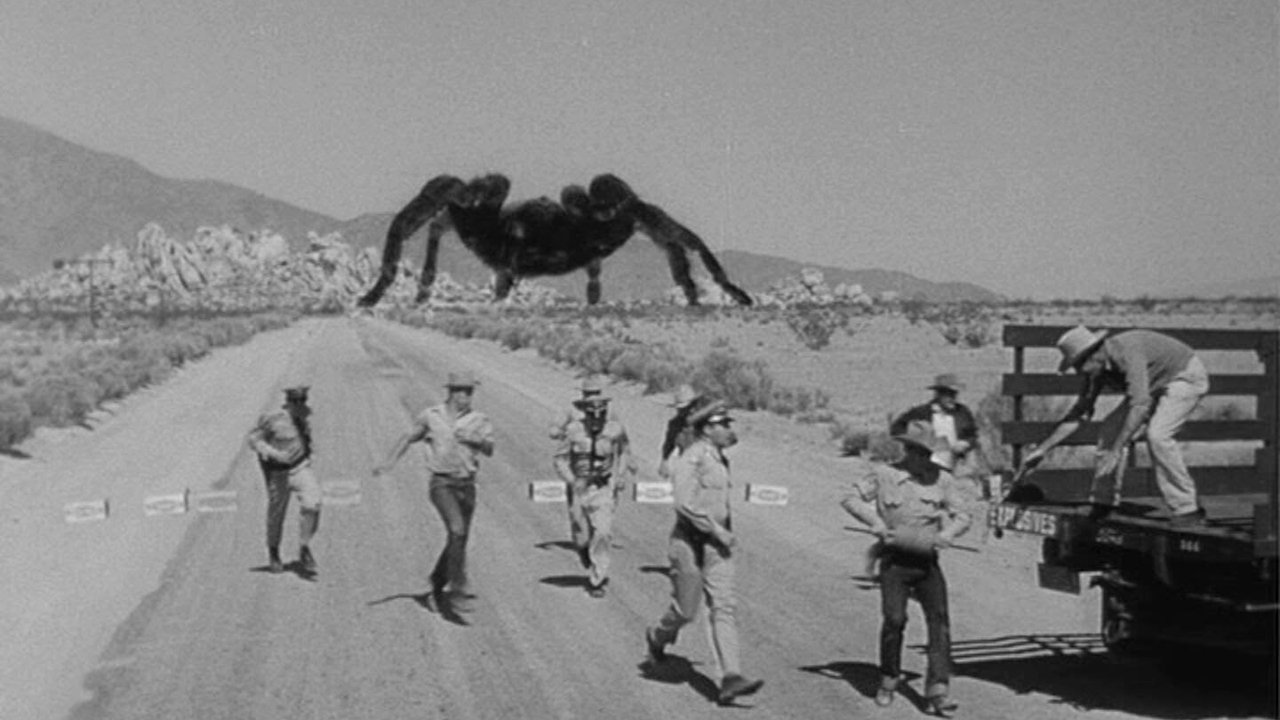
The post Day 13: House of Usher (1960) first appeared on It's Just Awesome DOT com.]]>There is still a certain B-movie feel to it (the premise is that a gigantic tarantula is terrorizing the town, after all), but for the most part it succeeds where many other monster movies of this era fail. It doesn’t go over the top with kooky, animatronic creatures and silly sound effects, and the movie is supported at its core by genuinely good storytelling.
Tarantula even features a strong, intelligent leading lady in Mara Corday, who, while beautiful, does things to further the plot beyond clutching her graceful cheekbones and shrieking. Imagine that!
Let me back up a bit, though, and give you a synopsis. Our film starts out once again in the Arizona desert– clearly, the most hip-happening place in the ’50s for mysterious, unexplainable phenomena. Young and ever-so-slightly oily Dr. Matt Hastings (John Agar) is urgently summoned to the Sheriff’s office to weigh in on the death of a horribly deformed, roadside John Doe. The Sheriff believes the body to be that of missing scientist Eric Jacobs, but it’s nearly impossible to confirm due to the twisted, diseased state of the face. Dr. Hastings is at a loss for answers, and it’s only through eventual confirmation from another well-known country doctor, Dr. Deemer, that they can positively ID the body as Jacobs. Deemer seems to be harboring secrets, but he assures Dr. Hastings that the affliction which befell Dr. Jacobs was nothing more sinister than acromegaly (even though Hastings knows acromegaly is incredibly rare, and usually takes years to advance to this level, not days).
As it turns out, Dr. Deemer and Dr. Jacobs were research partners at a remote laboratory 20 miles into the desert. Unbeknownst to the townspeople, they were conducting experimental research into human and animal growth hormones as a way to increase the world’s food supply. It’s almost like the inverse of an egomaniacal Bond villain scheme…and even though it will obviously never work, you have to applaud them for trying. Unfortunately, during a struggle at the lab after Jacobs’ death, a fire breaks out and many of the animal test subjects are compromised. Among these, a tarantula (one of the more advanced-stage subjects of the experiment) is able to escape the lab and flee into the desert, where it continues to grow ever larger and more menacing.
I appreciate that the filmmakers didn’t try to BUILD a giant tarantula out of robotics or claymation or papier mache or whatever, but instead used trick photography to make a regular-sized tarantula look huge on the set. It makes the film hold up much better over time. I also thought there was a perfect number of tarantula shots throughout the film–just enough to build suspense and see that it was growing larger and larger (and more bloodthirsty), but not straight-up 80 minutes of bombs going off and the tarantula running amok through the city. It’s a movie largely focused on the events leading up to, and in the wake of, the escape of the giant spider, with occasional cuts to the desert to see what the big guy is up to. I like this approach a lot, and tip my hat to the director for making the call.
Okay, let’s talk about Mara Corday’s character for a moment. Corday plays the sultry female scientist, Stephanie “Steve” Clayton, and her performance is fantastic! She arrives on the scene by way of a streetcar named Desire (thanks, Carol Burnett!), and proceeds to wow her male counterparts with the manly size of her brain. There are several little quips from Drs. Hastings and Deemer at first (“Give women the vote and what do you get? Lady scientists.”), but Steve remains unfazed. She is cool, collected, and well-read; it doesn’t take long for her to win the complete professional confidence of Dr. Deemer. Not only does Steve become an essential part of Deemer’s laboratory operations, but she is also Hastings’ girl Friday when it comes to unraveling the mystery of the tarantula. She seems to be channeling real-life Hedy Lamarr here, and I love it.
This movie is definitely worth checking out, and you can do so via Netflix DVD. I’d say it’s among the better-done monster movies of the decade, carried by an interesting (if fantastic) plot, solid acting, and progressive female roles. Let me know in the comments below whether you agree or disagree!
Tomorrow, join me again as I review our first movie of the 1960s: House of Usher, starring Vincent Price. I hope you’ve been enjoying our 31 Days of Horror series so far, and that you’ll continue to come back for more during the rest of October!
The post Day 12: Tarantula (1955) first appeared on It's Just Awesome DOT com.]]>I’m sorry to say it, but I really didn’t enjoy this movie very much. It is a combination of all the worst aspects of ’50s movies: it’s supremely cheesy, xenophobic, flimsy in plot, and just plain boring. It isn’t horrible, or even BAD, necessarily…but it definitely does not stand the test of time. I fell asleep at least twice while watching, and then had to rewind to be sure I hadn’t missed anything. Spoiler alert: I hadn’t.
It might be fun to see with friends at the drive-in for a cult movie night or something, but ultimately It Came From Outer Space is just another goofy alien flick. Or, to put it another way, it’s like a mashup of all the least popular episodes of Star Trek, The Twilight Zone, and The Andy Griffith Show. Read into that what you will.
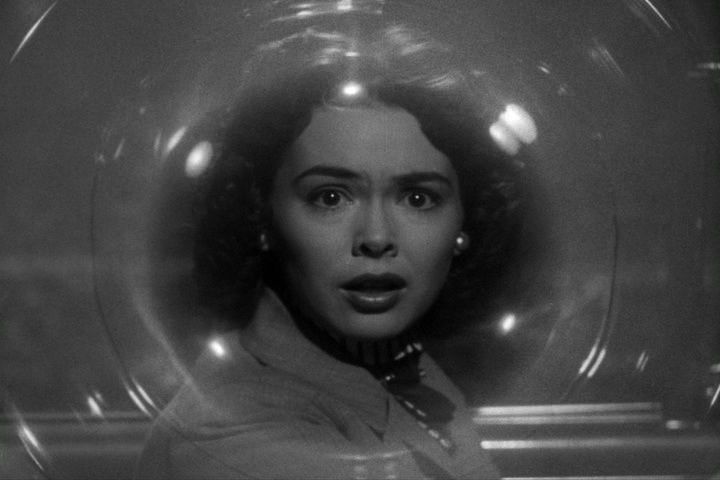
The movie begins with young couple John Putnam (Carlson) and Ellen Fields (Rush) enjoying a candlelit dinner at their home in Arizona, making carefree jokes about living together “in sin”. They go out onto the terrace for a little late-night stargazing (Putnam, as an amateur astronomer, has a massive telescope set up there), when they see what they believe to be a meteor streaking across the sky. It crashes into the desert nearby, and the two lovebirds race to the scene of the collision. John skitters down into the bowels of the crater to get a closer look (casting aside the frantic remonstrations of schoolteacher Ellen), and what he sees astonishes him. It’s not a meteor at all, but instead an alien spacecraft! Naturally, no one believes him–not even Ellen at first.
Putnam butts heads with Sheriff Matt Warren (who is clearly in love with Ellen as well) time and time again over his theories regarding the crash, to no avail. Even after Putnam has seen and talked with the aliens (which takes a ridiculously long time to occur), Sheriff Warren and the townspeople refuse to believe in their existence. It’s a classic mob mentality situation–they don’t believe in the aliens until they suddenly do, and once they do, they charge in with guns literally blazing, despite Putnam earnestly beseeching them to do the opposite. The filmmakers are pretty heavy-handed with the “humans fear that which they do not understand” metaphor, and, while true, it is incredibly frustrating to watch.
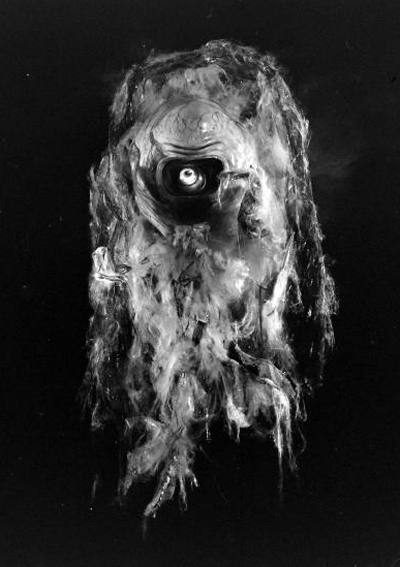
The aliens themselves are pretty hilarious-looking, though. They’re kind of these amorphous blob shapes, with a long, protruding eyeball and…hair? It’s extremely bizarre, and makes me appreciate the lack of screen time they have in their “true” form. I think the sight is intended to be frighteningly grotesque (even the stoic Putnam cheesily recoils in horror), but it’s just funny to me. The aliens also leave a glittering, slug-like trail (reminiscent of bedazzled jeans) everywhere they go, which is pretty much a drinking game waiting to happen. Every time you hear the theremin accompany a slow camera pan along the bedazzled alien sludge, finish your drink. See you in the E.R.
Again, this movie could be worth checking out under the right circumstances…as long as those circumstances involve friends, the ability to throw popcorn at the screen, and a setting where nobody is taking things too seriously. Otherwise, I do not suggest you rent this movie on a Saturday night, hoping for a good time. If you’re a contrarian and want to prove me wrong, however, you can find it available for streaming on Amazon Video and Apple TV.
Tomorrow, Charles will be continuing our journey through 1950s horror with 1954’s Gojira. Stay tuned for this and all the rest of our October reviews during the 31 Days of Horror!!
The post Day 10: It Came From Outer Space (1953) first appeared on It's Just Awesome DOT com.]]>The Uninvited is an interesting film to review, because it isn’t quite what I was expecting. It is eerie and suspenseful, yes, but it is also…charming? It’s unlike any horror movie I’ve ever seen, in that it fluctuates between the serious and the lighthearted at the drop of a hat. More importantly, it does this successfully. I admit, I’m still scratching my head over it a little bit. It’s one of those things that feels like it shouldn’t work, but somehow it does.
The film begins with composer Rick Fitzpatrick (Milland) and his sister Pamela (Hussey) vacationing together on the Cornish coast. They are frolicking happily up and down the rocky shore, when suddenly they find themselves chasing after their terrier into an abandoned seaside mansion. As they take in the majesty of the home’s interior, Pamela is immediately starstruck. She suggests to Rick on a whim that they pool their savings and buy the place–after all, you’re not embracing the spontaneity of life until you leave everything you know behind and spend your last cent on an immense gothic manor that you’ve been inside for five minutes. It does seem little odd that an adult (but still in their prime) brother and sister would consider buying a house together, but since it isn’t all that uncommon in these old movies, I guess I’ll let it go without further comment.
Anyway, they purchase the mansion from the elderly Commander Beech and his granddaughter, Stella, and immediately set about making it their own. There are rumors in town about the home being haunted (and Commander Beech is most definitely keeping secrets to himself), but Rick pooh-poohs that notion and explains it away as idle fantasy. It doesn’t take long, however, for the strange “disturbances” to become impossible to ignore/rationalize. In the dead of night, they hear the melancholy strains of a woman sobbing, and goosebumps prickle my arms when Pamela notes that “it comes from everywhere…and nowhere.” There are other disturbances as well, particularly in the upstairs studio: a cold, pervasive dampness to the air; flickering candles; a feeling of unshakable sadness; there are even several appearances by a ghostly, glowing source of light that is terrifying in its shapelessness. The movie does an excellent job of keeping the paranormal indicators subdued–it makes for a much more frightening and believable atmosphere.
The Uninvited is a very well-paced film, and the reasons for the haunting (as well as their connection to the sweet, young ingenue, Stella) unfold in an intriguing fashion that will keep you guessing. There are some legitimately hair-raising moments (including a staged seance that turns out to be not-so-fake after all), but not so many that it will keep you up at night. This is my favorite kind of scary movie, truth be told: it’s spooky while you’re watching it, but the horror factor is tempered by the excellent story-telling and subtle romantic sub-plot.
Speaking of the romantic sub-plot, it’s hard not to be charmed by Gail Russell’s dewey, school-girl portrayal of Stella, who obviously pictures herself sitting in a tree, K-I-S-S-I-N-G, with the much older Ray Milland. They definitely pulled a Rear Window here (see also: To Catch a Thief), because Milland has to be at least 15, maybe 20, years older than Russell. He almost seems more appropriately-aged to be her father, but oh well. It’s still cute.

Overall, I would give The Uninvited two thumbs up. I watched it on Netflix DVD (Netflix’s DVD game is apparently pretty strong–almost all of these old, slightly obscure films can be found there!), but now I may just have to go out and purchase my own DVD copy of this one. I’d love for you to check it out and let me know if you feel the same!
Tomorrow, Charles will be reviewing The Picture of Dorian Gray (1945), starring Hurd Hatfield and the inimitable George Sanders. Be sure to come back for this and other juicy reviews during the rest of our 31 Days of Horror!!
The post Day 8: The Uninvited (1944) first appeared on It's Just Awesome DOT com.]]>